Can Trump recalibrate US-China relations?

The April 2026 meeting in Beijing signals a move from open confrontation to managed competition
Summarise
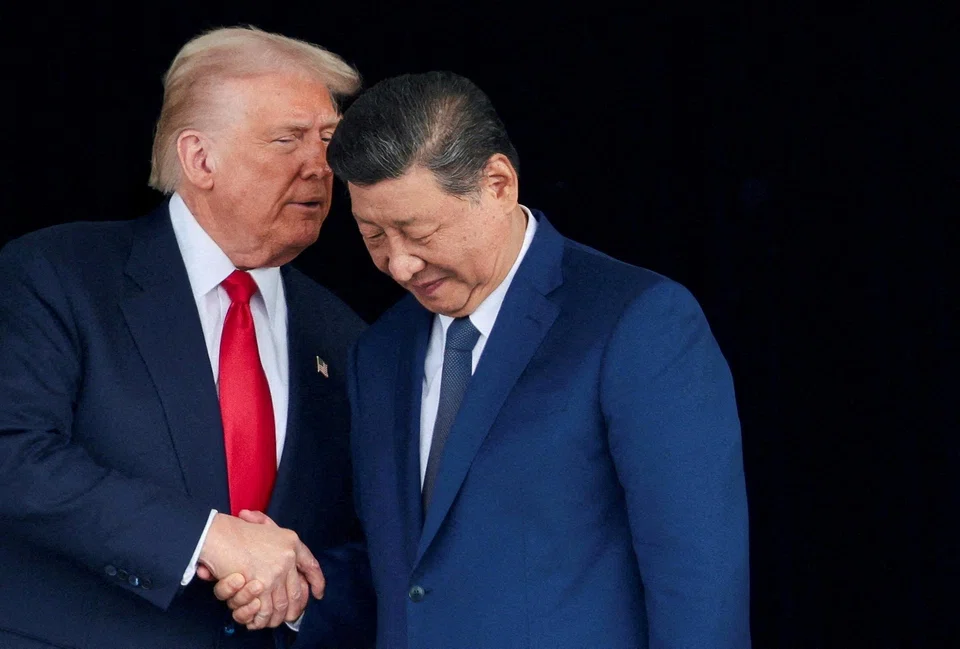
    • US President Donald Trump (left) and Chinese President Xi Jinping last met in South Korea in October 2025.
    • US President Donald Trump (left) and Chinese President Xi Jinping last met in South Korea in October 2025. PHOTO: REUTERS
    Published Fri, Nov 28, 2025 · 07:00 AM

    US PRESIDENT Donald Trump’s announced visit to Beijing in April 2026 marks a key moment in the evolving dynamic between the world’s two largest economies. Following a phone call on Nov 24, Trump’s acceptance of Chinese President Xi Jinping’s invitation signals a mutual commitment to managing – if not fully resolving – the tensions that have defined their bilateral relationship in recent years.

    A trade truce, not a trade peace

    The visit unfolds against the backdrop of the trade framework agreed between Trump and Xi at their October 2025 meeting in South Korea. While Trump has celebrated this as progress, characterising the relationship as “extremely strong”, significant challenges remain.

    The agreement on Chinese soybean purchases addresses the immediate concerns of American farmers in the Midwest – a key Trump constituency – but broader structural issues regarding technology transfers, intellectual property and market access persist.


    The framework represents “managed competition” – an acknowledgment that neither side can afford a complete decoupling, yet neither is willing to abandon core interests. Trump’s transactional approach may yield tactical wins on agricultural exports and specific trade imbalances, but the deeper strategic rivalry over technological supremacy and economic influence continues unabated.

    A notable divergence

    Perhaps most striking is what each side chooses to emphasise on – or omit from – their accounts of recent conversations. Chinese statements prominently feature Xi’s assertion that Taiwan’s reunification with the mainland is integral to the postwar international order. Trump’s public comments conspicuously avoid the Taiwan issue altogether, though Chinese readouts claim he acknowledged its importance to Beijing.

    This divergence is not merely rhetorical. The United States recently approved US$330 million in arms sales to Taiwan, drawing immediate Chinese protests. Meanwhile, Trump has reportedly held up a separate US$400 million arms package, suggesting he may be using military support for Taiwan as a bargaining chip in broader negotiations.

    The April visit will test whether Trump can maintain this delicate balance – reassuring Beijing enough to secure economic concessions while not abandoning commitments to Taiwan that have bipartisan support in Congress. The recent friction between China and Japan over Taiwan further complicates this calculus, potentially drawing the United States deeper into regional security disputes.

    Strategic implications

    Trump’s approach diverges from traditional diplomatic engagement in several ways. First is his willingness to negotiate directly with Xi, bypassing layers of bureaucratic preparation, creates both opportunity and risk. Such personal diplomacy can cut through gridlock but also risks miscommunication or commitments that prove difficult to implement.

    Second, Trump’s framing of the relationship as transactional rather than ideological may appeal to Xi, who has faced pressure from Western democracies on human rights and governance issues. By focusing on tangible deals, Trump creates space for cooperation on issues such as Ukraine and fentanyl trafficking while setting aside more intractable values-based disagreements.

    However, critics warned that Trump’s eagerness for a “big, splashy deal” might compromise national security, particularly regarding advanced semiconductors and Taiwan. The tension between Trump’s deal-making instincts and his administration’s broader containment strategy remains unresolved.

    Looking ahead

    The April visit and Xi’s reciprocal trip to Washington later in 2026 establish a cadence of engagement that both leaders clearly value. For Trump, visible progress with China offers domestic political benefits and demonstrates his self-proclaimed prowess as a negotiator. For Xi, engagement provides diplomatic legitimacy and potentially eases external pressure on China’s slowing economy.

    Yet sustainable improvement in Sino-American relations requires more than summit diplomacy. The structural drivers of competition – technological rivalry, military modernisation, influence over global institutions, and fundamentally different political systems – will persist regardless of personal rapport.

    The real test is whether this engagement produces mechanisms for preventing escalation. Can the two sides establish guardrails for trade disputes? Can they cooperate on global challenges such as climate change and pandemic preparedness? Can they maintain stability in the Taiwan Strait while both sides pursue incompatible long-term objectives?

    Ultimately, Trump’s upcoming visit to Beijing represents a recalibration towards managed coexistence. This is neither the strategic partnership that once seemed possible nor the complete decoupling that some advocate. It is a pragmatic recognition that the two superpowers must find ways to coexist even as they compete.

    The visit’s success should be measured not by rhetorical flourishes, but by the establishment of predictable frameworks for managing disputes. In an era of great power competition, stability may be the most ambitious achievable goal.