

COE premiums are higher than ever – will they continue this way?
Increased commercial interests and macroeconomic factors could mean an inevitable climb in car ownership costs in the long run


[SINGAPORE] Certificate of Entitlement (COE) premiums for passenger cars reached record levels in late October 2023.
The price of S$158,004 for the Open category remains the all-time high for COEs, while the passenger car categories A and B also set records of S$106,000 and S$150,001, respectively, in that round of bidding.
While a COE supply drought during that period meant industry observers expected prices to rise, none of them predicted the sheer scale of the price increases. As one observer told The Business Times, premiums were “crazy and the market made no sense”.
But those sky-high prices are reflective of the fact that premiums have been steadily rising over the past two decades.
They point to systemic factors beyond consumer demand that could continue to exert long-term price pressures on the COE market or at least, keep premiums from dipping to the lows of the past.
This includes persistent demand pressures from private-hire car (PHCs) fleets, aggressive bidding by major car brands, and macroeconomic factors like inflation and wages.
So will owning a car be a pipe dream for the average Singaporean? While most industry watchers believe that upward-creeping COE prices are here to stay, not all is doom and gloom. On a brighter note, there are mitigating factors that could provide some respite from accelerating premiums.
Up, up and away
For the past two decades or so, COE prices have operated on a predictable, roughly decade-long boom and bust cycle.
Now, the market is recovering from a bust period, but the recent peak and trough are higher than earlier corresponding points.
For example, at the nadir of premiums in February’s first round of bidding in 2009, Category A was S$1,020, while the corresponding nadir was S$23,568 in December 2018’s first round.
Category A’s previous peak was S$91,010 in January 2013’s second round of bidding, compared with the record S$106,000 of October 2023’s second round.
But even taking into account the decade-long cycle, COE premiums for passenger car categories have consistently trended upwards.
For the decade from 2015 to 2024, the average premium for Category A was 62 per cent higher at S$56,815, compared to the average for the decade of 2005 to 2014.
Over the same time frame, the average premium for Category B increased 65 per cent to S$67,820.
Private higher
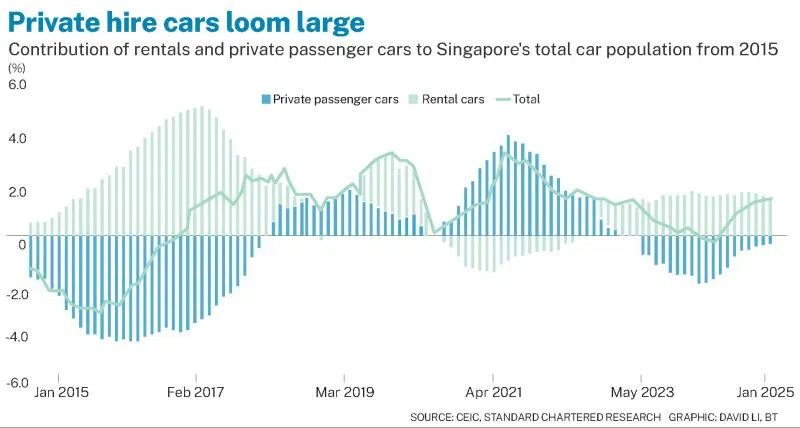
Industry observers have pinpointed the expanding population of business-owned PHCs as a prime driver of COE price increases since 2014, when ride-hailing debuted in Singapore.
Based on Land Transport Authority (LTA) data, the population of PHCs increased almost five times, to 90,383 in 2024. Over the same period, the number of private passenger cars declined to 524,418 from 536,882.
PHCs are used for ride-hailing services, such as Grab and Gojek, or self-driving services like GetGo and BlueSG.
While PHCs can be owned by individuals, industry sources say that as many as 80 per cent are owned by rental companies. Data from Standard Chartered Research shows that since 2015, the growth of rental cars has mostly outstripped that of private cars.
Automotive consultant Vincent Ng says that since PHC fleet owners are using their vehicles for a business purpose, they are driven by profit to secure COEs – even at a higher premium. Demand comes not just from them expanding their fleets, but replacing existing vehicles too, since PHCs are often highly utilised.
But as an alternative to car ownership, PHCs could also reduce COE demand.
Walter Theseira, associate professor of economics at the Singapore University of Social Sciences (SUSS), says that PHCs and taxis reduce overall demand for private vehicle ownership.
“These fleets work on high usage, so each vehicle replaces more than one privately owned car on average,” he says. It also “doesn’t make economic sense for fleet owners to favour high COE price periods for renewing their fleets”.
But Ng contends that even with recently implemented lock-in rules that prevent PHC fleets from selling their cars to the used vehicle market before three years, PHCs can still turn a profit at high COE premiums.
“PHC fleets still obtained COEs at their highest price around the end of 2023. Because even with that price, they can simply deregister the car after three to five years and take the rebate on the remaining COE, or sell the car to the used market. They would have utilised the car (as a rental) and met loan obligations by then,” he adds.
For the foreseeable future, PHCs will continue to exert their influence on the COE market.
Earlier in March, the Ministry of Transport announced it had decided not to remove PHCs from bidding in passenger car categories after a long study period.
“The supply will never be enough to meet much faster, growing demand. (With the ministry) not showing a willingness to rein in demand by PHC fleets, they will continue to exert pressure on premiums,” says Ng.
Driving unseen
Another way that commercial interests have put pressure on passenger car COE prices is the use of transfer pricing (TP) by major car companies to fuel aggressive COE bidding.
TP refers to the prices of goods that are transacted between related parties, such as companies under the same group or parent.
For the car industry, it means that the local subsidiaries of major car manufacturers – called national sales companies (NSCs) – can import cars into Singapore at a price lower than would otherwise be possible if they were third parties.
A car sold to a non-affiliated company, such as a third-party importer, would include the manufacturer’s margin, marketing and other costs as part of the price.
But an NSC can import a car close to cost price, which incurs less tax. The NSC then sells the car to local dealers or distributors with the markup and other fees added.
Major car manufacturers with established NSCs in Singapore include, but are not limited to, BMW, Mercedes-Benz and Toyota. When BT queried them on the use of TP in Singapore, these brands declined to comment or did not respond in time for publication.
Corporate adviser and accountant Chester Leong notes that TP is a legitimate practice commonly utilised by multinational corporations to allocate income fairly across jurisdictions, sometimes resulting in tax efficiencies, especially in competitive tax jurisdictions like Singapore or Hong Kong.
But while TP is used primarily to save on taxes, it can exert pressure on COE premiums if the manufacturer is competing aggressively for market share.
Say Kwee Neng, an automotive consultant and ex-managing director of multiple car dealerships, says that TP has been used to fuel more aggressive COE bidding by major car brands since the early 2000s, after the first NSCs were established in Singapore.
The fatter margin and tax savings are used to fund incentives to dealers if they achieve sales targets, he says.
Such dealers take these incentives into account and bid more aggressively, which secures the COEs needed for car sales. However, these higher prices put smaller players at a disadvantage.
BT understands that for major car brands, these incentives can be in the millions.
“If I have extra money in my pocket to bid higher, I will do so. As a major player, if you don’t hit your sales target, then you’re dead,” adds Say.

Leong emphasises that transfer pricing is a legitimate practice strictly regulated in Singapore by the Inland Revenue Authority of Singapore (Iras).
Taxpayers must substantiate transactions by demonstrating prices that closely align with market rates through documented market benchmarks and comparables, he says.
“Firms often engage experienced transfer pricing specialists who develop robust pricing strategies backed by detailed cost analyses and market studies. Provided pricing is justified, taxpayers can engage constructively with Iras during reviews or audits,” Leong says.
Although not all companies have sufficient scale or resources to implement comprehensive transfer pricing frameworks, larger participants leveraging TP practices can indirectly influence market dynamics, including areas like COE pricing.
“Given it’s not illegal and more of a case of pushing regulatory bounds, TP is already part of the landscape here and is not going away,” concludes Say.
Ballooning prices
While the COE market is artificially limited and has unique supply and demand swings, it is still subject to macroeconomic influences such as inflation.
Terence Fan, assistant professor of strategy and entrepreneurship at the Singapore Management University, has researched the relationship between inflation and COE premiums.
Every one percentage point increase in the consumer price index (CPI, the measure of inflation) from the 2019 base led to a 1.6 per cent increase in the COE premium of Category B at the end of 2024, says Prof Fan.
“While a high CPI alone makes inflation-adjusted demand go down, exerting downward pressure on COE premiums, the net effect still inflates COE premiums,” he adds.
Singapore should continue experiencing stable inflation – driven by policy measures – with COE premiums potentially rising as well.
But there is also a complex relationship between COEs and inflation, possibly even a feedback loop of rising premiums, wages and inflation.
Higher COE prices can contribute to inflation too, since the CPI takes car prices into account under the category of private transport. The COE can make up a significant proportion of car price – as much as 70 per cent for some mainstream models.
Prof Theseira noted that COE prices should rise together with inflation, since the willingness to pay increases along with inflation and wages.
Prof Fan, Prof Theseira and Dr Victor Kwan, a senior lecturer at SUSS, observe that growing incomes could also feed rising COE prices.
Indeed, then transport minister S Iswaran said in Parliament in 2023: “As household incomes continue to rise in the coming years, coupled with our policy of zero-growth in the car population, we must expect the long-term trajectory for COE prices to be upwards.”
The median monthly household employment income in Singapore grew from S$8,292 in 2014 to S$11,297 in 2024.
Lee Kwok Hao, assistant professor of economics at the National University of Singapore, says COEs could also contribute to cost-push inflation due to their nature as a major tax.
“If you tax (vehicles) so much at the outset, then some of that cost is going to be passed on to downstream producers as well as consumers.”
Out of the box
It may seem that COE premiums are destined only to climb in the future, but there are other factors that could moderate their price.
One possibility is Singapore’s increasing public transport network.
The Ministry of Transport aims to have eight out of 10 households within a 10-minute walk of an MRT station by the early 2030s, expanding the rail network to about 360 km from around 240 km currently.
This, Dr Kwan notes, would help reduce COE demand “significantly”.
Prof Fan notes that each one percentage point increase in rail kilometres operated leads to a 1.2 per cent reduction in Category B premium.
Prof Theseira says that MRT stations near higher-cost housing could also further impinge on COE demand: “It’s notable that the most popular new property developments today tend to be transit-oriented condos (near MRT stations), rather than the private enclave type condos of the past.”
Earlier in March, Transport Minister Chee Hong Tat said in Parliament that new MRT stations or lines will be added every year from now until the end of the decade.
Another factor in the equation is if government policy shifts from managing congestion by controlling car ownership, as it currently does with COEs, to controlling usage.
Singapore already has vehicle usage controls with the current Electronic Road Pricing (ERP).
LTA is updating vehicles with new on-board units for the future satellite-based ERP 2.0 system, which could allow it to better manage traffic congestion and vehicle usage.
In November 2024, Chee said that the government had not made a decision on whether to implement distance-based road pricing. If it is used, there might then be scope for a further increase in the COE quota, he says, as the mechanism would give LTA an additional tool to manage congestion.
Prof Fan speculates that with ERP 2.0, the government could do away with COE in theory, but it could simply be shifting costs to a different form.
“ERP 2.0 pricing may have to be significantly higher than what we have today to (manage congestion) effectively. A S$120,000 COE translates into S$1,000 a month or around S$30 a day,” he says. Foregoing COE and relying on ERP 2.0 may also help in sparsely-developed areas, or for those who travel in off-peak periods, he added.
But consultant Say suggests that it is time to consider a different approach that isn’t solely based on financial considerations.
“Car lite doesn’t mean car zero. I don’t think that Singaporeans will give up on the dream of car ownership even in the future. So perhaps this means we need a system that controls congestion, but also has more equity and goes beyond simply paying for the privilege to drive.”
TRENDING NOW

OCBC customers face difficulties accessing online, mobile banking services

SGX CEO Loh Boon Chye to step down; succession planning under way
Waymo founder predicts ‘landslide’ robotaxi adoption in Singapore, driven by high car costs

Vietnam’s northern provinces, not Hanoi or Ho Chi Minh City, are powering near 10% GDP growth

