

Europe’s focus on Asia intensified by Iran war
Ultimately, an underlying key goal of the EU’s pivot is to build a competitive advantage
THE ongoing Iran war may have stalled the US’ pivot to the Asia-Pacific, but the same conflict is prompting Europe to intensify its economic and political reorientation to the region, including Asean.
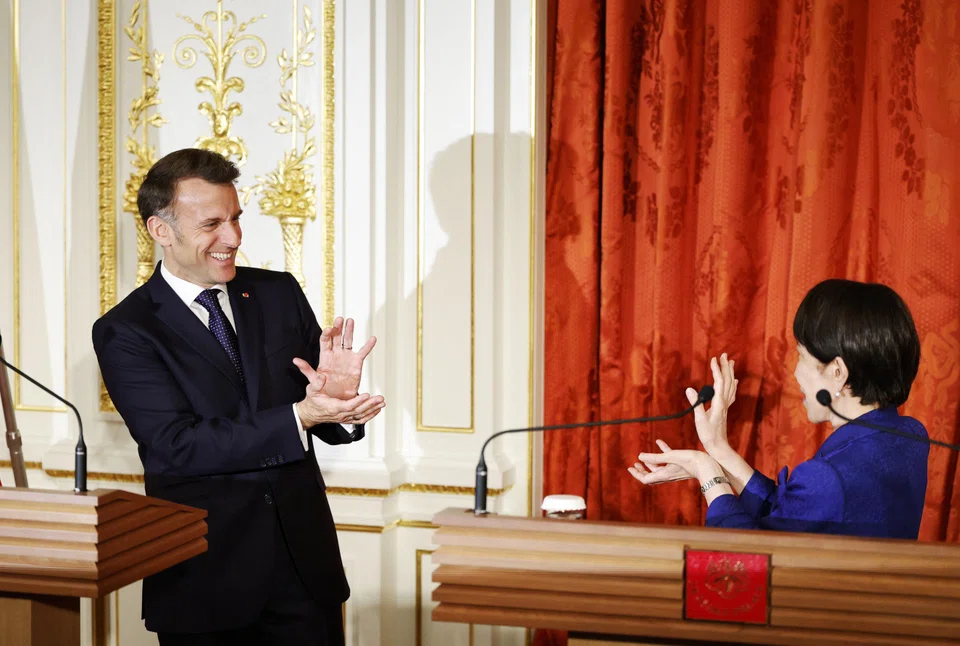
This was underlined last week by French President Emmanuel Macron’s important trip to Tokyo and Seoul. This follows his Asean-focused visit to Vietnam, Singapore and Indonesia in 2025, and his trip to India this February.
As Macron has highlighted, the Asia-Pacific accounts for some 60 per cent of global gross domestic product, about two-thirds of global growth. Together with the EU, the region drives some 70 per cent of global trade.
Macron’s visit to Tokyo and Seoul was undertaken not only as the French president, but also as the chair of this year’s Group of Seven. Both Japanese Prime Minister Sanae Takaichi and South Korean President Lee Jae-myung are scheduled to attend June’s leadership summit in Evian, France.
In Tokyo, Macron asserted that the Middle East conflict is intensifying the need for Europe to engage more closely with key Indo-Pacific powers, including Japan, South Korea, Australia and India. The latter two concluded trade deals with the EU in recent weeks.
Macron’s goal is to ensure the two regions are not “too much exposed to the unpredictability of the US” nor dependent on the “dominance” of China.
Boosting collaboration
Building on his recent trips, the French president sought last week to showcase this Europe-Asia collaboration.
With Japan, for instance, France and the wider EU have stepped up leadership in international trade and the rules-based economic order. This was bolstered in 2019 when the EU-Japan Economic Partnership Agreement entered into force, eliminating almost all duties on exports.
In Tokyo, Macron met Japanese Emperor Naruhito and Takaichi, signing joint road maps on critical minerals and defence cooperation; nuclear power; and security and partnerships in the space sector.
While a large French business delegation met with firms such as Softbank, Iwatani and Horiba, Macron also lobbied Takaichi to lift import barriers on French foie gras, which have remained in place since a 2023 bird flu outbreak.
In South Korea, Macron’s meeting with Lee focused on attracting investment from Samsung, Naver and Hyundai Motors into French industrial and technology sectors, and enhancing exports to South Korea.
Macron is the first European leader to make a state visit to Seoul since Lee took office. To mark this occasion, Macron inaugurated the Centre Pompidou Hanwha, a building designed by French architect Jean-Michel Wilmotte.
Lee called for stronger cooperation with France, noting that “in an increasingly fragmented and uncertain international environment, partnerships between democratic nations that share common values are no longer merely desirable but are becoming strategically essential”.
The countries aim to increase bilateral trade to US$20 billion by 2030 from US$15 billion in 2025.
Macron and Lee signed cooperation agreements in sectors including critical minerals, semiconductors, quantum technologies, wind power and nuclear energy – including a deal to secure fuel supplies for Korean nuclear power plants and lay the foundations for joint entry into the global nuclear market.
Asean remains a key focus for Europe
While Macron’s recent focus was on Japan and South Korea, Asean remains a key part of the European reorientation to the Asia-Pacific.
Hanoi, for instance, is seen as an increasingly important trade partner of Paris. Last year, Macron became the first French president to visit Vietnam in about a decade, signing over US$10 billion in deals across nuclear energy, defence, rail and maritime transport, planes and vaccines.
In Singapore, Macron gave a keynote address at the Shangri-La Dialogue, Asia’s top defence conference. He warned that Russia is destabilising Asia by deploying North Korean soldiers to Ukraine and supporting North Korea’s ballistic and nuclear programmes.
In Indonesia, Macron’s pitch to President Prabowo Subianto mirrored his recent message: that France and Europe are defenders of the international rules-based order.
Rationale of European reorientation
Europe’s increased focus on the Asia-Pacific aims to strengthen the two regions’ partnership. This is based on mutual respect and equality in security, trade, global value chains, digitalisation, the green transition and energy security.
A key underlying goal of the EU’s pivot is to build competitive advantage. Under European Commission President Ursula von der Leyen, the EU’s Asia-Pacific strategy has shifted to foster a rules-based, open environment for trade and investment, reciprocity, resilience, tackling climate change and supporting connectivity.
With Japan and South Korea at the cutting edge of digitalisation and technology, the EU intends to foster digital cooperation with the Asia-Pacific through the Digital for Development Hub and support sustainable, inclusive digital transformation.
Beyond economics, maintaining free maritime supply routes in full compliance with international law is paramount too. Europe is working closer with Indo-Pacific partners on security threats such as malicious cyberactivities, terrorism, and organised crime.
The EU has also extended its coordinated maritime presence in the North-West Indian Ocean. This will allow the EU to further support stability in the Asia-Pacific, optimise naval deployments, promote coherence of European action and facilitate cooperation with partners in the region, including by conducting joint maritime exercises and port calls.
Ultimately, these efforts showcase why European leaders are intensifying their Asia-Pacific pivot: The region is a growing priority for securing competitive advantage in the years to come.
The writer is an associate at LSE IDEAS at the London School of Economics
TRENDING NOW

Companies still in search of AI use cases with worthwhile ROI, says Broadcom’s CEO
Beauty World Plaza up for collective sale for S$165 million
Trouble in paradise: Bali runs low on fuel, sparking long lines at pumps

Philippine power giant First Gen rebuffs foreign offers, plans up to US$2.6 billion in expansion

