How Asean can ramp up regional cooperation on disaster relief
Partnerships must shift purposefully and be organised around capabilities instead of institutions
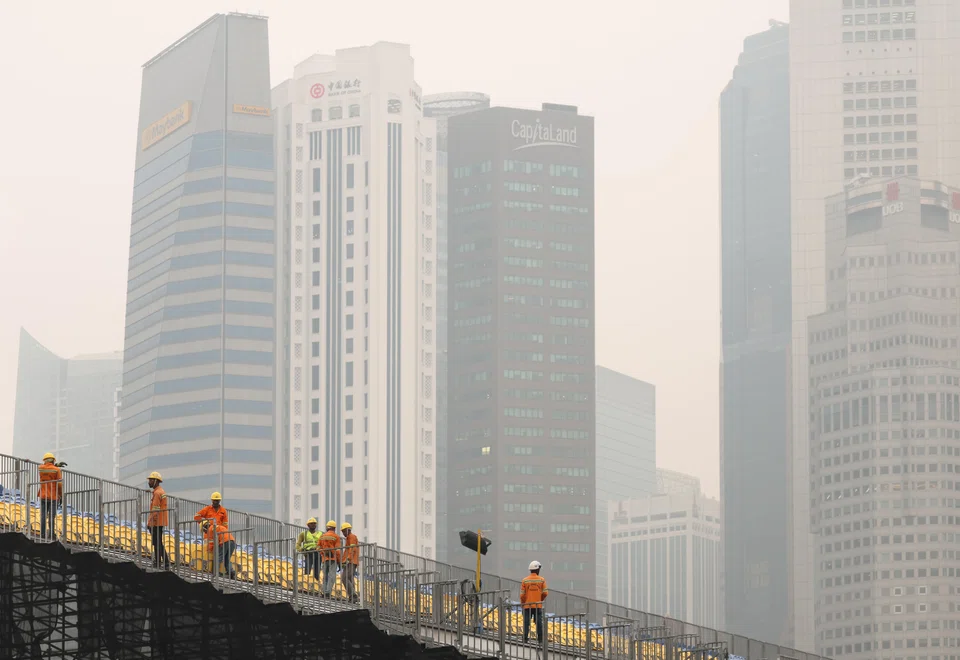
ACROSS South-east Asia, the haze has returned.
Smoke and smog from fires in Indonesia have crossed national borders, degraded air quality in Indonesia, Malaysia and Singapore, once again demonstrating how a man-made environmental hazard, aggravated by the El Nino weather phenomenon in one location, can have consequences in the region.
The haze forces us to consider something larger than the current emergency. The crises we face do not respect borders nor follow sectoral or institutional mandates.
Our systems of preparedness cannot afford to do so either. The deeper question is whether we have built the necessary relationships and capabilities before the next disaster.
In the last two decades, the Asia-Pacific has become substantially better at cooperation on disaster relief.
After the devastating 2004 Indian Ocean tsunami, South-east Asian leaders spurred efforts and signed the Asean Agreement on Disaster Management and Emergency Response in 2008.
Following this, the Asean Coordinating Centre for Humanitarian Assistance in disaster management was set up in 2011 as the operational engine for the agreement and mechanism to facilitate disaster relief efforts to member states affected by natural hazards ranging from cyclones to earthquakes and typhoons.
In 2010, the militaries in the wider Asia-Pacific region also agreed to the Asia-Pacific Conference on Military Assistance in Disaster Response Operations Guidelines, covering countries in South, South-east and North-east Asia, as well as the Pacific.
But the humanitarian architecture we spent two decades building was designed for a different landscape that now faces significant fragmentation.
We face a rise in geopolitical tensions, overlapping and concurrent disasters driving greater humanitarian needs, and mounting pressure on humanitarian financing.
How do we redesign a system that is fit for purpose?
Crises do not occur in isolation
The Covid-19 crisis exposed something deeper than shortcomings in global pandemic preparedness.
It showed that crises cascade across separately organised sectors: The health emergency became problems in logistics, supply chains, governance, economy and disaster-management, too.
The occurrence of increasing numbers and intensity of extreme weather events in the region, alongside pandemic restrictions then, revealed key operational challenges.
It showed that we still organise governance largely by sector, while crises increasingly affect multiple sectors at once or in quick succession.
The pandemic also exposed where civilian resilience was strong and where it was weak.
Militaries provided logistics, transport, medical support, infrastructure and other capabilities because governments faced demands surpassing normal civilian requirements.
The lesson was not that militaries should assume more civilian functions. Instead, strategic questions followed: which capabilities genuinely require military support; which reflect gaps in civilian preparedness; and where should investment be targeted ahead of the next crisis?
The development of regional disaster management architecture led to the agreed principle that it should be nationally led, regionally supported and international-as-necessary.
Now, the next phase must ramp up and go beyond disaster response towards building resilience across interconnected systems.
The current haze crisis is not solely an environmental sector problem. It affects healthcare system capacity and livelihoods, triggering civil protection responses such as school closures. Between August and Tuesday (Oct 20), the crisis had disrupted more than 2,600 flights, said Indonesia’s Transportation Ministry.
Asean member states’ next disaster management challenge is not simply coordinating more effectively when disasters happen. It is connecting the institutions and capabilities that prevent one disruption from cascading into many.
Partnerships for purpose
There is a need to develop partnerships for purpose that shift from organising cooperation around institutions to organising it around capabilities required to produce an outcome.
These partnerships should be based on three core principles:
First, build relationships before crises: Military and civilian exercises, professional networks, points of contact, data-sharing arrangements and institutional relationships should already exist before a disaster occurs.
Too often, trust-building begins only after a disaster has already happened.
The recent Exercise Trident Resolve hosted by Indonesia in late September was an example of a multilateral field training exercise involving 19 countries under the Asean Defence Ministers’ Meeting-Plus. It brought together military and civilian agencies from the Humanitarian Assistance and Disaster Relief (HADR), military medicine and cybersecurity domains.
Second, organise around capabilities, not institutions alone. We need to move beyond the rigid formula that governments lead alone, militaries support, humanitarians deliver and businesses donate.
Instead, we must ask: What capabilities are required? Logistics companies build supply chains. Telecommunications companies provide connectivity. Financial institutions enable payments and recovery.
Tech firms contribute data and analytical capabilities. Universities and think tanks contribute research and evidence for decision-making. Communities provide knowledge, networks and legitimacy.
The private sector must become more than a cash cow or contractor.
Third, institutionalise partnerships. Personnel are often rotated through roles. Relationships disappear. Lessons are at best observed, but rarely acted upon. Often, they are lost. Exercises, training and professional networks turn personal relationships into institutional resilience.
From coordination to collaboration
Coordination asks: “Who is doing what?” Collaboration asks: “How can we achieve more together?”
Coordination manages existing capabilities; collaboration creates new capability by connecting institutions that could not achieve the same outcome independently.
Military readiness must increasingly include partnership readiness. The same applies to governments, humanitarian organisations and businesses.
Turning these principles into practice requires spaces where these relationships can be built before the next crisis takes hold.
On Oct 27, the fifth Humanitarian Futures Forum in Singapore will bring together actors from various sectors and the humanitarian ecosystem to do precisely this.
Conversations will address areas such as changing civil-military dynamics in conflicts and disasters, and the consequences of harmful information during crises.
The wider purpose is equally important – creating the relationships, shared understandings and exchange of perspectives that future crises will demand.
Disasters do not fit squarely into one sector or institutional mandate.
Haze will cross borders and turn an environmental hazard into public health, economic and wider security challenges. Pandemics will coincide with extreme weather. Infrastructure disruption will produce humanitarian consequences.
Climate, health, economic and technological risk will intersect with security issues.
No government, military, humanitarian organisation or business alone will possess all the capabilities required to manage these challenges.
The future of humanitarian action will therefore depend less on the number of organisations that can be coordinated after disaster strikes, and more on whether the right partnerships have been built before it does.
The time to build those partnerships is now.
The writer is a senior fellow and coordinator in the Humanitarian Assistance and Disaster Relief Programme in the Institute of Defence and Strategic Studies at the S Rajaratnam School of International Studies (RSIS), Nanyang Technological University. The Humanitarian Futures Forum 2026 is co-organised by RSIS and the Changi Regional HADR Coordination Centre.
Artificial-intelligence tools were used in adapting this commentary from a keynote speech that the writer delivered at the conference, Focus in 2026.