Mecca defence accord underscores West Asia’s shifting geopolitical sands
The agreement between Saudi Arabia, Turkey and Pakistan is an uncomfortable development for Israel and the UAE
[SINGAPORE] Just when you thought that talk of an Asian Nato in East Asia – long cherished by Japan – had died out, come developments that have echoes of that all-too-familiar security grouping potentially showing up in the continent’s westernmost parts.
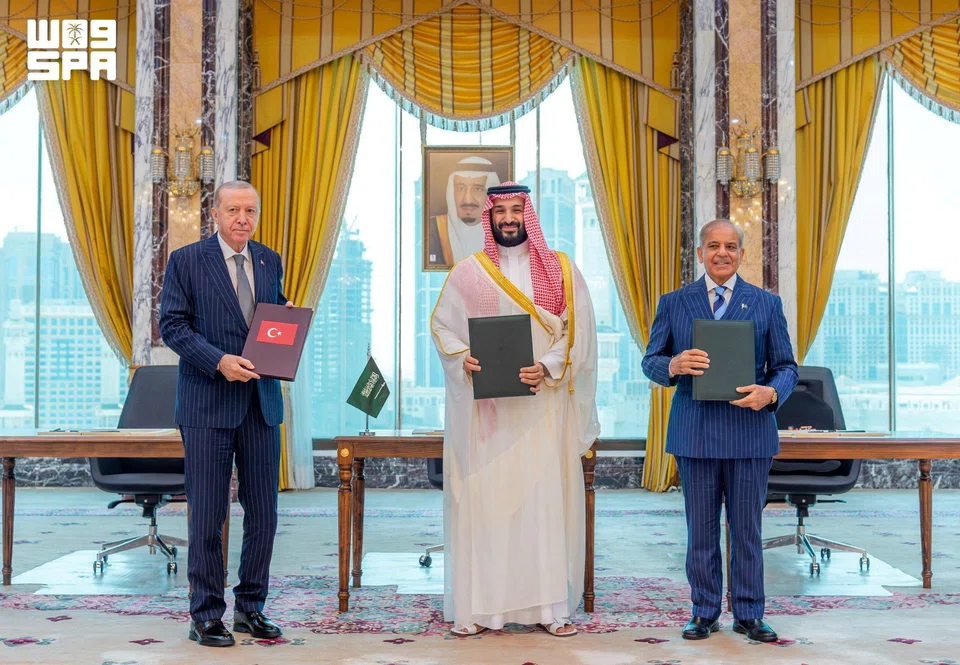
The Mecca Joint Defence Agreement, inked on Aug 7, brings together three Sunni Muslim powers – wealthy energy giant Saudi Arabia, Turkey with a respectable military-industrial base, and Pakistan, the only Muslim nation to have nuclear weapons and one that has a battle-tested military.
The full text of the agreement has not been disclosed. A joint statement from the three says it provides for the development of defence cooperation “in all its dimensions”.
It says the agreement will bolster “collective deterrence against all forms of aggression” and stipulates that “an armed attack carried out against any one of the three states shall be considered an attack against all of them”.
Turkish Foreign Minister Hakan Fidan sees the agreement – negotiated in Jeddah and signed in Mecca – as having provisions equivalent to Nato’s Article 5, where an attack on any member in Europe or North America is considered an attack on all.
The Mecca accord members say the agreement is directed against no particular country.
Clearly, the world has not seen the last of this matter. The three signatories have said others are welcome to join.
Egypt, the Arab world’s most formidable military power and a significant US ally, participated in the talks but skipped the final day, and could yet come in – if Turkey’s expressions of interest in such a development can be taken at face value.
Backstage, it appears that Qatar, another non-signatory, played a significant role in aligning the three politically.
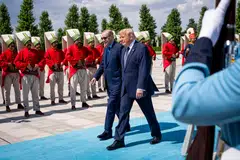
US blessings?
By any yardstick, this indeed is an important development. Amazingly, some of these countries had been on opposite sides of the Arab Spring not too long ago.
Qatar and Turkey in particular, with their backing for the Muslim Brotherhood – the organisation that gained the most from the upsurge – and Saudi Arabia firmly against it.
The widespread consensus is that Riyadh had a big hand in the overthrow of the Brotherhood’s Mohamed Morsi from power in Egypt in 2013.
Later, its agents murdered the prominent Saudi dissident Jamal Khashoggi inside the kingdom’s consulate in Istanbul, angering Turkey, which leaked graphic details of the assassination.
Why this sea change now?
The easy explanation is that Saudi Arabia, fearing strategic encirclement, is tightening relationships with key Sunni Muslim powers to confront the Iranian challenge.
Particularly so after the collapse of a ceasefire with the Iran-backed Houthis disrupted shipping in the Bab el-Mandeb strait, the alternative shipping route it was using to avoid the Iran-dominated Strait of Hormuz.
But discussions for the Mecca defence deal began in March when the three met in Riyadh at an Islamic summit, whereas the Houthis activated only four months later.
Why did the Saudis, who signed a key defence pact with Pakistan only in September 2025, feel the need to bolster their security by bringing in Turkey as well?
Clearly, the Mecca deal – which involves Asean’s recently added full dialogue partner Turkey and sectoral partner Pakistan – has deeper wellsprings.
First, most analysts have seen the defence agreement as motivated by two factors – Saudi fear of encirclement and a wider instinct in the region to start hedging against potential American retrenchment.
But could this have been done without Washington’s knowledge, or at least tacit endorsement? Unlikely.
Without that backing, neither Islamabad – whose military-political elite yearns for American validation – nor even Riyadh would have gone this distance.
The Saudis are among America’s oldest allies in West Asia, and the Pakistanis a longstanding defence partner. Turkey is in Nato.
Hence, it probably makes sense to see the agreement as a sort of regional security layer taking shape under the shelter of an American security canvas.
Second, this indeed is a breakout moment for Pakistani diplomacy.
Long constricted by its geographical mooring in South Asia, where it is eclipsed by India’s rising weight in global affairs, Pakistan has sought to unshackle itself from this yoke by injecting itself into West Asia as a security provider, particularly of Islam’s holy sites.
While its rekindled hopes of becoming more central to Washington’s South Asia strategy may not survive the Trump administration, its successful mediation in the conflict over Iran – combined with robust backing from US Central Command – has helped it to emerge as a central figure in America’s calculations for West Asia.
At the same time, Riyadh’s move to bring in Ankara is a tacit acknowledgement that, notwithstanding Islamabad’s nuclear arsenal, nimble diplomacy and battle-tested military, it does not have the comprehensive power that only Turkey can bring.
Making Israel, UAE uneasy
For all these reasons, this is a distinctly uncomfortable development for Israel, and it comes at a time when it is confronted by an American public that has turned distinctly anti-war and a White House that has lost patience with Israeli Prime Minister Benjamin Netanyahu.
The Mecca signatories may have emphasised deterrence as the prime motivation – Pakistan, particularly, has stressed the “defensive” aspect of the agreement – but Israel will know that the deterrence is not aimed at Iran alone.
Wariness of Israeli expansionism is becoming pervasive in the West Asian region, including in Saudi Arabia, which once considered joining the Abraham Accords.
Although at a slight remove from the epicentre of action, Turkey too is absorbing how Israel, far from making plans to leave Lebanon, actually fortified its positions along its Lebanese and Syrian borders.
No surprise that the Turkish leadership has explicitly named Egypt as a primary target for expanding the Mecca pact. Powerful as it might be, it knows Egypt’s heft as the most capable military in the Arab world would be invaluable for the Mecca enterprise.
Israeli overreach has sent negative perceptions of the Jewish state and Netanyahu soaring in the region and around the world.
A Pew survey conducted between February and May reported that across 36 countries surveyed, a median of 67 per cent of adults held an unfavourable view of Israel. In Turkey, that rose to 97 per cent.
There are side dynamics in play as well. The Mecca deal weighs on the growing security relationship between India and Israel.
The two maintain a robust channel for flows of everything from strategic intelligence to software to precision rocketry – all of which are of deep concern for Islamabad.
It was not too long ago that Israel, with Indian assistance, considered striking at Pakistan’s nuclear facilities. Amnesty International says India has shipped more than 2,500 consignments of weapons to Israel since it began its Gaza operations.
Attaching itself more tightly to Turkey, a Nato member and one that came to its aid in the May 2025 conflict with India, bolsters Islamabad’s security.
In recent years, Ankara has shifted to align with Pakistan on Kashmir and other issues. Riyadh may also feel more secure with Turkey by its side.
While an eventual struggle for regional influence between the Turks and the Saudis cannot be ruled out, their immediate priorities align.
It is also a fraught moment for the Emiratis, traditionally respected as one of the most diplomatically astute players in the Gulf region. Ties with Saudi Arabia have been affected by Riyadh’s attempts to encroach on the regional hub status enjoyed by the financial centre of Dubai.
For the Saudis to anchor a regional security network involving two of the most powerful non-Arab military powers in the Muslim world does not make for pleasant news for the United Arab Emirates (UAE).
What of India, a key outside player? For the moment, New Delhi looks adrift, with Israel and the UAE as its only steadfast partners in a region where it once had wide influence. Its strategic embrace of Israel will not escape Teheran’s eye, nor Riyadh’s, for that matter.
Saudi Arabia has fewer reasons to be mindful of New Delhi’s sensitivities after its economic diversification strategy took a knock when Saudi Aramco’s plans to pick up a big chunk of India’s Reliance Petrochemicals, the world’s largest refiner, went aground on valuation disputes.
New Delhi’s move to source cheap Russian energy, which saw it cut purchases of Saudi oil, also spawned outrage in Riyadh.
Little wonder that Indian Foreign Minister S Jaishankar skipped Prime Minister Narendra Modi’s July tour of Indonesia, New Zealand and Australia to travel in the West Asian region instead.
Yet, what appears logical on paper does not always translate to ground realities. For all the wealth and military means the Mecca accord assembles, it is hard to say what might happen in a real conflict situation.
It beggars belief to think Turkey would automatically participate in an actual conflict with Iran or that the Saudis would step in to assist Pakistan against India.
Likewise, Turkey has mixed feelings about Iran.
Turkish President Recep Tayyip Erdogan has in the past even referred to Hamas, which Teheran has backed almost since its founding in 1987, as “liberators and holy warriors”.
The Mecca accord, therefore, looks formidable on paper but is also riddled with ambiguity.
Nevertheless, its signals cannot be ignored.
Turkey’s Fidan has spoken of a strategic political and military committee similar to Nato structures, and even a secretariat.
Pakistani Defence Minister Khawaja Asif has called for more Muslim nations to join the Mecca accord and stand together “along the lines of Nato”.
A Nato-type arrangement may be a long way off. But the desert sands are rapidly shifting. Yesterday’s mirage may be tomorrow’s concrete structure. THE STRAITS TIMES
Decoding Asia newsletter: your guide to navigating Asia in a new global order. Sign up here to get Decoding Asia newsletter. Delivered to your inbox. Free.
Share with us your feedback on BT's products and services