As Singapore’s growth continues to surprise, doing better than expected has its own dangers
The risk could now lie in assuming that it will be mostly plain sailing ahead

[SINGAPORE] Three months ago, with the release of the advance estimates of Singapore’s first-quarter growth, the Ministry of Trade and Industry (MTI) warned that the US and Israel’s war on Iran could take an economic toll in the coming quarters.
Soon afterwards, however, Q1 growth turned out better than expected. Updated figures put it at 6 per cent year on year, higher than the advance estimate of 4.6 per cent.
On Tuesday (Jul 14), advance estimates of Q2 growth exceeded economists’ expectations again at 5.7 per cent, higher than the median 5.5 per cent forecast in a Bloomberg poll. Q1 growth was also revised upwards to 6.3 per cent.
Even as the conflict in the Middle East continues its roller-coaster ride, Singapore has been getting such pleasant surprises in economic data.
In May, for instance, non-oil domestic exports surged 38.4 per cent, not just beating economists’ forecasts but also representing the fastest growth in more than two decades.
For now, the official full-year growth forecast range remains at 2 to 4 per cent. This could change with updated Q2 figures in August – but even before that, wider expectations may be shifting.
Prepare for trouble?
Earlier in the year, as the closure of the Strait of Hormuz threatened to unleash a global energy crisis, the mood was one of preparing for a storm.
As Prime Minister Lawrence Wong warned at the May Day Rally: “Another storm is upon us – and this one is more severe.” Pressures from the Iran war were likely to intensify, and supply disruptions could worsen, he said then.
Some of this has started to show up, such as the higher electricity tariffs this quarter.
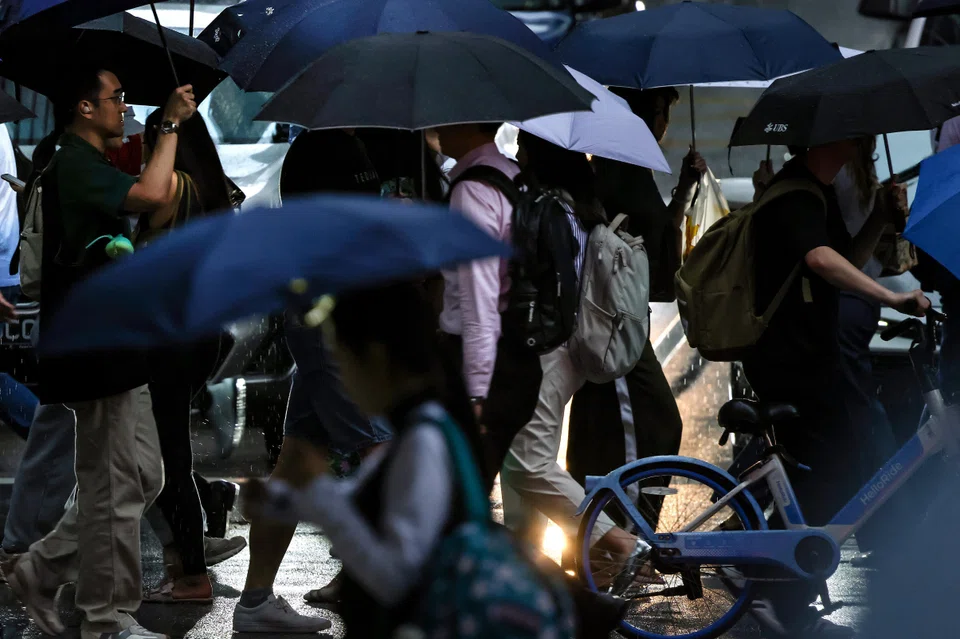
And yet, for the most part, the literal storms of monsoon season may be leaving a greater impression than economic turbulence. Inflation, for instance, was lower than expected in May.
Perhaps the danger now lies in assuming that it will be mostly plain sailing ahead.
Looking back, looking ahead
After Tuesday’s Q2 flash figures, several banks improved their full-year growth forecasts for Singapore. These included Citigroup, Maybank and UOB, which all raised it to 4.8 per cent – up from earlier forecasts of 4.5 per cent, 4.6 per cent and 4 per cent, respectively.
But of course, as the year progresses, full-year forecasts become less about the outlook and more about incorporating year-to-date data.
As Citi economist Kit Wei Zheng noted, the improved full-year forecast still implies a sharp slowing of growth in the second half: to 3.6 per cent year on year, from 6 per cent in H1.
There may even be a sequential slowdown. In H2, Citi expects flat growth on a quarter-on-quarter seasonally adjusted basis.
A technical recession in H2 could be a real possibility, even as the strong first half pulls up full-year growth.
Bubble, bubble?
Furthermore, any discussion of Singapore’s strong performance cannot avoid one factor in particular: the artificial intelligence boom, and the corresponding risk of a bubble.
As MTI highlighted, manufacturing growth in Q2 was driven largely by the electronics and precision engineering clusters, due to strong AI-related demand.
This more than made up for contractions in chemicals and biomedical manufacturing, with the former being affected by feedstock disruptions amid the Middle East conflict.
For now, tech firms still seem keen on AI-related capital expenditure. But as rumblings about potential overvaluation continue, we cannot rule out a sell-off that causes firms to pull back – a downside risk identified by UOB on Tuesday.
AI-related demand has been shielding the economy from the Iran-related fallout. If this demand softens or even dissipates, the storm may be closer than we think. Despite pleasant surprises, this is no time to let our guard down.
TRENDING NOW
He built the Vingroup empire. Now South-east Asia’s richest man is handing some key roles to his sons
Quarter of Singtel special discounted shares sold ahead of CPF Board transfer
Why Tan Aik Keong of digital solutions specialist Agmo wants to make himself less indispensable
Asia needs new energy security architecture