South-east Asia’s haze shows a diversified electricity source may not be that dependable
As countries grow reliant on power from across borders, how much will be available when several need it at once?
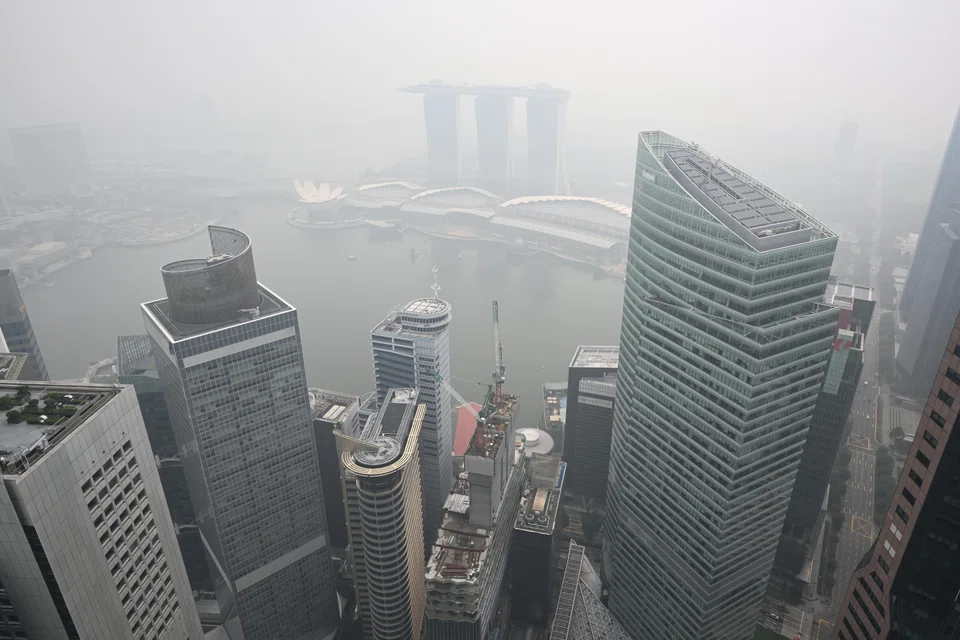
[SINGAPORE] On Oct 9, 2026, Singapore’s Pollutant Standards Index reached 192. The haze was choking throats and clouding skies.
Less visibly, it was also dimming solar panels: Operators in the city-state reported daily average electricity output falling by around 15 per cent during the episode.
It did not lead to an electricity shortage here. But as more South-east Asian countries prioritise generating and trading low-carbon electricity, the episode offers a glimpse of a challenge they face – that suppliers might face the same risks in power generation.
Different sellers, same sky
When shipping through the Strait of Hormuz was disrupted from early March, several Asean members limited air-conditioning and rationed fuel simultaneously: one choke point, many countries.
The lesson drawn is to diversify, including through domestic renewables and electricity traded with neighbours.
Singapore has conditionally licensed six electricity-import projects from Indonesia, totalling 3 gigawatts (GW); all six pair solar generation with battery storage. By 2035, the city-state aims to import around 6 GW of low-carbon electricity from the region.
Other South-east Asian countries are also planning new cross-border connections under the Asean Power Grid.
These links can improve reliability, but they additionally make neighbouring countries more dependent on one another. The catch is that global choke points are not the only risk countries can have in common. Neighbours tend to also share each other’s weather.
In dry years, Cambodia has suffered power shortages at home, and so has Laos, the region’s biggest electricity exporter. El Nino brings hot, dry conditions to much of the region at once, increasing the risks of fires and haze.
The projects in Indonesia involve different developers, but a widespread smoke plume can affect solar generation for weeks across multiple sites.
Haze can also increase electricity demand. In a study of Singapore households, economist Alberto Salvo found that residential electricity consumption increased by about 1.1 per cent for every 10 micrograms per cubic metre increase in fine particulate pollution. People may use more electricity to cope with polluted air, just as solar panels produce less.
When everyone needs the same electricity
Electricity that is readily available in an ordinary year may be much harder to obtain in a regional crisis.
Consider an electricity exporter facing a prolonged shortage. It has obligations to deliver electricity to a neighbouring importer, but its consumers also need power.
Meeting its export commitments may become increasingly costly, as domestic supplies tighten.
At the opening of Singapore International Energy Week on Oct 26, Minister for Energy, Trade and Industry (Energy and Industry) Tan See Leng warned: “When there is a supply crunch, countries may also prioritise their own domestic needs.”
He was discussing energy security broadly, including fuel supplies.
The electricity the importer most needs may also be the electricity the exporter finds most costly to spare.
As the International Energy Agency noted in a report in October, after this year’s fuel disruptions, governments that protect their consumers in a crisis can leave import-dependent neighbours short.
The region needs clearer arrangements for such moments – not just for fuel, but also for electricity trade.
For electricity, the existing arrangements are mostly commercial contracts, written to secure financing; banks usually want more than 15 years of revenue certainty before funding a cable. They establish delivery obligations and remedies for interruptions.
But compensation for undelivered electricity does not keep the lights on by itself. Bankable is not the same as dependable. In a regional shortage, replacement power may be scarce or expensive, whatever the contract says.
Different countries may also plan to rely on the same backup supplies during an emergency. Each country’s plan can look reasonable on its own, even if those plans cannot all work at once.
What counts as dependable electricity?
None of this argues against regional electricity trade. Connections between countries remain valuable, especially when shortages are confined to one place.
The challenge is to distinguish electricity available in normal conditions, from electricity that can be relied upon when several countries face scarcity together.
Import proposals are already tested for bankability. The bad year needs a test of its own. Singapore assesses the resilience of its electricity imports, and Asean’s integrated resource and resilience-planning framework provides a foundation for examining regional risks.
But countries must assess whether their plan still holds when a bad year hits all of them at once: hot, dry weather and a fuel shock together.
The plans cannot all hold where several countries are counting on the same limited imports or reserves. Those are also the places where agreements need clearer terms on what is cut first and where replacement supply comes from.
Such a test needs data shared across borders. Asean already issues seasonal outlooks for haze. Europe’s grid operators publish reservoir levels and forecasts of wind and solar output.
A seasonal electricity outlook for the region would combine the two, and is a foundation to gauge whether national plans in Asean can all hold at once.
Singapore’s 2027 Asean chairmanship offers an opportunity to advance that work with regional partners.
The real test of South-east Asia’s electricity trade is not how much power crosses borders in good times, but how much remains available when supplies run short and countries must balance domestic needs against their commitments to neighbours.
The writer is a research fellow at the Energy Studies Institute, National University of Singapore