

‘Take some pain today for growth tomorrow’: Why policymakers should heed IMF’s call
AI, high energy prices and rising public debt are major ‘cross-currents’ the world economy must navigate
DESPITE Asean’s economic vibrancy, the region is rarely at the centre of global financial diplomacy.
However, that changes next week when Bangkok hosts the International Monetary Fund (IMF)-World Bank Annual Meetings from Oct 12 to 18.
In her agenda-setting curtain-raiser speech in Singapore on Wednesday (Oct 7), IMF managing director Kristalina Georgieva warned that “winter is coming” – an allusion to TV series Game of Thrones and seasonal pressures soon arriving in the Northern Hemisphere.
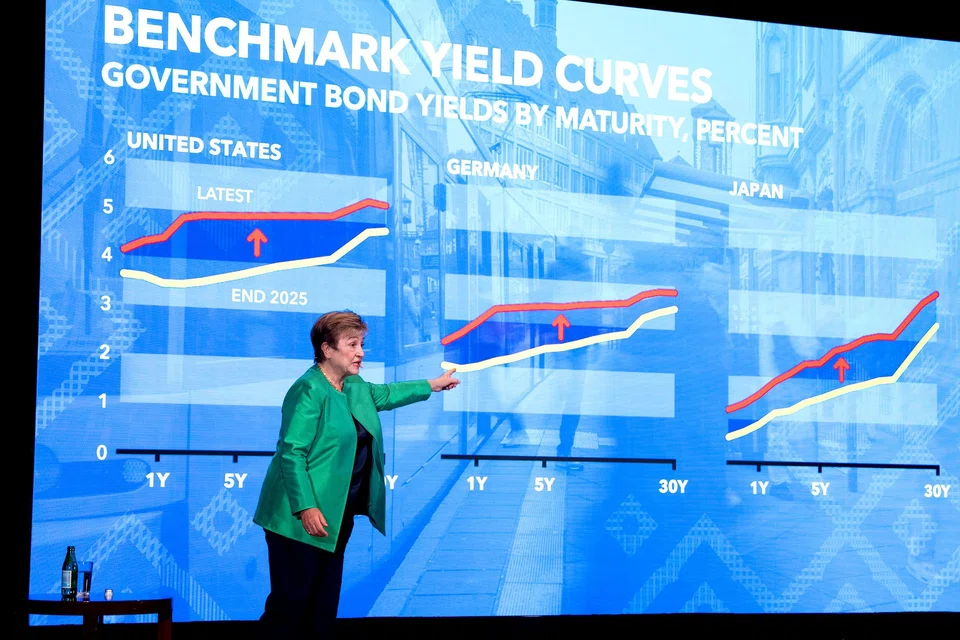
Georgieva highlighted that current economic turmoil is being triggered by factors including spiralling total global debt, which has now surpassed US$365 trillion, according to the Institute of International Finance; and high energy prices with Brent crude oil futures indicating high oil prices until the end of 2027, following the Iran crisis. Troublingly, US, German and Japanese 10-year sovereign bond yields are at their highest levels since 2007, 2009 and 1996, respectively, and are still rising.
Georgieva’s remarks point to a clear deterioration in assessments of the global economy since the last half-yearly update. While headline growth has held steady, the averages hide variations between nations.
The global economy is being pulled in two opposite directions: parts of North America and Asia benefit from an artificial intelligence investment boom, while war-torn nations and energy-importing developing states bear the brunt of negative supply shocks.
Rather than a uniform downturn, policymakers face a multi-speed “polycrisis” – an era of overlapping, interconnected disruptions where a permanent sense of crisis affects nations differently based on their fiscal space, energy reliance and position in tech value chains.
AI is one of the few remaining bright spots, with the potential to lift global growth by as much as half a percentage point a year – roughly equivalent to adding “an economy the size of Asean to the world economy” over a decade – “if done right”, said Georgieva.
However, even the AI boom carries risks, including elevated stock market prices, which are vulnerable to a correction.
She warned: “Should earnings fall flat, hyperscaler leverage and large and growing global holdings of US equities could turn a disappointment into a far-reaching shock.”
Thailand: a microcosm of wider change
Thailand now becomes only the third country besides the United States – after Japan and Turkey – to host the IMF-World Bank Annual Meetings twice (1991 saw the last gathering in Bangkok).
The upcoming event, with more than 15,000 delegates from 191 countries expected to attend, reflects not only Bangkok’s emerging role as an international convening hub, but also Asean’s growing importance in the global economy.
Notably, both 1991 and 2026 were defined by major flux, including conflict in the Middle East. In 1991, a US-led coalition from around 34 nations fought against Iraq, which had invaded Kuwait in 1990.
Yet, the panoramas of then and now have key differences, too. Three-and-a-half decades ago, international relations were characterised by the decline of the Soviet Union. This ultimately dissolved into sovereign republics, including Russia.
Today, rising powers such as China and India appear preponderant.
Indeed, the Asia-Pacific’s rise is perhaps the biggest overall global game changer since 1991. The region’s share of the global economy has risen from some 25 per cent in 1991 to around 43 per cent today.
Thailand, Asean’s second-largest economy, is a microcosm of this wider change story. Gross domestic product per capita has more than doubled; significant strides have been made towards combatting poverty at the lower-middle-income levels; around 11 million formal jobs have been created, alongside numerous informal ones.
With the nation aiming to become a high-income country by 2037, the coming week presents a major opportunity for Thai leaders to engage global investors, including around key themes such as connectivity, advanced manufacturing, clean energy and digital technology.
Urgent action needed amid profound change
Yet, Thailand’s growth momentum has slowed in recent years, following the Covid-19 pandemic and Iran crisis.
As Georgieva warned, the succession of recent shocks has ballooned public debt, and inflationary pressures remain high in many countries.
The overall theme of the IMF curtain-raiser comments is clear: The global economy needs a fundamental structural reset.
Because borrowing costs now exceed economic growth rates in many countries, relying on economic growth alone to erase accumulated debt is a risky policy miscalculation.
Instead, authorities should execute medium-term fiscal consolidation, complementing this with structural reforms.
With the days of cheap money and fast growth to keep debts in check now gone, the IMF chief said “very tough political choices are staring us in the face”. She urged policymakers to explain the necessity of fiscal consolidation to their people: “Take some pain today for growth tomorrow.”
The key priorities she outlined include rebuilding fiscal buffers, maintaining monetary policy with a prudently hawkish bias, and pursuing structural reforms such as slashing red tape, enhancing workforce skills and fostering labour market flexibility – to enable entrepreneurship and reap long-term productivity gains from AI.
When Thailand last hosted the IMF-World Bank meetings in 1991, policymakers largely met the demands of that moment. Despite challenges such as the 1997 to 1998 Asian financial crisis, 1990s growth was fuelled by an extension and intensification of globalisation. Deliberate policy choices, market integration, and falling transport and communication costs drove this.
Although progress was uneven, rapid expansion lifted hundreds of millions of people across India and China out of poverty, achieving what the World Bank described as the “profoundest reshuffle of individual incomes on the global scale since the Industrial Revolution”.
Fast-forward to today, however, and it is unclear whether the latest generation of public officials will now step up to the plate with similar successes.
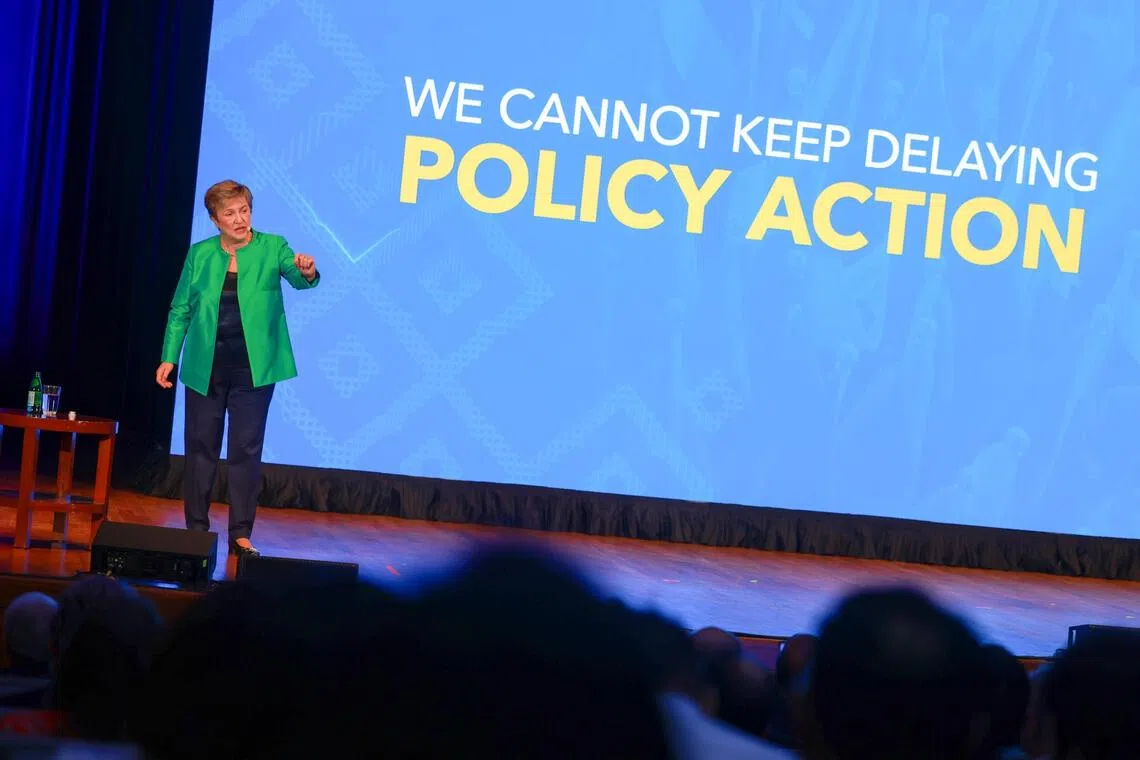
In Georgieva’s words on Wednesday: “We cannot keep delaying necessary policy action – you have the tools, now have the wisdom to use them.”
Indeed, now is time to walk the walk, not just talk the talk, to try to secure the possibility of a new generation of resilient, sustainable growth amid the many challenges of the moment.
The writer is an associate at LSE IDEAS at the London School of Economics
TRENDING NOW

DBS, OCBC, UOB rout lops billions off STI as inflation, rate concerns spook investors

Grab CEO’s wife Chloe Tong on life with Anthony Tan and finding her purpose

OCBC sheds S$8 billion in value as shares close nearly 6% down; analysts cautious on banks

Deal between tycoon friends sparks scrutiny of Philippine power sector

