Tesla’s flying Roadster with cold rockets is mostly hot air
The US automaker should dial down on the stunts and focus on its fundamentals

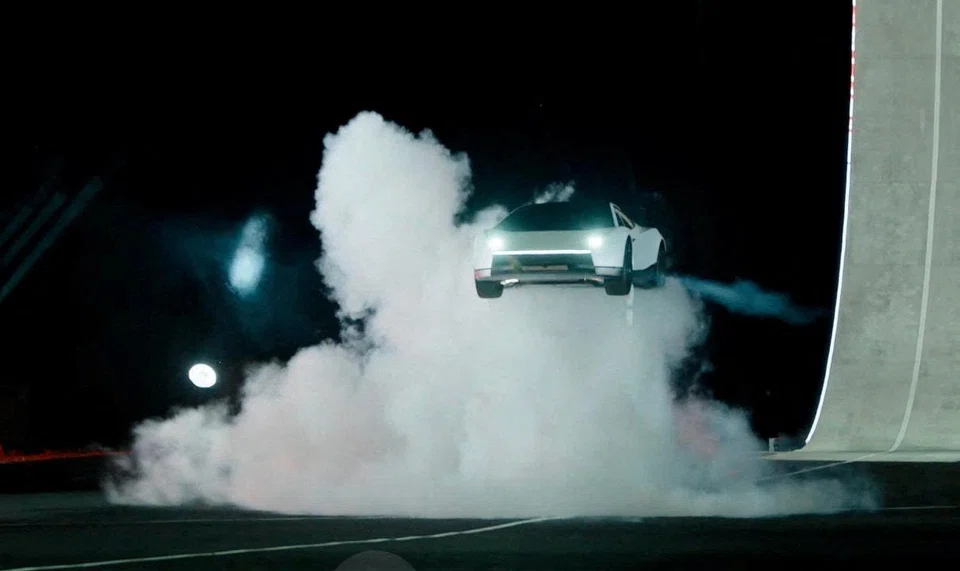
[SINGAPORE] On Oct 15, Tesla displayed the long-delayed second-generation of its Roadster sports car. Fitted with rockets – cold gas thrusters (CGTs) – the machine climbed an inverted ramp, did a flip and landed intact.
At the launch, CEO Elon Musk declared: “Flying cars are real. It’s got altitude controls, thrusters and main thrusters in the rear. So it can basically fly like a rocket.”
It’s just the type of stunt aimed at drawing funding, but the Roadster’s commercial viability is far from certain.
It also shows Tesla continues to ignore the fundamentals of its car business.
I believe I can fly
Slated to begin production in 2028, the Roadster comes in three models: two with CGTs to boost performance and one named Rocket, with a “full flight system”.
CGTs generate thrust via pressurised gas bursts instead of combustion, as in chemical rockets. In spacecraft, CGTs enable precision manoeuvring.
While no burning is involved, CGTs on a car are not a good idea.
Tesla claims the Roadster’s pressure container can hold compressed gas at 10,000 pounds per square inch. This is extremely high pressure and would be a significant risk in a car crash.
Even if Tesla addresses this risk via engineering, other issues render it a real hazard.
Musk acknowledges the Rocket version is not likely to be road legal. But it is unlikely to be safe anywhere.
Forceful blasts from the CGTs can turn road debris, such as pebbles, into dangerous projectiles.
Consider the impact on the driver too, given its acceleration at dangerous levels – zero to 60 miles per hour (97 kmh) in less than 0.6 seconds – which generates about 5 g of gravitational force and can cause loss of consciousness.
I doubt even the most adventurous racetrack owner will allow a car that can fly over barriers and into neighbouring jurisdictions.
Still, Musk may be targeting a specific audience: “If safety is your top priority, don’t buy the Roadster.”
Space oddity
The non-rocket Roadster may not hit the streets as quickly as planned, if Tesla’s recent history is anything to go by.
The brand’s last new product, the Cybertruck, which finally entered production in 2023 after years of delay, has been a commercial failure, facing multiple safety investigations and recalls.
The second-generation Roadster announced in 2017 has since missed every targeted delivery date.
Market analysts said the Roadster will not affect earnings much. Musk himself called it a “small potato” for Tesla, which has been pivoting towards robotics and autonomous vehicles – a move that has so far met regulatory hurdles and limited success.
As analysts suggest, the play here with rockets is SpaceX. The Roadster launch has fuelled talks of a merger between Musk’s two companies, though such a move is likely years away.
For now, Tesla’s main revenue driver remains cars – which account for more than 70 per cent of its US$95 billion revenue in 2025.
But its model range has shrunk over the years and competition from players such as Geely and BYD has grown.
Sales in Tesla’s largest market, China, are sliding – falling almost 12 per cent in the first nine months of 2026 from 2025, based on China Passenger Car Association data.
The balance sheet may be more telling than the publicity stunts. Surely Tesla should accelerate its EV research rather than take off on flights of fancy.