

UK-China reset part of wider Western wooing of Beijing
Another US ally courts China as a hedge against unpredictable ties with Trump
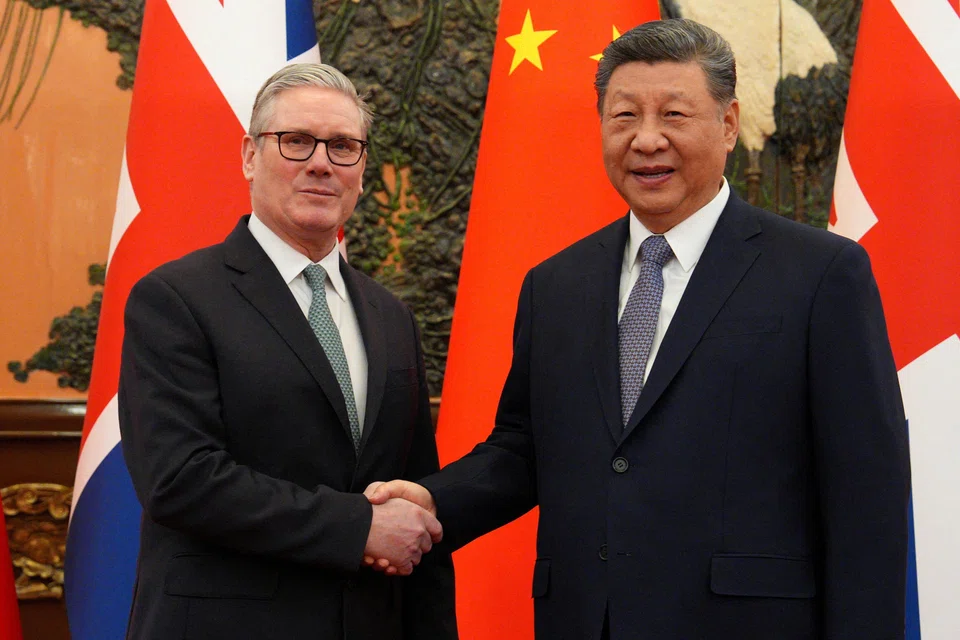
KEIR Starmer last week became the first UK prime minister to visit China in eight years. Yet, he is only the latest Western politician to double down on diplomacy with Beijing.
Leaders, ranging from Canadian Prime Minister Mark Carney who visited China last month, to German Chancellor Friedrich Merz who is expected to visit in late February, have a broadly common agenda: seeking to hedge against the unpredictability of US policy under President Donald Trump.
A similar political phenomenon occurred during the last Trump administration from 2017 to 2021. The EU concluded the long-stalled Comprehensive Agreement on Investment in 2020 to enhance bilateral market access. However, ratification was frozen in Brussels during the Biden administration.
Since Trump’s re-election, a flurry of Western leaders have again sought a reset with China. Most recently, Starmer called for a “more sophisticated” relationship to provide stability after the diplomatic rollercoaster of the last decade and a half.
Bringing greater stability to UK-China ties
Starmer said that UK-China relations had gone from “the golden age to the ice age”, referring first to warm ties during the government of David Cameron and the subsequent cooling in the post-Brexit period under prime ministers Boris Johnson, Liz Truss and Rishi Sunak.
It is not just Starmer, but also Chinese President Xi Jinping who voices the need for greater equilibrium in ties. Xi noted last week that “the UK and China need a long-term, consistent and comprehensive strategic partnership” to move beyond “twists and turns”.
Despite this apparent meeting of minds, the trip has been widely criticised in the UK, and also by Trump. The latter called Starmer’s visit “dangerous”, even though Trump himself is also planning an April visit to China.
Within the UK, Starmer has been slammed by the political right and left. Reform UK leader Nigel Farage, a Trump ally, declared himself “very nervous” about the UK’s moving towards Beijing. Meanwhile, Conservative leader Kemi Badenoch criticised Starmer for moving ahead with a trip “not in the national interest”. Criticism also came from the Liberal Democrats; deputy leader Daisy Cooper said Starmer went “cap in hand” to China, while China continues waging its “campaign of espionage”.
While these critics come with different viewpoints, they purported to disagree with the government’s decision to grant China permission for a “super-embassy” in London. They also perceived that Starmer won too few concessions from Beijing.

Perhaps the key prize Starmer secured is a feasibility study for a possible trade in services agreement. This is welcome as the UK had a £10 billion (S$17.4 billion) surplus in services with China last year.
Broader deals include a Scotch whisky tariff reduction worth roughly £250 million over five years; visa-free travel in China for UK citizens (which brings the UK in line with more than 50 other countries); and cooperation on organised crime.
Deepening UK focus on Asia-Pacific trade
Starmer’s policy largely represents a continuation of policy started by prior governments. Especially post-Brexit, the UK has actively re-oriented itself to the Asia-Pacific, with Starmer having visited Japan, India and Samoa so far.
There now appears an intensification of these efforts. Structural factors, such as the nation’s new National Security Strategy released last autumn, are contributing to this drive.
Over the next five years, the overall global economy is forecast to increase by around £30 trillion, according to the UK Parliament. A huge chunk of that growth will come from Asia, a prize that far exceeds the UK’s total gross domestic product of around £2.56 trillion in 2024.
The Asia-Pacific is thus a key strategic priority for the UK government. In a world of growing protectionism, London must diversify its trade and investment markets towards the region, including Asean – an economy set to be the fourth largest in the world by 2030.
While the UK has reached deals with countries like India, the anchor is the Comprehensive and Progressive TransPacific Partnership which includes Australia, Brunei, Japan, Malaysia, New Zealand, Singapore and Vietnam. Since leaving the EU, the UK has made significant diplomatic progress in the Asia-Pacific, with trade agreements now covering around 65 per cent of gross domestic product in the region.
While the share of UK goods exports to Asia has doubled between 2000 and 2022, it has mainly been due to the growth of China. Excluding China, goods exports only increased from 9 per cent to 12 per cent, while services exports have actually declined.
So the case for diversification is clear, but high tariffs and wider regulatory barriers remain a challenge. For instance, tariffs on UK automotive exports can reach up to 80 per cent in Thailand, and 50 per cent in Indonesia. Starmer has yet to visit Asean, but the region is a top target, as exemplified by Deputy Prime Minister David Lammy’s trip to Malaysia and Singapore in July 2025.
The Starmer team is only likely to deepen and broaden the UK’s focus on Asia. While his China policy is attacked both domestically and by Trump, it broadly continues a trajectory essential for navigating the changing world order.
The writer is an associate at LSE IDEAs at the London School of Economics
Decoding Asia newsletter: your guide to navigating Asia in a new global order. Sign up here to get Decoding Asia newsletter. Delivered to your inbox. Free.
Share with us your feedback on BT's products and services
TRENDING NOW

Once staunchly pro-China, Malaysian Chinese businesses are now distancing themselves from Beijing

Stocks to watch: HPL, Aims Apac Reit, Zico, Advanced Systems Automation, ComfortDelGro
‘How many will survive?’: Bubble fears arise as China’s humanoid robotics face reality check

Smaller board lots can’t fix a market run by three banks

