

To understand China’s growing confidence, look at the ‘Summer Davos’
At the WEF summit, Beijing rebuts critics as it enters a new era of prominence on the global stage
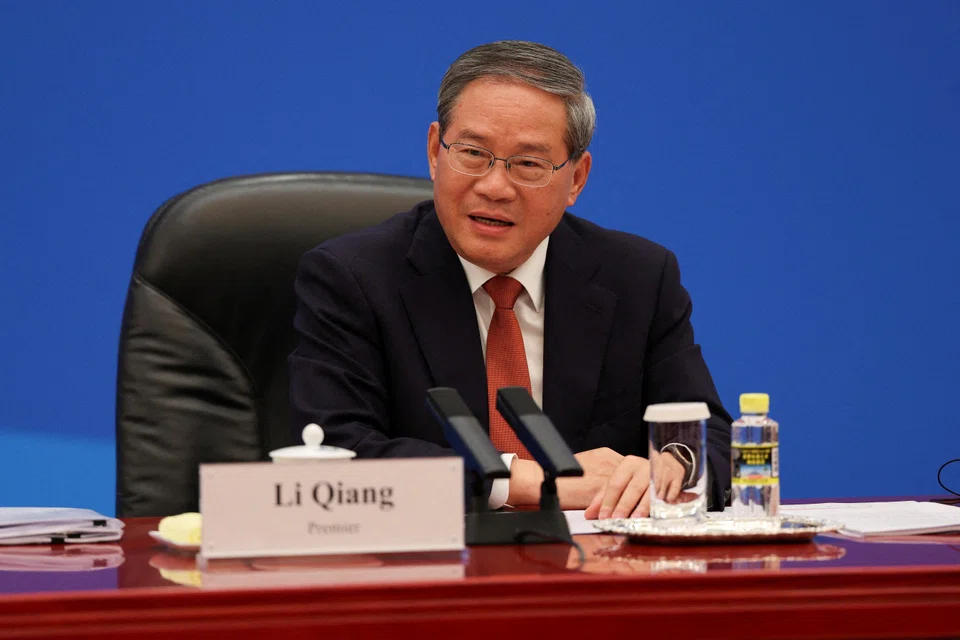
THE dominant perception of the annual summit hosted by the World Economic Forum (WEF) has long been that of the snowy landscape of Davos, Switzerland, where it is held.
However, its counterpart, the so-called “Summer Davos” organised in China, has been perhaps the most important one yet.
The conference’s coming of age was exemplified by a hard-hitting keynote speech by Chinese Premier Li Qiang on Wednesday (Jun 24).
He challenged concerns over the nation’s record-high trade surplus of US$1.2 trillion in 2025, which, to critics, represents “China Shock 2.0”: a phenomenon in which China’s exports overwhelm other countries’ domestic industries.
Instead, Li argued that the rest of the world should understand it as “China Opportunity 2.0”.
In a robust defence of the nation’s policies, he said that Chinese technological advancements in areas from electric vehicles to artificial intelligence are behind Beijing’s trade figures, and they benefit the rest of the world.
Correspondingly, he questioned the view – most recently articulated in a June 2026 report by the Organisation for Economic Co-operation and Development – that state subsidies are a key driver of those imbalances.
It is significant that his speech took place at the Summer Davos. Previously, China’s boldest interventions at the WEF have tended to happen at the Swiss event in January.
The most striking example was when Chinese President Xi Jinping gave the Davos keynote in January 2017, in which he extolled the virtues of economic globalisation, just as US President Donald Trump entered the White House for his first term.
Making a stand at the Summer Davos as well is suggestive of China’s growing confidence on the world stage.
It is also no coincidence that the nation’s message in Dalian was similar to that of Xi in 2017: In a fragmenting and volatile world order, China – with its economic strength – can be a “safe haven”, in the words of Li.
One manifestation of this conviction is that Beijing is no longer beseeching others to believe in its potential. It is asking foreign businesses and governments to adapt to a reality in which China is a technologically advanced and manufacturing superpower.
The rise of “New Champions”
Aside from the location, the main difference between the Swiss and Chinese WEF forums lies in each event’s focus.
While the January forum in Europe concerns itself with the next 12 months, the June event, which alternates between the Chinese cities of Dalian and Tianjin, takes a longer-term view of the decade ahead.
Issues that were addressed at the 2026 Summer Davos included ways of building prosperity amid shifting geoeconomics and industrial realities; how to harness technology to unlock opportunities in industries and economies; and the creation of jobs for the next generation amid disruption.
However, the topic that attracted the most attention was the way to understand the next phase of China’s trajectory.
Geopolitically speaking, the nation appears to be entering a new era of prominence on the global stage.
This period is marked by the start of Trump’s second presidency in 2025, which has caused a decline in international favourability towards the US, a Pew Research Center survey showed.
A 2026 research article from the Asia Society Policy Institute found that between 2013 and 2025, the world was increasingly convening in China to see Xi.
Moreover, the Chinese president has made significantly fewer foreign visits than before the pandemic, reflecting the nation’s growing importance to the international community.
A divergence also exists with other countries’ state visits to the US. In 2025, 75 foreign heads of state and governments visited Beijing, higher than the 50 who went to Washington. That is a trend that stretches back to 2023, when China fully lifted its pandemic restrictions.
Economically, China is also beginning a new chapter with its 15th Five-Year Plan that was released in March 2026. The plan emphasises “substantial improvements in scientific and technological self-reliance… (and) the development of new quality productive forces”.
The reference to “new quality productive forces” refers to the need for more home-grown and advanced tech in China, building on the successes of domestic companies such as Alibaba and e-commerce platform PDD, which are already earning a considerable share of their revenue abroad.
These companies are examples of what the Summer Davos terms “the New Champions” – businesses and leaders from emerging and middle-income markets, helping to reshape the future of geoeconomics.
The Swiss Davos may remain the WEF’s flagship event. However, its summer sibling is becoming more consequential in stature and agenda-setting power; a transformation that coincides with growing Chinese confidence on the world stage.
The writer is an associate at LSE IDEAS at the London School of Economics
TRENDING NOW

Britain’s mansion tax shows the difficulty of targeting wealth

Once staunchly pro-China, Malaysian Chinese businesses are now distancing themselves from Beijing

The only common thing in S-E Asia is that we all eat rice: Cisco’s Asean president
Singapore data centre operator DayOne opts for US IPO at likely US$20 billion valuation

