

US intervention of the yen revives currency diplomacy as a geoeconomic tool
Washington’s move is not a purely economic one
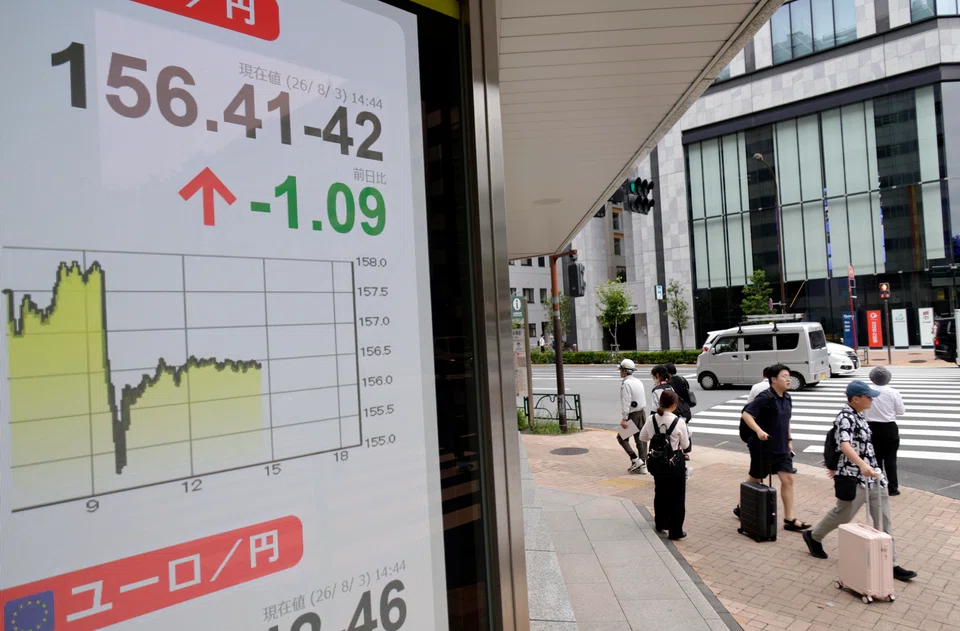
ON JUL 31, 2026, the US did something it had not done in more than two decades: It intervened directly in foreign exchange markets to prop up another country’s currency.
The US Treasury, acting through the Federal Reserve Bank of New York, sold euros from its reserves and used the proceeds to buy Japanese yen, joining a Bank of Japan (BOJ) operation that may have deployed US$53 billion.
It was the first joint US-Japan yen-buying intervention since 1998, and the first time that Washington backed the yen specifically since the Asian financial crisis.
The trigger was a currency in genuine distress. In late July, the yen had slid to almost 164 per dollar, a nominal 40-year low, and, in inflation-adjusted terms, a level not seen since the 1960s.
US President Donald Trump characterised the move in personal terms, framing it as a favour between allies.
Treasury Secretary Scott Bessent gave it a more structural justification: a “substantial undervaluation” of the yen that risked destabilising markets well beyond Japan.
Both framings are true, and both understate what is actually going on. This was not simply an act of alliance management. It was a case study in how currency policy has become a geopolitical instrument, and an indicator of great-power economic strategy.
The financial logic
A weak yen does not stay a Japanese problem. Because Japan competes directly with South Korea, Taiwan and China across autos, electronics, machinery and semiconductors, a sharply undervalued yen pressures its neighbours to either accept lost competitiveness or devalue their currency in response.
Bessent made this explicit, warning that continued yen weakness could push other Asian currencies into a competitive spiral, and could complicate Beijing’s management of the renminbi.
Analysts have already flagged the risk of a broader “Asian currency war” reminiscent of the dynamics that preceded the Asian financial crisis. Intervening in the yen was as much about containing regional spillovers as about Japan itself.
Others would argue that the joint operation may be less about the yen than about US Treasury bonds. If the BOJ sells its holding of Treasuries to finance yen purchases, that could drive up Treasury yields, or the interest that the US has to pay on its debt.
Interestingly enough, rather than selling dollars directly, the Treasury reportedly sold euros from reserves to buy yen, showing it could mobilise a multicurrency toolkit, not just its own currency, to shape an ally’s exchange rate.
This surprised markets and drew Bessent to reassure European counterparts that it was a reserve reallocation, not a signal about the euro itself. Indeed, Washington could have been trying to avoid weakening the greenback against other currencies.
Markets have been sceptical that intervention alone solves anything. The yen rallied sharply after the move, briefly surging 5 per cent before paring gains. This suggests that the currency’s underlying weakness is structural: The BOJ’s real policy rate remains negative.
Bessent himself conceded that the move can give the market signals, but that “it’s policy that turns it” – an acknowledgment that without further BOJ rate hikes, the Jul 31 operation buys time rather than reverse a trend.
The geoeconomic impulse
Currency intervention on behalf of another sovereign state is rare and costly. By throwing its weight behind the yen, Washington sent a message to Tokyo, to the region and to Beijing simultaneously: The US-Japan alliance extends into monetary policy, not just security guarantees.
Framed by Trump as being “always there for Japan”, the forex operation functions as a tangible, market-visible act of reassurance in an era when allies increasingly question the durability of US commitments.
Then there is the strategic value to Washington: Intervention lets the US position itself as the guarantor of regional financial stability, competing directly with the economic weight that China has been building through the renminbi’s internationalisation.
A stable, US-backed yen is also a stable anchor for a dollar-centred Indo-Pacific financial order, one that Washington has every strategic interest in preserving, as China works to offer alternatives.
And let’s not forget the message to Beijing. The intervention was announced days after friction over Middle East diplomacy and amid broader US-China trade tensions.
A firmer yen relieves some of the pressure that would otherwise push Beijing towards renminbi depreciation to stay competitive.
But a weaker renminbi undercuts US trade-rebalancing goals and could reignite accusations of Chinese currency manipulation. In this sense, defending the yen is also an indirect tool for managing the US-China currency relationship without confronting Beijing directly.
But by showing that it will intervene to support an ally’s currency, the US invites the question of who else might expect similar treatment, and under what conditions.
South Korea, another US treaty ally facing currency volatility, is an obvious candidate for comparison.
Hence, this precedent could complicate future currency diplomacy: Allies may now factor in an implicit US backstop when managing their own monetary policy, potentially reducing the domestic political cost of delaying necessary but painful adjustments.
That is the classic moral-hazard critique of any bailout intervention, applied here to exchange rates rather than debt.

A signal, not a solution
The Jul 31 intervention was small, relative to daily yen turnover, and by itself it will not resolve the structural gap between Japanese and US interest rates that has driven the yen’s decline.
What it does is more interesting than what it accomplishes: It reveals how currency policy has become an explicit instrument of alliance management and great-power competition.
The US used its position at the centre of the global financial system to stabilise a partner, discipline a source of regional contagion and quietly respond to Chinese economic influence, all through a tool that had been essentially dormant since the late 1990s.
The durability of the effect depends on Tokyo, not Washington. If the BOJ follows through with credible rate hikes, the intervention will be remembered as the moment the policy floor was reset.
If it does not, this episode may instead illustrate the limits of financial statecraft: Even the world’s reserve-currency issuer cannot substitute market signalling for the underlying policy adjustments that actually move exchange rates.






