

What Qantas’ Project Sunrise really means for Singapore
Direct Sydney-London flights will bypass Changi Airport, yet Singapore can retain its competitive edge
FOR nearly a century, to travel between Australia and Europe, you had to stop somewhere, and Singapore’s Changi Airport was the most efficient place to do it.
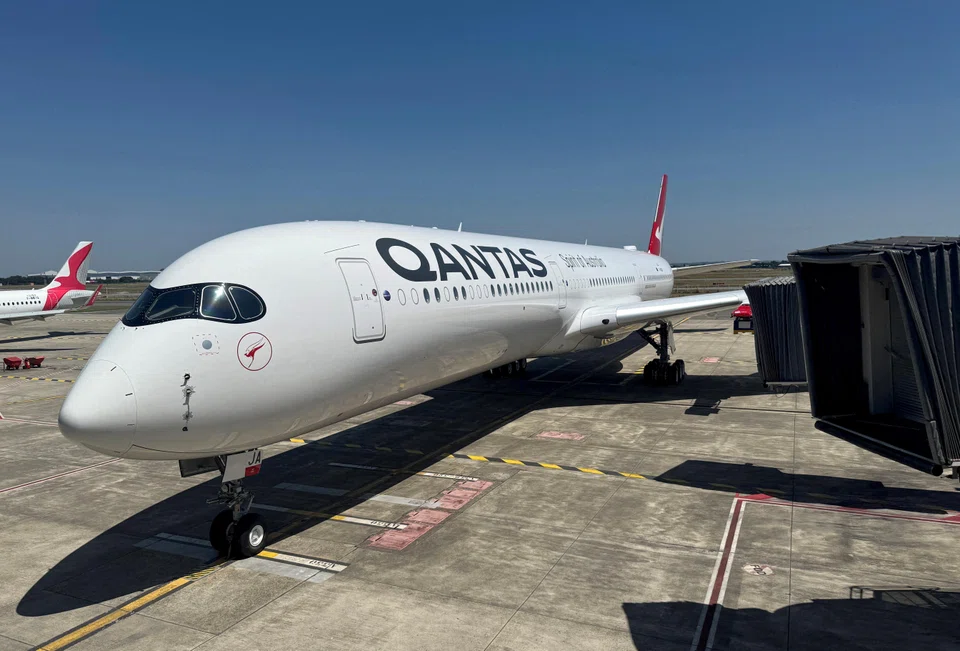
On Jun 17, Qantas set out to erase that fact. From October 2027, it will fly Sydney to London non-stop – the world’s longest scheduled flight, taking up to 22 hours – aboard a specially modified Airbus A350-1000ULR.
Tickets go on sale in February 2027. Sydney-New York follows.
The instinct in Singapore will be to ask how badly this wounds Singapore Airlines (SIA), the carrier that today operates more flights to Australia than to any other country and anchors the modern Kangaroo Route through Changi.
The honest answer: less than the headlines suggest, but in precisely the place that matters most.
Start with what Qantas is actually putting in the air. Project Sunrise launches as a single daily Sydney-London rotation: 238 seats, of which only about 98 are premium – six first-class, 52 business and 40 premium economy – and 140 economy.
That is not a capacity assault on a market served by more than 25 carriers operating one-stop. It is a rifle aimed at the very top of the fare ladder.
Qantas has been explicit that it will not fight on price; roughly 70 per cent of its international customers are premium-leisure travellers who pay for time. The up-to-four hours saved over a one-stop via Singapore – and the removal of the connection entirely – is the whole pitch.
That pitch lands the hardest on exactly SIA’s best traffic. The Sydney-origin executive who today chooses SIA because Changi is the quickest, most reliable one-stop is the same passenger Qantas now courts directly.
This is the cream of the crop: the highest-yield, most schedule-sensitive premium cell. Qantas will take a meaningful share of it, and to pretend otherwise would be complacent.
But three structural facts contain the damage, and Singapore should hold them clearly in view.
First, this is a Sydney story before it is an Australia story. Melbourne – the other large east-coast premium pool – has no committed date, and Brisbane, Adelaide and Perth are not covered. Every one of those origins still needs a hub, and Changi remains the best one.
Second, and more important, Project Sunrise is London-only. It is a point-to-point product to a single airport. Singapore’s advantage was never one city pair; it was the network.
The traveller bound for Frankfurt, Zurich, Paris, Milan or Manchester – or onward to Africa and the Gulf – is untouched. Qantas can sell “non-stop to London”. SIA sells “Australia to all of Europe, on your schedule”.
Third, the fleet is the ceiling. Twelve aircraft must stretch across Sydney-London, Sydney-New York and, eventually, Melbourne.
That math implies a single daily frequency per route for some time. One departure cannot serve every itinerary; schedule-flexible demand spills back to carriers with depth.
The line between a margin dent and a structural loss for SIA is not whether Melbourne launches – it is whether Qantas ever reaches double-daily frequency.
Until then, this is unbundling, not conquest: Qantas peels off the one city pair where non-stop flights now work and leaves SIA the connecting network it was always better equipped to serve.
There is a deeper current here that should reassure Singapore more than worry it. Qantas’ bet is not against any single conflict; it is on the structural direction of global airspace.
The past decade has moved aviation from an era of discrete, recoverable shocks to one of durable constraints – Russian airspace closed indefinitely, GPS interference, drone harassment at airports, hubs sitting near risk zones.
A one-stop routing exposes a journey to two flight segments plus a hub, each a place the trip can fail. Removing the midpoint reduces those dependencies, and the premium traveller’s willingness to pay for fewer of them rises as the skies grow more contested.
That logic favours Qantas on Sydney-London. But it favours Changi almost everywhere else ultra-long-haul flights are not yet possible.
Singapore’s value to the global network is not that it is a convenient place to break a journey to London; it is that it is the most reliable, best-connected, multi-directional hub in the Eastern Hemisphere – to a hundred destinations, not one.
In a fragile-airspace world, a dependable hub with optionality is an asset, not a liability.
The threat is therefore confined to the narrow set of journeys where non-stop has finally become possible.
So the strategic response writes itself, and SIA is already drafting it. The carrier is midway through a S$1.1 billion cabin retrofit, and will ultimately roll out a new business class and add first class to its A350-900ULR ultra-long-range fleet for the first time.
The right move is not to chase Qantas seat for seat on a route geography cannot win, but to widen the gap where Singapore is unmatched: frequency, network breadth, product consistency and the Changi experience.
Reframe the contest from “who flies farthest” to “who takes you anywhere, best, and most often”.
Qantas has done something genuinely impressive, and Singapore should resist both panic and dismissal. The tyranny of distance has not been beaten; it has been priced – and only on the routes where the geography allows.
For Singapore, the lesson is the one that built it: the value of a great hub was never the stop itself. It was everywhere the stop could take you.
The writer is founder of BAA & Partners






