

When AI gets full marks, what is an exam worth?
A cheating scandal in Korea raises hard questions about testing and licensing
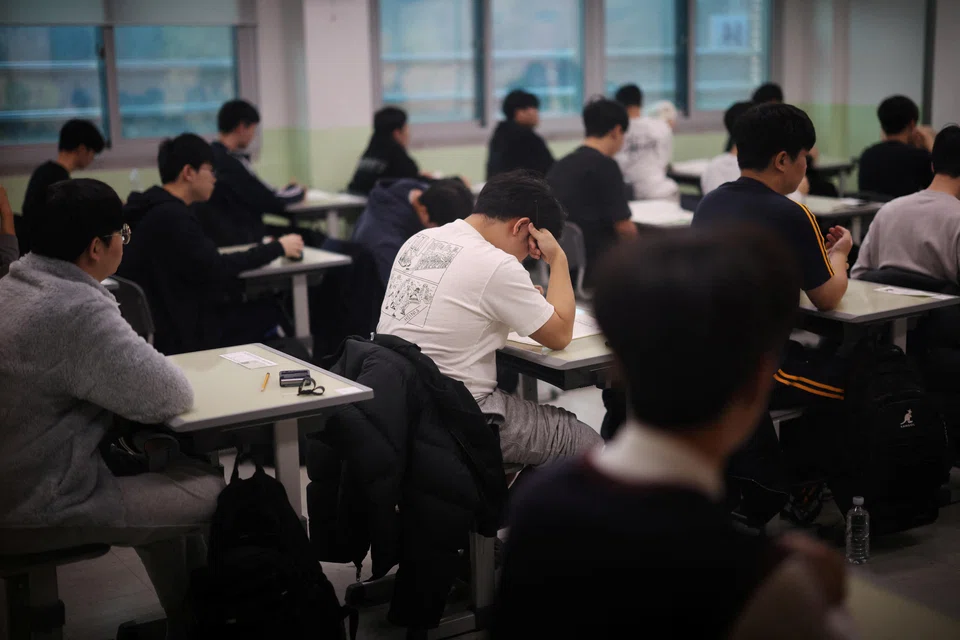
[SEOUL] Two proctors, 20 seats. No video surveillance. Phones switched off in bags, not collected. Sitting for South Korea’s certified tax accountancy exam, Han Won-seok, 34, photographed his question paper with a hidden miniature camera.
The images went to a generative artificial intelligence tool; the answers came back on his smartphone. Han scored 397.5 out of 400, with full marks in tax law, a paper where three candidates in four fell below the cut-off. The previous two top scores were 342.5 and 327.5.
As Han also aced the exam’s other round, with 663 out of 800 marks, he was announced overall top scorer on Oct 28. The proctors did not catch Han. His score did. On Sunday, Nov 15, via his lawyer’s YouTube channel, a masked Han confessed to cheating.
“If they hadn’t scored so unusually high, wouldn’t it have just been buried?” asked Jang Dong-hyuk, leader of the People Power Party, who called for urgent countermeasures ahead of South Korea’s annual college exam on Nov 19.
Korea spent much of last week on camera and device checks, the least interesting part. The big exam on Nov 19 drew 8,400 extra supervisors. Emergency alerts exposed 49 candidates with undeclared phones; in Yongin, one candidate was ejected for a concealed camera, earphones and a tablet.
Given the same papers, OpenAI’s and Google’s latest models answered every question correctly, spanning Korean, maths and English.
Licensing exams still reward producing correct answers; AI models produce them all – in minutes.
The doubt did not stop at Han. Lee Jin-woo rose from the bottom of Korea’s nine-grade scale in 2013 into Seoul National University’s dentistry programme, and achieved a perfect law-school entrance score in 2026.
Suspected of using AI, which he denied, Lee promised to solve the Nov 19 Korean paper on a YouTube livestream. Lee never showed up. That afternoon, Seoul police found him unresponsive in a motel and later confirmed his death. Investigations are under way.
The only alarm that rang in this unfolding scandal was experts reading a scoreboard, and scores can be managed.
At 2.5 points a question, the next cheater could miss 24 on purpose and finish on 340, within the range of the last two top scores. Since Han’s revelation, Seoul has ordered a re-check of three to five years of scores. Would investigators find the student who missed 24? They would have nothing to confess.
So what is left for the human?
We never trusted lawyers, accountants or judges just for being right. We trusted them for being answerable. A professional can be sued, sanctioned, struck off; an AI model cannot, even as it surpasses humans on recall.
In 2023, OpenAI’s GPT-4 scored 297 on a simulated US bar exam, above every uniform bar exam jurisdiction’s pass mark. As a Sungshin Women’s University professor noted, tax work now centres on verification and accountability.
That was always the core of professional judgment: deciding which interpretation of tax law a client can live with, weighing legal risk and knowing when to tell a founder to walk away.
Even predictive judgment is being tested: in an Oxford-Vela benchmark of 9,000 anonymised founder profiles, leading AI models picked startup winners better than Y Combinator and top-tier venture firms.
A benchmark is not a 10-year return, of course, and picking winners from historical data is not the same as bearing legal responsibility for advice, but it moves the question.
Across professional services, a new human-AI division of labour is taking shape: the machine drafts and ranks; the human finds the error and puts a name to what survives. The accountant signs the model’s memo; the partner backs the company it ranked last and answers for it.
Exams tested statute because statute was easier to grade than judgment. Nobody yet knows the right exam for what’s next.
One possibility: keep a shorter closed-book paper under stricter physical controls as a floor, since nobody spots a machine’s error in unfamiliar law, then allow AI.
Hand each candidate an AI-drafted tax memo with a planted flaw; they defend the correction, as at a doctoral oral defence, before two practitioner-examiners who push back. The candidate is graded on knowing when to overrule AI.
Critics will say this cannot scale to tens of thousands or will invite subjective grading. The onus on institutions is to find a way.
McKinsey already deploys tens of thousands of AI agents beside its consultants, and its interviews involve candidates using AI tools and client avatars.
Time to rewrite institutions
Most exam halls still ban the machine. Every ban wagers that detection will outrun cheating.
Yet firms hiring on such exams inherit the blind spot. What good is certifying recall for a job that now turns on overruling machines, when what a client pays for is a name that can be held accountable?
Someone will be first to certify the human’s role beside the machine, and it is unlikely to be a large country with the most institutions to protect.
Rewrite the exam and the examiners lose their work; rewrite the curriculum and the schools lose theirs. Every pivot costs someone a livelihood, so institutions defend the question they already know how to ask.
Startups do the opposite: they ship an imperfect plan, learn what breaks, pivot 10 times or a hundred, and build what incumbents could not. AI changes daily. A perfect exam, set once and defended for years, has already failed.
Yet knowing is easier than changing. In August, the Massachusetts Institute of Technology (MIT) AI committee found that machines can produce credible answers to almost any written assignment.
The committee recommended oral exams and portfolios. But it also warned of “cognitive surrender” if students turn to AI instead of working through challenges themselves.
Three weeks later, its co-chairs had no specific proposal for grading. Decisions remained with individual departments and instructors. Even MIT has shown how hard it is to make the decisions that AI now demands of our institutions.
Building models is one race. Rewriting the institutions that certify human ability is another. The second rewards a nimble country that can move like a startup, without compromising public trust.
Singapore’s record points that way: in 1975, it charged drivers to enter its city centre via the Area Licensing Scheme, the world’s first urban traffic congestion charge, 28 years before London. In 2016, it followed Britain’s fintech sandbox within months.
Prime Minister Lawrence Wong puts Singapore’s edge in applying AI, and the city-state anchors its economic strategy on remaining a “trusted hub”.
A hub is trusted only if its credentials are. A licence obtained with a hidden camera certifies little.
Singapore is still calibrating. Since June 2026, Singapore’s chartered-accountant foundation papers have assumed a multiple-choice question format. What a full professional licence should test is harder. Universities, professional bodies and regulators must design and run the new scheme together.
The experiment goes first to whoever can move every institution at once. Will Singapore succeed?
The writer is a former investment banker turned business journalist, writing at the intersection of capital, technology and geopolitics. He used AI for research and polishing the text before submission.
TRENDING NOW

As Indonesia picks new vice-president to succeed Gibran, investors see risks and opportunities

Seatrium to lay off 2% of its Singapore workforce

Singapore telco recovery at least 2 years away despite StarHub-M1 merger, say analysts

Why Singapore, Johor and Riau Islands should build a cross-border ecosystem for AI

