

Apac office demand to withstand AI disruption as growth moderates: CBRE
Occupied office space is projected to expand 13% through to 2030 under a moderate AI-displacement scenario

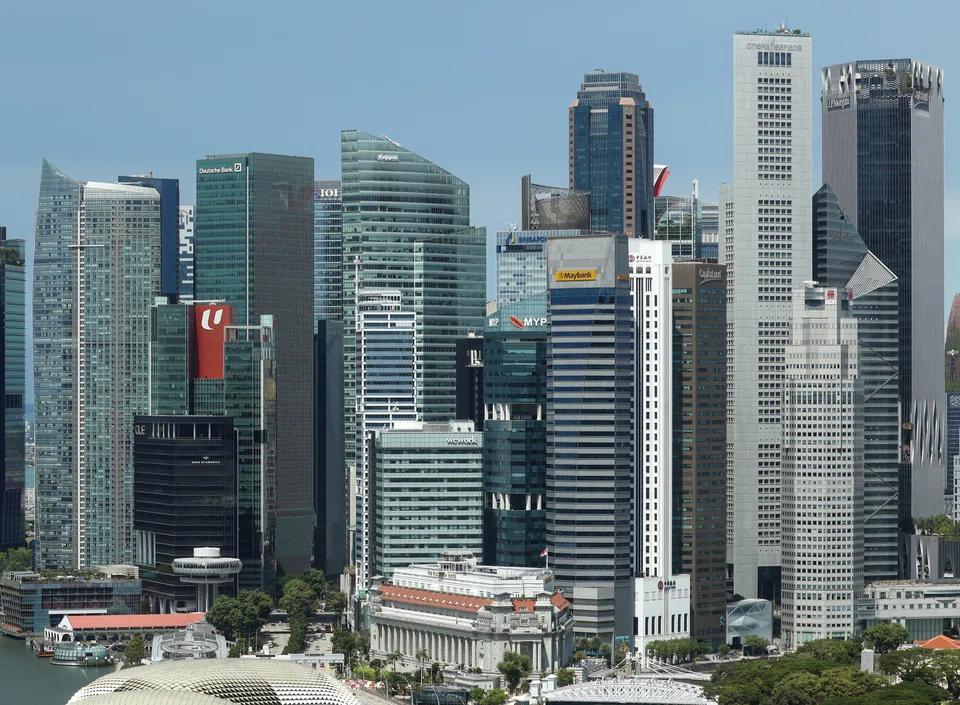
[SINGAPORE] Office demand across the Asia-Pacific is expected to remain resilient despite the growing adoption of artificial intelligence, although the technology could moderate office employment and demand growth through to 2030, said CBRE in its latest research report on Thursday (Oct 15).
Under its moderate AI-driven job displacement scenario, occupied office space in the region is projected to grow 13 per cent between 2026 and 2030. This compares with 18 per cent under the base-case scenario, which assumes no AI-related job displacement.
Meanwhile, office employment is forecast to grow 9 per cent under the moderate scenario between 2026 and 2030, in which vulnerable office jobs are displaced at a moderate pace. Growth is estimated to be 14 per cent in the baseline case.
Even under CBRE’s rapid-displacement scenario, in which organisations aggressively automate routine office functions and a majority of vulnerable positions are displaced, office employment in Apac is projected to expand 2 per cent over the same period.
Under the slow-displacement scenario, growth would come in at 12 per cent.
CBRE estimated that just 1.8 per cent of total employment in Apac is vulnerable to AI, referring to occupations that have high exposure to the technology but low capacity to adapt.
A further 8 per cent of the workforce is considered potentially at risk. These jobs are also highly exposed to AI, but the workers have better scope to adapt through reskilling and occupational mobility.
Developed economies have a higher ratio of vulnerable jobs than emerging Asian markets. This reflects that developed Apac markets have a higher proportion of knowledge and cognitive workers.
Office workers account for more than 35 per cent of employment in Singapore, Hong Kong and Australia, compared with less than 10 per cent in Indonesia and Vietnam, said CBRE.


Still, it expects AI to reshape the region’s labour market by changing the scope of existing jobs and creating new occupations and industries.
Tom Gaffney, CBRE’s Apac head of leasing, said that AI would increasingly take over routine tasks, making collaborative and client-facing work “even more valuable”.
“Around half of occupiers intend to expand their real-estate footprint over the next three years, underscoring the resilience of office demand even as AI reshapes workplace roles and tempers employment growth in some sectors,” he added.
Resilient demand
CBRE expects occupied office space to expand at a slightly faster pace than office employment from 2026 to 2030.
This comes as occupiers rebalance their portfolios amid higher workplace utilisation under stricter return-to-office policies, less aggressive space-efficiency targets and continued confidence in long-term business growth.
The impact on office demand will also vary markedly between developed and developing markets.
In developed Apac markets, occupiers are expected to replenish space after several years of portfolio optimisation during the pandemic, when occupied office space growth lagged office employment growth.
As workplace attendance rises and companies place greater emphasis on employee experience, occupiers are expected to increase space allocation, supporting 5 per cent growth in occupied office space in the five-year period under a moderate AI-displacement scenario.
Office demand in developing markets is supported by structural economic upgrading, including the expansion of tertiary industries and the migration to institutional-grade offices.
These long-term shifts are expected to underpin continued demand, with occupied office space projected to grow 19 per cent through to 2030, even under a moderate AI-displacement scenario.
A shrinking development pipeline is forecast to cushion the effect of slower demand growth on office vacancy rates.
Ada Choi, CBRE’s Apac head of research, said: “Even if AI moderates office demand growth, we do not foresee a major supply-demand imbalance emerging in Apac.
“At the same time, a shrinking development pipeline is expected to help support market balance and relatively stable vacancy levels throughout the remainder of the decade.”
Under the base case, the overall Apac office vacancy rate is projected to ease from 16 per cent in the second quarter of 2026 to 15 per cent by 2030 as occupied-space growth outpaces new supply.
Under the moderate displacement scenario, the overall vacancy rate is projected to rise to 18 per cent by 2030.
Divergence between prime and secondary assets
While AI is unlikely to increase overall vacancy, it could widen the gap between prime and secondary office assets.
CBRE expects demand to become increasingly concentrated in top-quality buildings in core districts that support collaborative and knowledge-intensive work, as shrinking development pipelines keep such space in relatively short supply.
Secondary buildings, meanwhile, could face greater pressure as occupiers place more emphasis on connectivity and building quality.
As a result, CBRE expects this mismatch to accelerate the refurbishment, repositioning and conversion of older office properties, with assets that are no longer economically viable being redeveloped or converted for alternative uses.
Decoding Asia newsletter: your guide to navigating Asia in a new global order. Sign up here to get Decoding Asia newsletter. Delivered to your inbox. Free.
Copyright SPH Media. All rights reserved.
TRENDING NOW

ComfortDelGro appoints two new independent directors

Once staunchly pro-China, Malaysian Chinese businesses are now distancing themselves from Beijing

NoonTalk needs continued financial support from CEO Dasmond Koh, auditors warn

DP Architects sets the benchmark for sustainability disclosure and design

