

Singapore construction demand to stay firm at S$47 billion to S$53 billion in 2026: Chee Hong Tat
Demand is projected to stay elevated from 2027 to 2030 at S$39 billion to S$46 billion per year

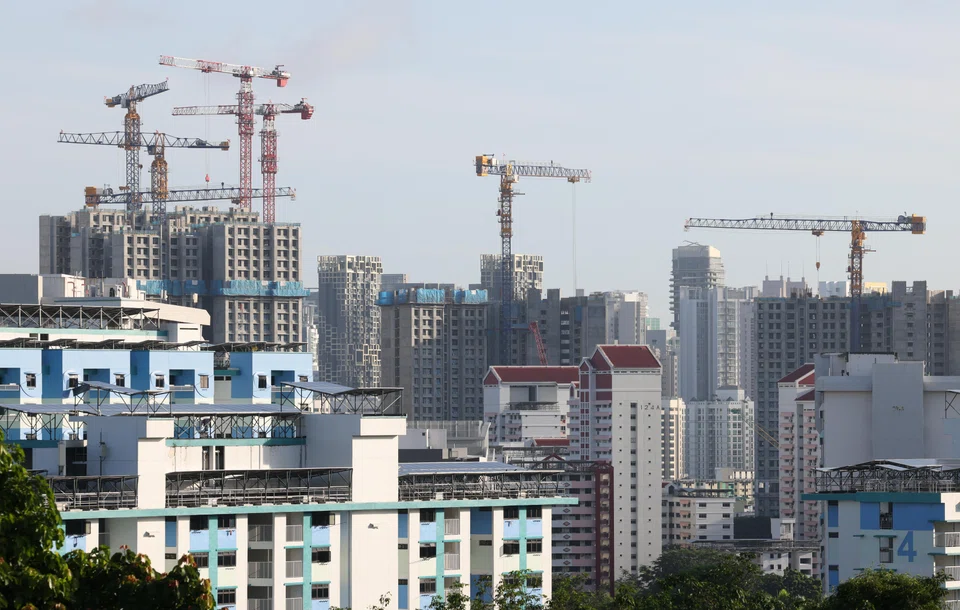
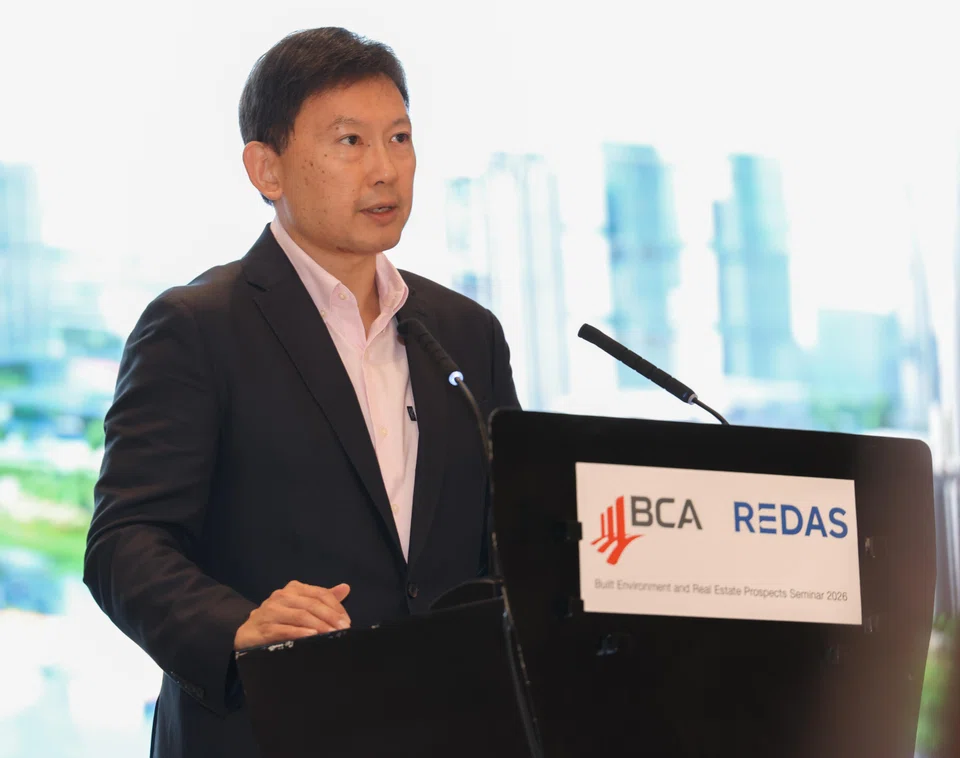
[SINGAPORE] Construction demand in Singapore is expected to remain firm in 2026, with S$47 billion to S$53 billion in contracts expected to be awarded, said Minister for National Development Chee Hong Tat on Thursday (Jan 22).
This is broadly in line with the previous year’s S$50.5 billion in nominal terms, and within the Building and Construction Authority’s (BCA) earlier forecast of S$47 billion to S$53 billion.
Much of the growth will be fuelled by key projects such as the Changi Airport Terminal 5 development, the Marina Bay Sands expansion, the new Tengah General and Community Hospital, and the Downtown Line extension.
Institutional and ramped-up housing projects have also contributed to the continued uptick in construction demand.
Of the S$50.5 billion contracts awarded in 2025, nearly a third or S$16.1 billion were from institutional and other projects – the highest recorded in the segment and more than 35 per cent higher than 2025’s S$11.8 billion.
This was followed by the public housing sector with a record high S$9.5 billion in contracts awarded in the year and civil engineering with S$9.3 billion.
Industrial projects contributed around S$7.1 billion, private residential projects, S$6.2 billion and commercial projects, S$2.2 billion.
In 2026, BCA expects institutional and other projects to hold fairly steady at around S$13.5 billion to S$15 billion, versus the S$3.4 billion to S$6.6 billion posted in previous years.
Commercial projects are predicted to more than double to between S$6.1 billion and S$6.7 billion and civil engineering projects, to between S$11.6 billion and S$13.4 billion.



Meanwhile, construction value from the public housing sector is likely to ease to S$6.8 billion, with new flats accounting for S$4 billion to S$5 billion of the contracts.
The private housing sector is expected to moderate as well, to between S$5 billion and S$5.5 billion, and the industrial sector to between S$4.6 billion and S$5.4 billion.
“Collectively, these projects will help to shape the next phase of Singapore’s growth,” said Chee at a prospects seminar conducted by BCA and the Real Estate Developers’ Association of Singapore (Redas).
“But we cannot become complacent,” he added. “If we continue business as usual, we will soon run into resource constraints, which will adversely impact our ability to seize new growth opportunities.”
The construction of Changi T5, for instance, is a one-off project, so industry demand could moderate following its completion and potentially revert to pre-pandemic levels, BCA said.
It expects total construction output – that is, the value of certified progress payment – to increase to between S$43 billion and S$46 billion in 2026. Its average projected output of S$44.5 billion is around 7 per cent higher than 2025’s preliminary estimate of about S$41.7 billion.
Between 2027 and 2030, construction demand is projected to range from S$39 billion and S$46 billion (*see amendment note) a year, in nominal terms.
Medium-term construction demand is likely to come from a strong pipeline of various large developments, said BCA, such as the redevelopment of National University Hospital at Kent Ridge, various junior colleges and Singapore University of Social Sciences’ new city campus.
“To deliver on our ambitious building plans, we will need to press on with our transformation efforts to save time, save costs and save manpower,” Chee said.
Boosting capacity
To support businesses in boosting productivity, Chee announced a new tranche of the Productivity Solutions Grant. Launched in April 2018, this grant helps Singapore companies in adopting IT solutions and equipment to streamline operations and automate processes.
The new tranche of grants will take effect on Apr 1, and broaden support for more advanced capabilities.
This includes expanded funding for robotic and automation equipment that can deliver up to 50 per cent manpower savings for certain construction trade activities, as well as a wider range of pre-approved digital solutions in areas such as digital contract management and coordinated regulatory approvals.
Grant caps will also be raised to support longer-term adoption of these digital solutions and advanced equipment.
Previous tranches of the grant have benefited more than 1,100 small and medium-sized enterprises (SMEs) in the built environment sector, said Chee.
For instance, engineering consultant Novaars International used it to implement an artificial intelligence-powered facade inspection system, which saved about 30 per cent in manpower and time.
SMEs that previously received support under the Productivity Solutions Grant may apply for the new tranche to “unlock productivity gains in new areas”, Chee said.
BCA and the Project Management Institute will also roll out an enhanced project manager competency framework in the second half of 2026.
It will update existing accreditation standards to help project managers build the right competencies – such as in stakeholder and supply chain management – through structured training, as well as provide them with locally and internationally recognised credentials, said Chee.
“Through this, we will develop a pool of reliable project managers who can confidently help our (built-environment) firms deliver projects on schedule, within budget and resources, and which are aligned with quality and safety requirements.”
From Jun 1, the government will also extend the listing validity of the public-sector panels of consultants – which lists registered firms that provide consultancy services for public-sector building and construction projects – from one year to three years.
Companies listed on the panels will be able to participate in public-sector consultancy tenders, with four panels classified by project value banding.
“This will help them to save time and save costs, which they can then use to provide better service to their clients or to pay higher salaries to their staff... to improve talent attraction and retention,” said Chee.
Chee said the government is considering making consultant evaluations of public-sector agencies a two-way process as well. This follows industry feedback that consultants are assessed by agencies at the end of projects, but cannot formally rate agencies in return.
“As a minister, I do want to know how our public-sector agencies are working with the industry,” said Chee. “And those public-sector agencies who consistently have poor ratings, I will ask them why and how they would improve.”
Taken together with other measures, he added these could help improve industry practices and lift productivity across the built-environment sector.
BCA chief executive Kelvin Wong added: “The sustained project pipeline gives our industry a solid foundation to build on. We are creating an environment in which firms can invest in better ways of doing business, whether that is through new technology, better collaboration or upskilling their teams.”
*Amendment note: An earlier version of this story said construction demand was projected to range from S$39 billion to S49 billion a year. This has been corrected to up to S$46 billion.
Decoding Asia newsletter: your guide to navigating Asia in a new global order. Sign up here to get Decoding Asia newsletter. Delivered to your inbox. Free.
Copyright SPH Media. All rights reserved.
TRENDING NOW

Once staunchly pro-China, Malaysian Chinese businesses are now distancing themselves from Beijing

Looking beyond looming CEO succession, should UOB potentially pursue a transformative merger?

Could stablecoins be the future of money?

Grab CEO’s wife Chloe Tong on life with Anthony Tan and finding her purpose

