What’s in store for Hongkong Land’s new Landmark in Singapore?
Rebranding paves the way for a refreshed tenant mix and physical enhancements

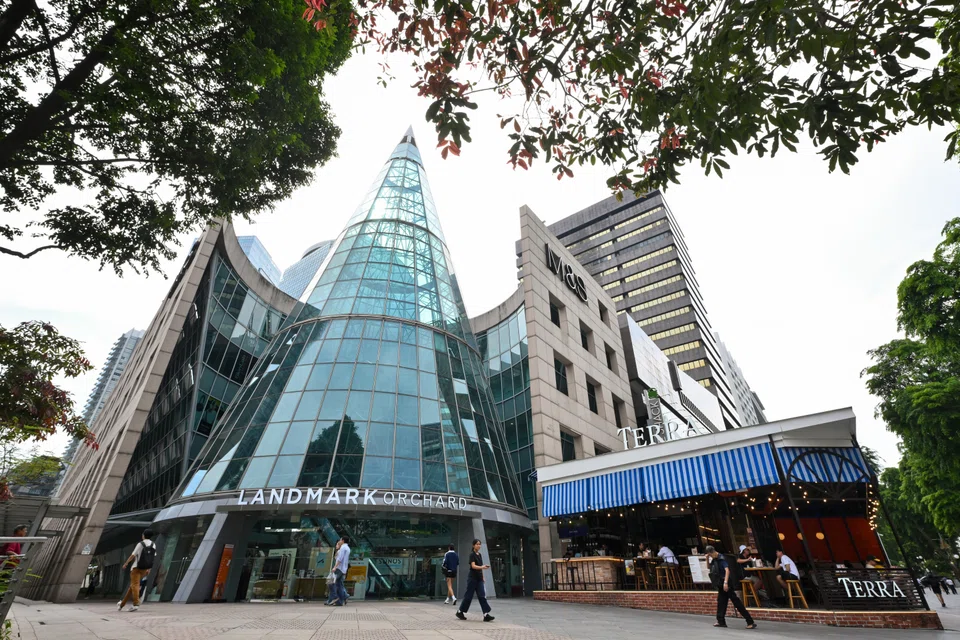
[SINGAPORE] Hongkong Land’s decision to bring its upscale Landmark brand to Singapore signals a new direction for the former Wheelock Place, with retail consultants pointing to opportunities to upgrade its tenant mix and enhance its physical layout.
The Jardine Matheson group’s real estate arm renamed the Orchard Road mall Landmark Orchard on Thursday (Nov 12), in the first use of the Landmark name outside Hong Kong.
The move follows the S$1.1 billion acquisition of Wheelock Place in August by Hongkong Land’s Singapore Central Private Real Estate Fund (SCPREF) from Wharf Real Estate Investment Company.
While Hongkong Land has not disclosed specific plans for its new Singapore property, it said it would look to “enhance the mall by drawing on its experience investing in and managing premium commercial properties across Asia”.
Mall owners in Singapore are upping their game in the fiercely competitive retail trade, pumping in hundreds of millions into asset enhancement incentives (AEIs) to turn unutilised space into lettable area and shaking up their tenant mix. Retail analysts expect Hongkong Land to also invest in improvements.
Foo Pei Teng, chief executive of SCPREF, said: “Hongkong Land has a long history of investment in its assets and we look forward to bringing that long-term investment approach to Landmark Orchard.”
In Hong Kong, Landmark sits at the centre of the group’s 12-building Central portfolio, combining retail space across four connected buildings under one concept and integrated with a Mandarin Oriental hotel. Its store directory reads like an A to Z of luxury retail brands, including the largest Hermes store in Hong Kong.
A US$1 billion revamp is now under way at Landmark Hong Kong, with tenants including Louis Vuitton, Hermes, Dior, Tiffany & Co, Cartier and Van Cleef & Arpels shelling out US$600 million collectively on the fit-out of their new stores. Hongkong Land itself will pump in US$400 million.
Real estate veteran Desmond Sim said the Landmark name is synonymous with high-end brands in Hong Kong, and that the group could seek to replicate elements of its luxury retail offering in Singapore.
He expects the new owner of the Orchard Road mall to fine-tune the tenant mix, potentially drawing on its existing relationships with luxury retailers in Hong Kong to introduce new offerings.
Many of the luxury brands represented at Landmark Hong Kong already have a presence in Singapore, Sim noted.
Most have flagship stores at Ion Orchard, which stands directly across the road from Landmark Orchard and is jointly owned by CapitaLand Integrated Commercial Trust and Hong Kong group Sun Hung Kai Properties.
Many also have large stores at Ngee Ann City and Paragon down the road.
Still, there could be opportunities to introduce brands that have yet to establish a standalone presence here, Sim added, noting that there is room for more luxury retail offerings in Singapore.
Despite uncertainties affecting global luxury spending, the city-state continues to attract tourists from across Asia with an appetite for luxury brands, making it a viable location for flagship stores, he said.
“We’re not only looking at the Chinese... We’re also looking at the Indonesians and high-net-worth individuals from Thailand and Malaysia.”
Sulian Tan-Wijaya, executive director, deputy head of private wealth and head of retail at Savills Singapore, reckoned that the adoption of the Landmark name does not necessarily mean Hongkong Land intends to reposition the property as a luxury mall.
“I would be surprised if that is the intention,” she said, noting that it does not make sense to compete with “the big three” as these already represent luxury well.
She pointed to opportunities to reposition the mall and update its tenant mix with brands and concepts that are more aligned with newer retail trends and consumer behaviour.
“Landmark Orchard can instead leverage (its) connectivity to Ion and offer a retail mix that complements Ion,” said Tan-Wijaya, who sees potential for the landlord to introduce more street fashion and experiential retail concepts.
Drawing shoppers beyond the basement
Sim pointed out that the former Wheelock Place functioned largely as a thoroughfare for pedestrians moving between neighbouring developments, with activity concentrated around its basement connections to Ion and Shaw House.
“Retail is a very visual business. If you notice, with the inherent design of the property, the shops are quite hidden. Accessibility is only (via) an escalator,” he noted.
“The only way to improve that is basically to create destination tenants to bring the footfall up and let (their effect) cascade down. I think that is something Hongkong Land will look into.”
Tan-Wijaya also pointed out that the tenant mix at the former Wheelock Place had not kept pace with changing retail trends.
Wheelock Place began life in 1994 as Lane Crawford Place, bringing a slice of Hong Kong retail to Singapore.
After the luxury department store Lane Crawford closed its doors in the city-state in 1996, the building was reconfigured, with US book chain Borders taking up the anchor space until 2011 when Marks & Spencer moved in.
Other current tenants in the five-storey mall include aesthetic clinics, salons, beauty brands, boutique retail tenants and a handful of F&B operators. The complex includes a 21-storey office block.
Tan-Wijaya noted: “Having an anchor like Marks & Spencer may provide stability to the mall’s rental income; but given the mall’s intimate size, it may somewhat overpower the other tenants, some of which do not enjoy much visibility within the mall.”
Potential for AEI
Analysts reckoned an AEI could also improve shopper circulation and make better use of the mall’s existing layout.
“The building itself has a unique architecture which could be preserved while the interior layout can be enhanced to improve the visibility of shops towards the back and encourage more shopper flow,” said Tan-Wijaya.
She added that there is a trend for malls to be “more outward facing and interacting more with outdoor spaces”; this could make the mall more enticing to shoppers along Orchard Road.
Ethan Hsu, CEO of boutique retail consultancy and real-estate firm Catbird Singapore, said the mall’s relatively generous walkways could present opportunities to unlock additional net lettable area, while improving the circulation of shoppers within the property.
He added that changes to the placement of escalators could also help direct footfall more effectively across the different levels, and improvements to the entrances could create a stronger sense of arrival and make the property more inviting to shoppers.
Hsu added that a repositioning of Landmark Orchard as an ultra-luxury mall, similar to its Hong Kong namesake, could provide much-needed prime retail space for luxury brands looking to establish or expand their presence in Singapore.
Sim also pointed to Landmark Orchard’s strategic position between Ion and a cluster of properties owned by Hotel Properties Ltd (HPL) further down Orchard Road, where potential redevelopment could bring new attractions to the shopping belt.
HPL was given provisional government approval in 2023 to redevelop the three properties into a mixed-use project comprising a hotel, retail, office and residential components, as well as a rooftop garden and a performance theatre.
In October this year, Hongkong Land was reported to be in talks to acquire a majority stake in three adjacent properties from HPL – voco Orchard Singapore hotel, Forum The Shopping Mall and HPL House.
Sim believes that, whether HPL sells the properties or redevelops them with partners, a new development along the stretch could bring additional attractions and footfall to the area, potentially benefiting Landmark Orchard.
“Landmark Orchard seems to be very strategically placed. It could be the connecting spot,” he said.