

Singapore real estate agencies may consolidate further: IREUS
Salespeople within the same agency still compete with one another, helping to prevent oligopolistic manipulation

Singapore
THE Big Four real estate agencies in Singapore - PropNex Realty, ERA Realty Network, OrangeTee & Tie and Huttons Asia - are likely to continue attracting more salespersons, while smaller players face higher attrition rates and costs.
The industry could thus become even more consolidated in the coming years, said the Institute of Real Estate and Urban Studies (IREUS) at the National University of Singapore, in its analysis of data from the Council for Estate Agencies (CEA).
"This raises issues relating to consumer interests and healthy competition amid a landscape that is starting to resemble an oligopoly," said IREUS deputy director Lee Nai Jia.
He drew parallels between the estate agency business model and online-shopping portals: "Property salespersons are the analogues of e-commerce merchants using platforms to connect to buyers."
Agents are also extremely mobile and therefore drawn to agencies with strong ecosystems and networks. Housing nearly 80 per cent of the industry sales force, the Big Four enjoy wide-ranging outreach and can attract a substantial number of buyers, sellers and eyeballs for marketing events, Dr Lee noted. They also have considerably more resources to implement digital transformations.
PropNex, ERA, OrangeTee & Tie and Huttons are expected to keep competing aggressively for salespersons to strengthen their market-leading positions, he added. They may invest more in tech and digitalisation, help agents leverage social media and regional markets, and provide training and market intelligence.
Moreover, the top four could also continue to grow in numbers via mergers and collaborations. "Medium-sized agencies that are facing rising costs and attrition of agents will come under pressure to either join the larger agencies or pivot to a boutique model targeting sub-segments by location or type," Dr Lee noted.
That being said, such consolidation has had limited impact on homebuyers, sellers, tenants and landlords in the private residential market. This could be because salespeople within the same agency still compete with one another for the same clientele, similar to merchants with listings on the same e-commerce platform.
"Micro-level competition among salespersons is expected to keep commission rates competitive, and consumer interest is thus protected from any manipulation that an oligopoly may attempt," Dr Lee noted.
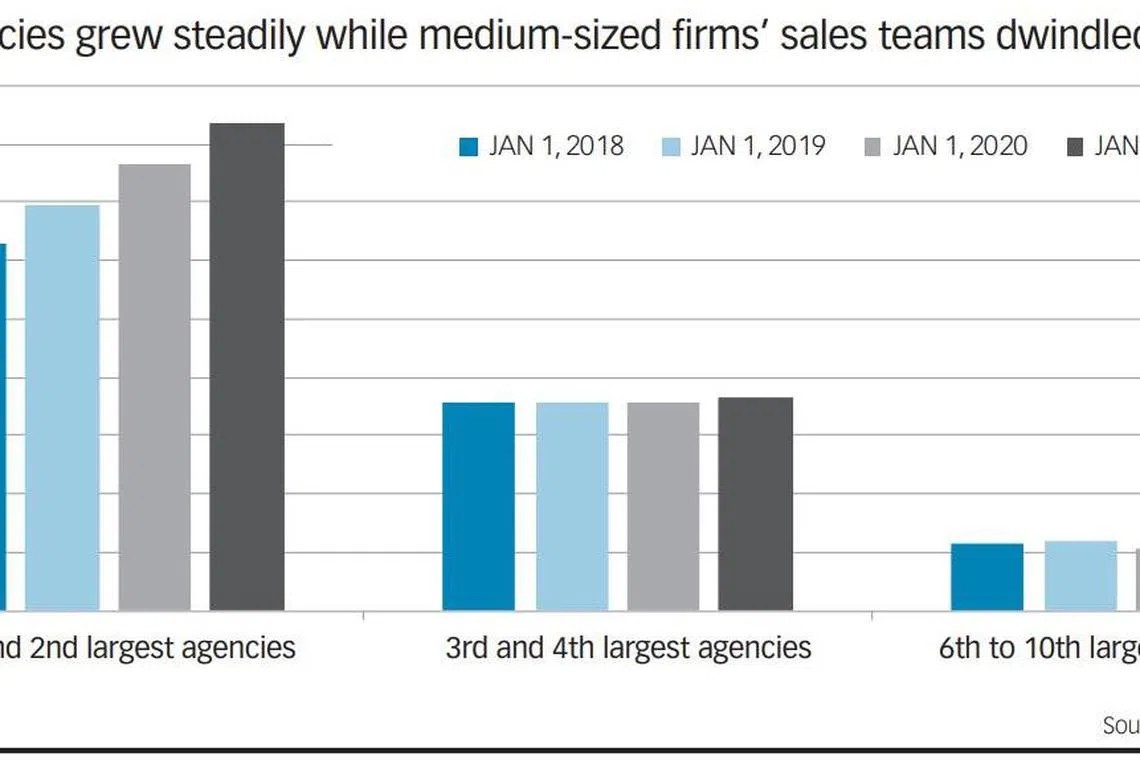
He foresees the top two estate agencies, PropNex and ERA, staying in the lead, given their ample resources to retain existing salespersons and attract new entrants. On the other hand, medium-sized players with 100-500 agents could face increasing pressure to invest, in order to bolster their numbers.
Going by CEA data, there has been a steady trend of fewer industry players grabbing bigger slices of a growing pie in recent years.
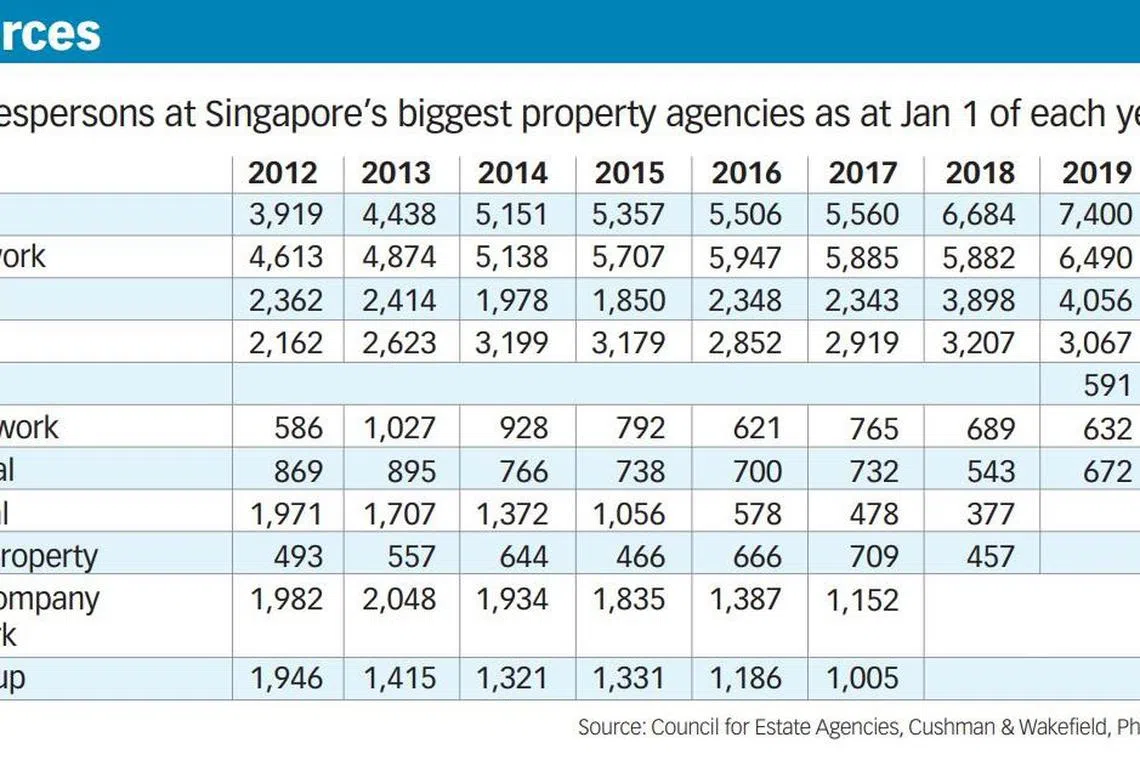
The number of agencies declined for a fifth straight year in 2020, falling to 1,164 as compared with 1,369 as at Jan 1, 2016. In contrast, the total number of salespersons rose to 30,399 last year, from 28,397 at Jan 1, 2017.
PropNex, ERA, OrangeTee & Tie and Huttons collectively have more than 24,000 salespersons, or 79 per cent of the entire pool of agents as at Jan 1, 2021. That is a "tremendous jump" in their share of the industry headcount since the start of 2012, when the four accounted for 43 per cent in a more fragmented landscape, Dr Lee said. Back then, there were also three other prominent agencies, each with almost 2,000 salespersons.
When the private housing market subsequently slowed in 2014-2017, a corresponding fall in headcount was seen at many smaller agencies. To stem the outflow of agents, some medium-sized firms merged with the Big Four, Dr Lee noted. This was because a dwindling sales force would erode an agency's economies of scale and competitive advantage, which would exacerbate the situation, he added.
In 2017, PropNex absorbed Dennis Wee Group, forming the largest real estate agency here, while OrangeTee merged with Edmund Tie & Company Property Network and became the third-biggest player.
Some 280-290 CBRE Realty Associates agents focused on residential transactions moved to ERA in 2018 under a "strategic collaboration". And in September 2020, Savills Singapore's associates arm, Savills Residential, merged with Huttons.
The Big Four went on to grow their sales teams further last year, helped by the buoyant property market that enticed more individuals to dip their toes in the sector.
However, "in a stunning display of divergence", the sixth to 10th biggest agencies lost about half of their total salespeople year on year as at Jan 1, 2021, Dr Lee noted.
The exception was SRI, the fifth largest agency, as its headcount surged to 1,004 as at Jan 1, 2021, from 591 as at Jan 1, 2019. Such a significant increase may occur when one of the large divisions within an agency decides to join a medium-sized outfit or form their own independent companies, Dr Lee said.
READ MORE:
- Property agents' share of pie shrinks as their ranks swell further
- OrangeTee & Tie sets sights on 30% revenue growth in digital, data push
- Grooming younger agents paying off at ERA
- ERA Realty eyes 40% increase in revenue amid boom in property transactions
- PropNex expands to Cambodia, its fourth overseas market
TRENDING NOW

LTA proposes combining car COE categories, adding rebate-surcharge system

StarHub to acquire MyRepublic’s mobile business amid ongoing telco consolidation

DBS, OCBC, UOB rout lops billions off STI as inflation, rate concerns spook investors

Grab CEO’s wife Chloe Tong on life with Anthony Tan and finding her purpose

