

As AI reshapes entry-level work, fresh grads must prepare for the ‘third-year job’: panel
They will need to place greater emphasis on internships, work-study programmes and adaptability
Meera Pathmanathan
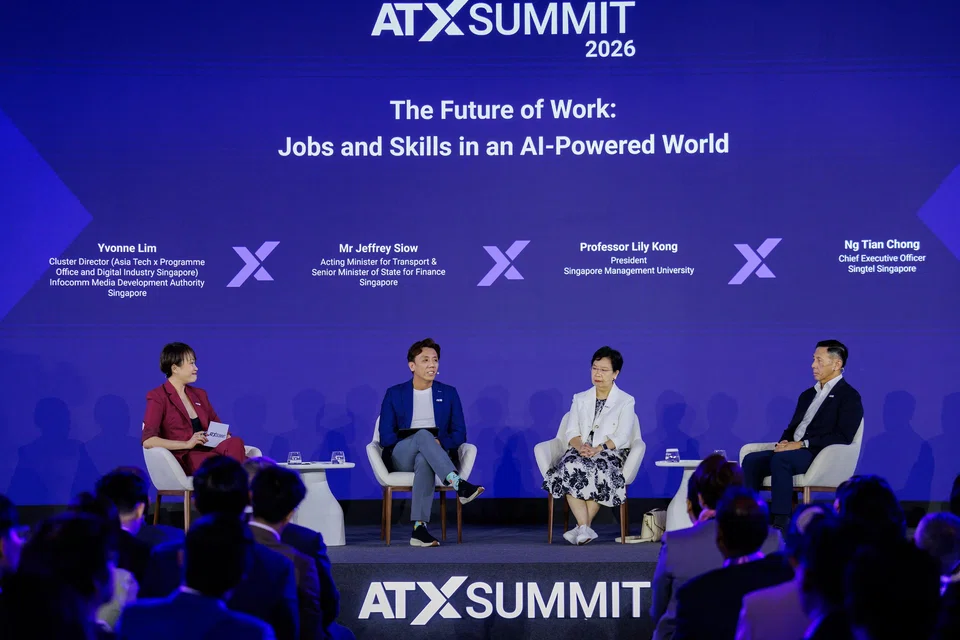
[SINGAPORE] Workflow redesign and a rethinking of work processes are leading to some entry-level jobs being automated, with agentic artificial intelligence taking over certain tasks, said Singtel Singapore CEO Ng Tian Chong.
These changes – brought on by advances in technology – have resulted in fresh graduates now taking on roles “equivalent to someone with maybe two years of work experience or more when they’re coming (into a company)”, he added.
He was speaking on Thursday (May 21) at a panel titled “Future of Work: Jobs and Skills in an AI-Powered World”, part of the Asia Tech x Summit 2026 event held at Capella Singapore.
Fellow panellist Professor Lily Kong, president of Singapore Management University, agreed.
With fresh graduates expected to enter the workforce already equipped with the relevant experience, universities need to focus on preparing students for the “third-year job”, she said.
This is especially if the first two years are going to be “taken over by agentic AI” or other technologies, she noted (*See note).
Ng added that undergraduates require “thoughtful internships and work-study programmes” to help them add value when they join the workforce.
The panel also discussed how AI-driven efficiency gains are reshaping job markets and testing the resilience of talent pipelines across industries.
Acting Minister for Transport Jeffrey Siow, who was also a panellist, highlighted that while “there are fewer safe paths, there are more exciting paths” in today’s job market.
SEE ALSO

What matters, he said, is fresh graduates’ attitudes in embracing challenges and taking on “less tried and true paths”.
Transport sector looks to AI
Addressing AI’s impact on the transport sector, Siow said there is a need to ensure that the infrastructure built is “deeply integrated with digital technology and AI” to keep up with connectivity demands.
He cited the role of an air traffic controller as an example.
“When we do Terminal 5, we should expand our airport capacity by another 50 per cent, (but) it’s not going to be possible for us to have another 50 per cent growth in our air traffic controller workforce.”
This is where AI use becomes needed, so that each air traffic controller “can do more within their own capacity”, said Siow, who is also senior minister of state for finance.
He also flagged the importance of helping workers adapt to disruption.
“The (key performance indicator) is helping people to bounce back, to help them take the jobs that are being created, to help create enough opportunities.”
Ng added that being adaptable and staying curious would also help fresh graduates with employment.
Siow noted that Singapore’s stance has always been to “protect the person, not to protect the job” amid economic transitions.
The focus, he added, lies in ensuring that good opportunities are created for workers, and that they are supported in taking on new roles as they emerge.
Note: This article has been revised for clarity
Decoding Asia newsletter: your guide to navigating Asia in a new global order. Sign up here to get Decoding Asia newsletter. Delivered to your inbox. Free.
Share with us your feedback on BT's products and services
TRENDING NOW

Once staunchly pro-China, Malaysian Chinese businesses are now distancing themselves from Beijing

Looking beyond looming CEO succession, should UOB potentially pursue a transformative merger?

Could stablecoins be the future of money?

Grab CEO’s wife Chloe Tong on life with Anthony Tan and finding her purpose

