

Budget 2026: AI boost a shot in the arm, but funding alone won’t drive transformation, says industry
Expanded support lowers barriers to adoption, but scaling will depend on guidance and workforce readiness

- Clear guidance in adopting AI will help SMEs build sustainable solutions
- Spotlighting champion firms in AI adoption creates replicable transformation models that can raise standards across entire sectors
- Transformation in sectors with higher regulatory compliance will be slower if support is not tailored
[SINGAPORE] While the government’s new artificial intelligence (AI) initiatives lower financial barriers to adoption, industry observers say that transformation hinges on clear guidance to help small and medium-sized enterprises (SMEs) avoid one-off pilots and build scalable, sustainable solutions.
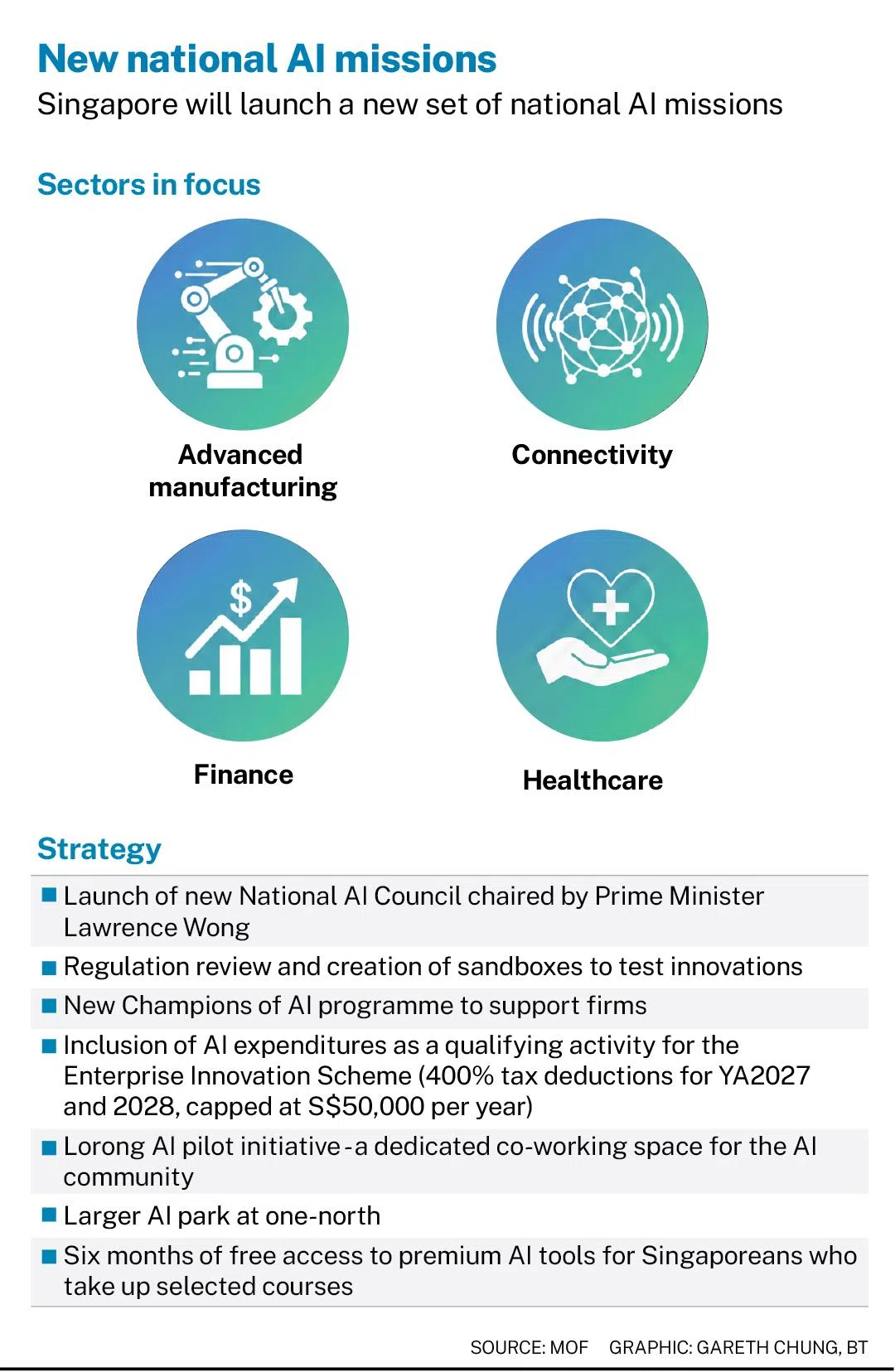
The expanded Enterprise Innovation Scheme (EIS) and Champions of AI programme were among the measures announced by Prime Minister and Finance Minister Lawrence Wong during his Budget speech on Thursday (Feb 12) to accelerate enterprise AI adoption.
A new set of national AI missions to drive AI-led transformation was also unveiled, with a focus on four sectors: advanced manufacturing, connectivity, finance and healthcare.
A springboard for AI adoption
Under the expanded EIS, AI expenditures will be included as a qualifying activity for the years of assessment 2027 and 2028, capped at S$50,000 a year.
This provides a “helpful starting point” for SMEs to test AI tools and run small pilots, said Manik Bhandari, co-chair of SGTech’s AI, cloud and data chapter.
However, he also noted that AI adoption goes beyond buying a tool or conducting research and development (R&D).

“In many cases, the first S$50,000 should go into planning, which includes understanding business needs, mapping workflows, checking data readiness, and identifying where AI can add real value.”
He added that integration and customisation often cost much more than this amount. Without proper planning, SMEs risk running pilots that never scale or fit into daily operations.
As such, he highlighted that financial support needs to be paired with clear implementation guidance.
Sector-specific adoption
Ang Wee Seng, executive director of the Singapore Semiconductor Industry Association, said the enhanced EIS lowers the cost of investing in AI. It also encourages companies to strengthen R&D, automation and innovation capabilities, which are critical for semiconductor competitiveness.
He noted that the scheme will likely benefit SMEs the most, as the S$50,000 cap could be considered modest by large semiconductor companies with significant R&D spending.
“Its effectiveness will depend on how it works together with talent development and broader innovation initiatives,” he added.
On the healthcare front, Professor Tan Bhing Leet of the Singapore Institute of Technology (SIT) said the expanded EIS creates opportunities for healthcare organisations to explore how AI can strengthen preventive care and enable more personalised treatment in later stages of life.
Prof Tan, who is health and social sciences cluster director at SIT, stressed that long-term impact will depend on workforce development and organisational redesign.
She noted the importance of an approach that ensures AI-driven insights translate into practical improvements in patient outcomes and system sustainability.
“At the same time, it is important to be cautious of enterprises adopting AI simply for novelty, and to evaluate the merits of each innovation in terms of meaningful, scalable and sustainable adoption,” she added.
For logistics, Kim Yoon Young, cluster president for Singapore and Brunei at Schneider Electric, said the industry is a highly data-driven operation, and productivity gains can accrue quickly with AI investments.
He noted that real-time monitoring enables the company to use AI to drive robotics and other automation to support employees. The company also utilises the technology for training purposes.
In finance, StraitsX co-founder and chief legal officer Samson Leo said regulatory readiness is the key to AI adoption.
“Singapore’s emphasis on reviewing regulations and expanding sandboxes is critical, giving industry a supervised path to test AI safely while regulators harden guard rails in parallel.”
Trusted financial infrastructure must evolve in tandem, he added, ensuring AI-enabled payments and digital asset systems are built on secure, resilient and auditable rails.
The Champions of AI programme
Chiu Wu Hong, partner and head of private enterprise at KPMG, said the newly announced Champions of AI programme would help in three main ways: moving beyond pilots to scaled deployment, integrating workforce transformation to embrace AI, and creating industry benchmarks.
He noted: “Sectors like healthcare or advanced manufacturing require higher regulatory compliance, validated data sets and safety assurance – making transformation slower if support is not more sector-tailored.”
Prof Tan echoed this, saying that support for enterprises in the healthcare sector must go beyond funding for tools.
“Providers will benefit from structured test environments, access to multidisciplinary expertise, and guidance on redesigning care processes alongside technology adoption.”
She added that programmes should support training in data stewardship, safe AI use and clinical interpretation to ensure that medical professionals remain confident and accountable when integrating AI into care delivery.
On a broader scale, PwC Singapore AI hub leader Anthony Dias said that spotlighting champion firms in the Republic creates replicable transformation models that raise standards across entire sectors, reinforcing the country’s national competitiveness as an AI-ready economy.
He noted that potential challenges include the development of solutions that engage only relatively advanced or larger companies capable of transformative investments – which could leave smaller SMEs challenged in emulating those successes.
Other AI initiatives that the government announced include a National AI Council chaired by PM Wong and the establishment of a larger AI park at one-north.
KPMG’s Chiu said that it is crucial for the parks at one-north and expanded Lorong AI precinct to attract and retain top-tier AI and data talent.
This is because talent concentration is what ultimately drives innovation density and knowledge spillovers, he added.
Decoding Asia newsletter: your guide to navigating Asia in a new global order. Sign up here to get Decoding Asia newsletter. Delivered to your inbox. Free.
Copyright SPH Media. All rights reserved.
TRENDING NOW

Once staunchly pro-China, Malaysian Chinese businesses are now distancing themselves from Beijing

Looking beyond looming CEO succession, should UOB potentially pursue a transformative merger?

Could stablecoins be the future of money?

Grab CEO’s wife Chloe Tong on life with Anthony Tan and finding her purpose

