

Budget 2026: AI adoption, business growth drive Singapore’s ambition to ‘aim higher, move faster, take calculated risks’
In the largest Budget to date, Finance Minister Lawrence Wong warns growth will be harder to achieve

[SINGAPORE] Artificial intelligence (AI) and Singapore’s response to the Economic Strategy Review (ESR) took centre stage in Budget 2026 – the largest in the nation’s history with an estimated size of S$154.7 billion for the 2026 fiscal year.
This was alongside announcements on foreign manpower policy tweaks, vehicle tax changes, startup funding support and a new Central Provident Fund (CPF) investment scheme.
This is with the aim of securing growth at the higher end of the 2 to 3 per cent range over the next decade, said Prime Minister and Finance Minister Lawrence Wong on Thursday (Feb 12) in his first Budget speech of this government term.
Singapore’s economy proved more resilient than expected, achieving 5 per cent full-year growth in 2025 thanks to the resilience of the global economy.
Widespread fears that US President Donald Trump’s tariffs would trigger a sharp slowdown did not materialise, with stronger external demand boosting key clusters such as electronics and biomedical manufacturing.
Yet, growth will be harder to achieve amid current economic conditions, PM Wong noted. “We must aim higher, move faster and be prepared to take calculated risks.”

The ESR was thus convened in August 2025 to chart Singapore’s economic strategy and strengthen its economic competitiveness. In January, the committees made several recommendations to achieve this.
But securing growth itself is not enough, PM Wong said. “Growth must translate into good jobs and rising incomes for Singaporeans.”
AI key to success
Central to achieving this is accelerating AI adoption across the economy – a key recommendation by the ESR committees.
SEE ALSO




PM Wong noted that in a changed world, a “decisive factor for success will be how we harness new technologies”, AI chief among them.
“Harnessed well, AI will be a strategic advantage for Singapore,” he said. “It can help us overcome our structural constraints – our limited natural resources, rapidly ageing population and tight labour market.”
Yet, Singapore should not simply follow what other jurisdictions are doing with AI. Instead, it must invest “deliberately and with discipline” in areas that play to Singapore’s strengths, he said.
“Our advantage does not lie in building the largest frontier models. It lies in deploying AI effectively, responsibly and at speed.”
Singapore can position itself as a trusted hub where companies and researchers come together to develop, test and deploy impactful AI solutions more quickly and coherently than larger economies.
For such efforts to bear fruit, initiatives must go beyond individual pilots and isolated experiments to scale nationally, PM Wong said.
Driving AI adoption
To this end, the Budget outlined several schemes to accelerate AI take-up, with both new initiatives and enhancements to existing programmes.
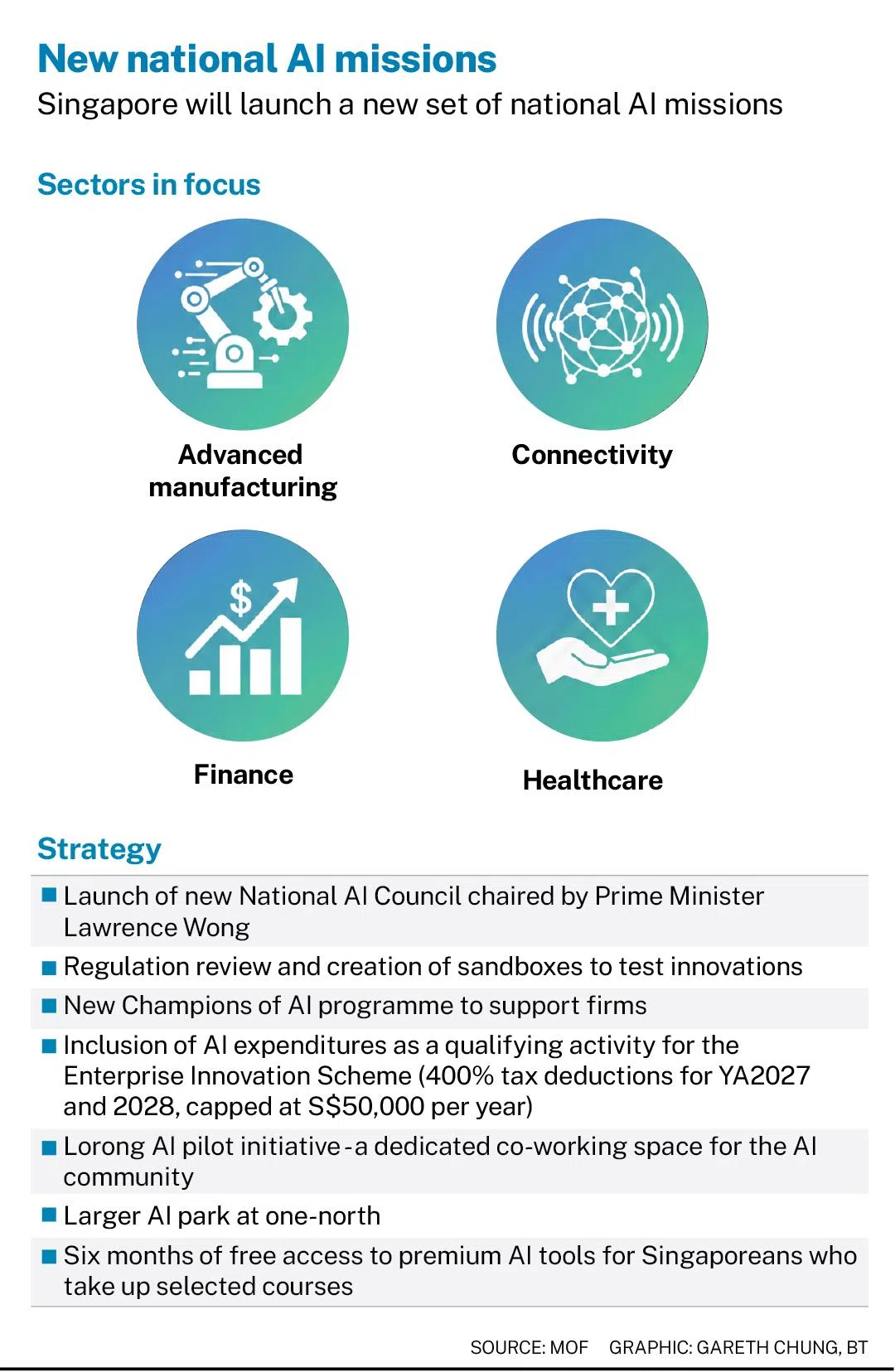
A new National AI Council, chaired by PM Wong, will drive Singapore’s AI agenda, while national AI missions will transform four key sectors: advanced manufacturing, connectivity, finance and healthcare.
These missions aim to spur industries to “push the boundaries of what is possible”. For instance, advanced manufacturing could build globally competitive factories, while connectivity and logistics could use AI to automate port operations.
“These are not abstract aspirations,” said PM Wong. “Each AI mission will be anchored in clear objectives and tangible outcomes.”
For enterprises, a Champions of AI programme will support firms to transform their businesses through AI, including enterprise transformation and workforce training.
Meanwhile, the Enterprise Innovation Scheme will be expanded to include qualifying AI expenditure, while the Productivity Solutions Grant will support a wider range of digital and AI-enabled solutions.
To bring AI founders, practitioners, researchers and innovators together, a new AI park will be established at one-north, building on the pilot Lorong AI at Cross Street.
For workers, a tech skills accelerator will equip legal and accountancy professionals with AI capabilities, while those enrolling in selected AI courses will get six months’ free access to premium tools such as ChatGPT and Gemini.
The SkillsFuture website will also be revamped to prioritise industry-relevant courses and make it easier for workers to find AI-related training.
Going global
The Budget also responded to the ESR committees’ calls for stronger support to help businesses venture abroad.
Doing business overseas is not easy, especially for smaller firms, PM Wong noted. “Companies face unfamiliar regulations, different business practices and intense local competition.”
To help with costs, support levels for internationalisation schemes will be enhanced – up to 70 per cent for small and medium-sized enterprises (SMEs), and up to 50 per cent for non-SMEs.
The Market Readiness Assistance grant will also be enhanced to help enterprises access new markets and deepen their presence in existing ones.
Businesses will get double tax deduction for more internationalisation activities, with the claims ceiling raised to S$400,000 from S$150,000 per year of assessment.
The maximum loan quantum for the Enterprise Financing Scheme will also be increased for greater financing flexibility.
Catalysing growth capital
A vibrant startup ecosystem is key to Singapore’s economic advancement, and funding is a critical part of this.
While startups now have better access to early stage funding than a decade ago, many still struggle at the growth stage, PM Wong noted. More will thus be done to catalyse growth capital.
The Startup SG Equity scheme, which provides initial capital to catalyse private funding for promising startups, will receive a S$1 billion injection, with its scope expanded to include growth-stage companies.
For more mature high-growth startups seeking public listings, a fresh S$1.5 billion tranche of the Anchor Fund will be launched, co-invested by the government and Temasek, to encourage Singapore startups to list locally.
In tandem, the Financial Sector Development Fund will get a S$1.5 billion top-up to support efforts to revitalise Singapore’s equities market.
Foreign manpower policy tweaks
As Singapore creates better jobs and upskills citizens, it must also remain open to global skills and talent, PM Wong said, while continuing to ensure the foreign workforce complements a strong Singapore core.
Further refinements to foreign worker policies were announced to keep pace with rising local wages.
Minimum qualifying salaries for Employment Pass (EP) and S Pass holders will be increased. For EP holders, it will rise to S$6,000 from S$5,600, or to S$6,600 from S$6,200 for those in the financial sector.
For S Pass holders, the minimum will rise to S$3,600 from S$3,300, or to S$4,000 from S$3,800 for the financial sector.
Qualifying salaries for older EP and S Pass applicants will be raised in tandem. This will take effect for new applicants from January 2027, and renewals from 2028.
Work permit levies will also be adjusted. Levies for “basic-skilled” workers in the marine and process sectors will rise to S$100 and S$150, respectively, while the levy structure for manufacturing and services will be simplified. These changes kick in from 2028.
Separately, the local qualifying salary for local workers in companies employing foreign workers will rise to S$1,800 from S$1,600.
Investments and taxes
Other key announcements included a new voluntary CPF investment scheme for members with a longer runway to retirement who are prepared to take on more risk for potentially higher returns.
The scheme will use a life-cycle investment approach, with investments rebalanced towards safer assets as members approach retirement.
PM Wong said that fees will be kept low for the scheme, and two to three credible providers will be selected to keep choices simple for CPF members.
The CPF Board will engage industry and invite potential providers to express interest later this year.
To ease cost-of-living pressures, all Singaporean households will receive a further S$500 in Community Development Council (CDC) Vouchers in January 2027.
There will also be a one-off cost-of-living special payment of S$200 to S$400 in cash for Singaporean adults earning up to S$100,000 in annual income who do not own more than one property.
On the tax front, vehicle taxes will be adjusted. The Preferential Additional Registration Fee (PARF) rebate will be reduced by 45 percentage points, and the PARF rebate cap lowered to S$30,000 from S$60,000, applying to all cars with Certificates of Entitlement obtained from the next bidding exercise.
Singapore is also implementing a 20 per cent increase in tobacco excise duty across all tobacco products, effective immediately, to discourage consumption.
Capping off his speech, PM Wong said Budget 2026 is one to “support Singaporeans today, prepare our society for tomorrow, and enable us to navigate this changed world with confidence”.
“Together, we will secure a stronger, fairer and brighter future for all.”
For more of BT’s Budget 2026 coverage, go to bt.sg/budget26
Decoding Asia newsletter: your guide to navigating Asia in a new global order. Sign up here to get Decoding Asia newsletter. Delivered to your inbox. Free.
Copyright SPH Media. All rights reserved.
TRENDING NOW

Once staunchly pro-China, Malaysian Chinese businesses are now distancing themselves from Beijing

Looking beyond looming CEO succession, should UOB potentially pursue a transformative merger?

Could stablecoins be the future of money?

Grab CEO’s wife Chloe Tong on life with Anthony Tan and finding her purpose

