

Budget 2026: Not grand pronouncements, but steady steps in longer-term plans
Rather than show-stopping policies, this year’s spending plan is heavier on targeted moves and extensions of past efforts

[SINGAPORE] There is an understandable impulse – not least for those in the news business – to comb through each year’s Budget speech for what is huge or dramatic or brand new. Take such an approach to Budget 2026, and you might come up short.
If anything, it was striking just how many of Thursday’s (Feb 12) announcements were either enhancements or extensions of existing programmes.
Some of the biggest headline figures – in the realm of S$1 billion or S$1.5 billion – were top-ups to schemes that began years ago, such as the 2017 Startup SG Equity initiative and the 2021 Anchor Fund.
But perhaps it is a mistake to expect blockbuster announcements all the time. The government consistently frames each Budget as part of longer-term plans; Budget 2026 embodies this on multiple levels.
It is the first Budget of a new term, and thus heralds just the beginning of this government’s plans. At the same time, it is part of a series of spending plans to advance the fourth-generation leadership’s broader Forward Singapore agenda.
Political cycles aside, Budget 2026 also implements early recommendations from the Economic Strategy Review – a plan not for a new year, but a new phase of economic development.

The apparent lack of show-stopper policies can also be interpreted another way: prioritising specific, targeted moves. Even the new national artificial intelligence (AI) missions – perhaps the closest that Thursday’s speech came to a centrepiece policy – deal not in grand pronouncements, but specific targets.
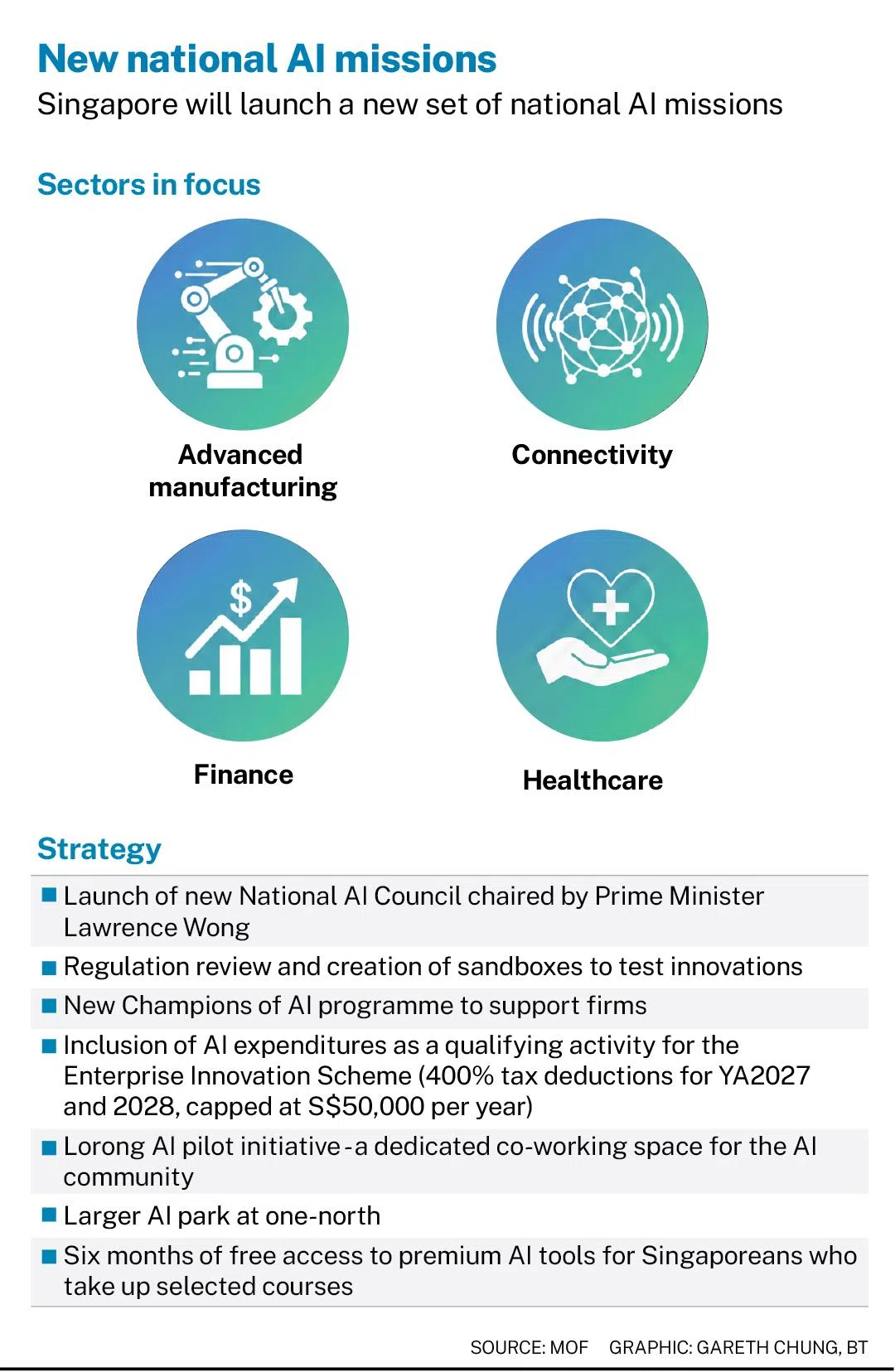
As Finance Minister Lawrence Wong put it in his Budget speech: “These are not abstract aspirations. Each AI mission will be anchored in clear objectives and tangible outcomes.”
Building foundations, not castles in the air
Wong, who is also prime minister, situated Budget 2026 clearly in a larger context. The government has “a full agenda in this term... to refresh our strategies and strengthen our social compact”, he said.

“Budget 2026 is the first step in this effort, to secure our future in a changed world.”
Yet, even as it “lays the groundwork” for how Singapore will navigate its next phase of development, this year’s Budget also builds on past foundations.
Support for internationalisation takes the form of enhancements to earlier schemes; AI adoption is encouraged via existing incentives.
This is not just a reminder of Singapore’s long-running efforts to get firms to go abroad or transform themselves. It also demonstrates the government’s practicality: working within existing frameworks, rather than announcing a brand-new initiative for the sake of novelty.
Such practicality is also visible in Singapore’s keenly targeted approach to the future.
In research and development, for instance, PM Wong stressed the need for investments to be “disciplined, focused and strategic – directed at areas where Singapore has clear strengths, and where our efforts can make a real difference”.
This same discipline is invoked in relation to AI. Here, too, the country “must invest deliberately and with discipline” – not following the crowd, but playing to its strengths.
Beyond the strategic level, discipline and focus also apply to relatively smaller announcements such as the new cost-of-living special payment of between S$200 and S$400 for those who are eligible.
Not only is this one-off cash payment restricted to Singaporean adults with up to S$100,000 in assessable annual income and who do not own more than one property, it is also tiered by both income and residence.
Budget 2026’s sobriety comes in contrast to its pre-election predecessor, which offered something for everyone in Singapore’s 60th anniversary year in 2025.
But of course, not every Budget is or should be a celebratory occasion. This one for a fraught and uncertain world, amid changes that will continue far beyond a single year. Its approach seems only fitting – measured and steady steps on a longer-term journey.
For more of BT’s Budget 2026 coverage, go to bt.sg/budget26
Decoding Asia newsletter: your guide to navigating Asia in a new global order. Sign up here to get Decoding Asia newsletter. Delivered to your inbox. Free.
Copyright SPH Media. All rights reserved.
TRENDING NOW
High Court rules against Julius Baer’s Singapore trust arm in US$50 million family trust dispute

MSCI proposes standalone status for Indonesia; Jakarta stocks plunge 8%

Once staunchly pro-China, Malaysian Chinese businesses are now distancing themselves from Beijing

No chicken feed: How Malayan Flour Mills built an empire from flour to fowl

