

Companies that replace workers with AI risk losing competitive edge, relying on vendors: Jasmin Lau
Investing in employees, such as by training them, facilitating their access to frontier AI tools are in firms’ long-term interest, she notes

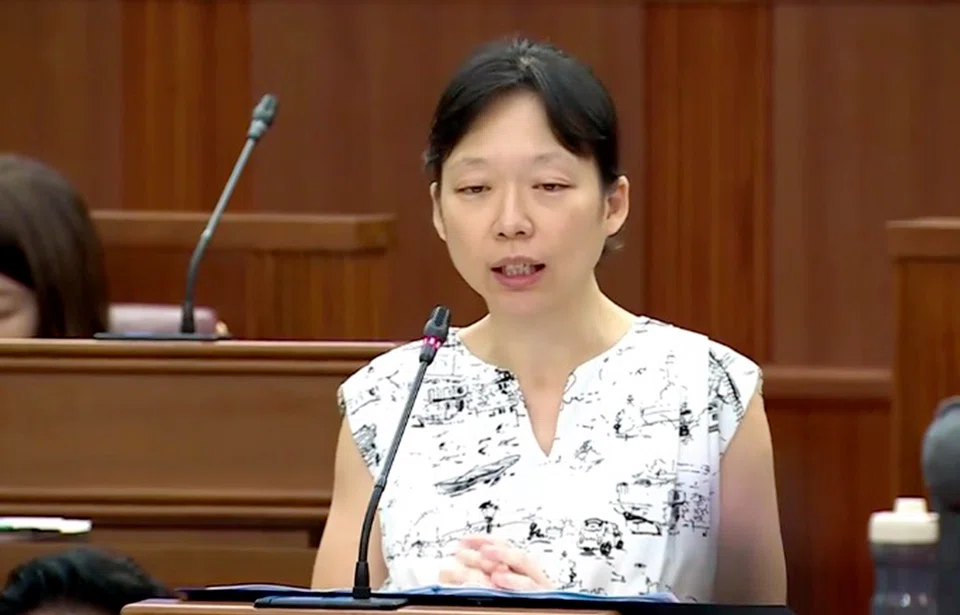
[SINGAPORE] Companies that rely entirely on artificial intelligence to replace their human workforce risk losing their competitive edge and becoming beholden to AI vendors, said Minister of State for Digital Development and Information and Education Jasmin Lau in Parliament on Wednesday (May 6).
“If companies here replace humans completely with AI, they will find themselves in future to have no competitive edge when AI is available to all,” she said. “They will also find themselves at the mercy of AI companies.”
Lau was speaking during a debate on a motion by labour chief Ng Chee Meng that calls for an AI transition without “jobless growth”.
She was responding to concerns raised by several MPs during the debate that companies could use AI primarily as a headcount-reduction tool, with productivity gains accruing to businesses rather than being shared with workers.
She said what Singapore was working towards is an approach that best positions companies for sustainable growth in the long term, and that means investing in people alongside technology.
In practice, this means training as many existing workers as possible and not just hiring new ones, facilitating employees’ access to frontier AI tools, creating communities of practice, and redesigning jobs in close consultation with workers.
“We are not asking our companies to do national service. We are asking them to do what is in their own long-term interest.”
Human judgment remains indispensable even in an AI-enabled workplace, added Lau, who is also MP for Ang Mo Kio GRC.
When working with AI, employees need to steer it, ask the right questions and apply judgment as they refine outputs – a process that is iterative and requires deep organisational knowledge that cannot be easily replicated by machines.



“If you do not develop people who understand the context of your organisation and use this knowledge to reinforce your AI systems, you will be left with a very shallow and hollow company in the future,” she noted.
Responding to calls by People’s Action Party MP Saktiandi Supaat (Bishan-Toa Payoh GRC) for balanced regulatory approaches that do not disincentivise AI adoption, Lau said the government will not seek to legislate its way to good outcomes.
“That has never been Singapore’s primary approach,” she said. But she also stressed that “voluntary” cannot mean “optional”.
Where public resources are deployed, she noted, the government will ask for worker outcomes, and where there are persistent gaps, it will review how its support is applied.
Workers will not face disruption alone
Addressing the concerns of workers worried about being displaced by AI, Lau said that the Economic Strategy Review (ESR) committees are studying how the government, employers and unions can offer more timely support to those affected.
For displaced workers, the ESR is studying ways to encourage earlier retrenchment notifications, and will recommend more targeted support for professionals, managers, executives and technicians who may face greater job uncertainties.
This includes considering enhancements to the Jobseeker Support Scheme, as well as tapping private-sector expertise to strengthen placement support for this group.
For workers at risk of displacement, the ESR will recommend practical ways to help them move into “more resilient roles with stronger demand”, added Lau, who co-chairs the ESR’s committee on technology and innovation.
The government will identify sectors with sustained labour demand and lower AI-displacement risk, and work with unions and employers in those sectors to create clear, supported entry points for workers making the transition.
That said, she noted that no government in the world has all the answers to the AI transition.
“What we in Singapore can commit to is this: We will not wait for perfection before acting. We are starting now, and we will adjust our efforts along the way.”
The ESR’s full report is expected to be released by mid-2026.
Decoding Asia newsletter: your guide to navigating Asia in a new global order. Sign up here to get Decoding Asia newsletter. Delivered to your inbox. Free.
Copyright SPH Media. All rights reserved.
TRENDING NOW

DBS, OCBC, UOB rout lops billions off STI as inflation, rate concerns spook investors

Grab CEO’s wife Chloe Tong on life with Anthony Tan and finding her purpose

OCBC sheds S$8 billion in value as shares close nearly 6% down; analysts cautious on banks

Deal between tycoon friends sparks scrutiny of Philippine power sector

