

Don’t assume growth will create good jobs, says DPM Gan, as Economic Strategy Review unveils seven plans
The ESR’s full report will be released in the middle of this year

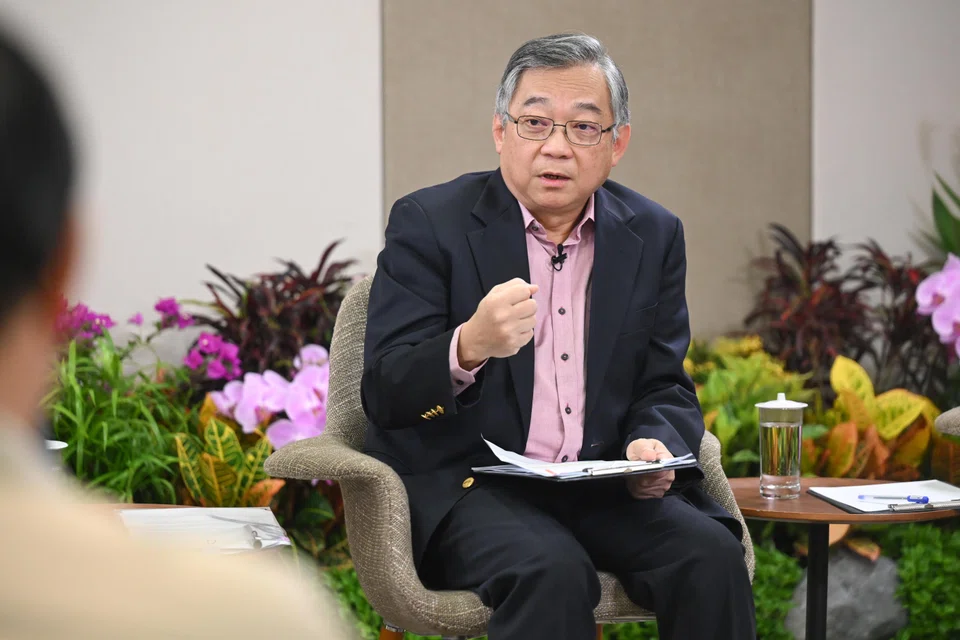
[SINGAPORE] Economic growth will be harder to achieve amid challenging global conditions and can no longer be counted on to generate good jobs, said Deputy Prime Minister Gan Kim Yong as he gave an update on the national review of Singapore’s long-term economic strategies.
“It is going to be very challenging to achieve economic growth, not the same as we have done before, because the environment we are in… is a new world (and) a changed world,” he added in a media interview on Friday (Jan 30).
The Economic Strategy Review (ESR) committees have proposed seven recommendations to help the country achieve 2 to 3 per cent annual growth over the medium to long term, while securing good jobs for locals.
DPM Gan, who is also minister for trade and industry, said that despite the headwinds, Singapore is still aiming for the higher end of that growth target.
Convened last August, ESR comprises five committees, each co-chaired by two political officeholders and comprising members from the private sector, academia and unions. In all, seven of the 10 co-chairs are first-time officeholders.
They are looking into these areas: strengthening the country’s global competitiveness; leveraging technology and innovation; nurturing entrepreneurship; enhancing human capital; and managing the impact of restructuring.

The government will respond to some of the committees’ recommendations during next month’s Budget 2026 and the Committee of Supply debates. The ESR’s full report will be released in the middle of this year.
Doubling down, branching out
Four of the seven recommendations focus on growth. First, Singapore should double down on its strengths and establish global leadership in key sectors, said Acting Transport Minister Jeffrey Siow, who co-chairs the committee on global competitiveness.
These include advanced manufacturing, semiconductors, specialty chemicals, biotech and finance – sectors that already form a big part of Singapore’s economy, explained Siow.
SEE ALSO



Multinationals in these fields are already here, he noted, and Singapore wants to work with them to “deepen their investments, do more interesting things here, and in some instances, even take more risks”.
Second, the country should also boldly pursue emerging technologies to “push up our growth boundary”, he noted. These include quantum computing, decarbonisation and space technologies – industries where Singapore may not have the “right to win yet”, but wants “to win the right to play”.
This also involves nurturing the next generation of global leading businesses – fast-growing companies that are “not quite” multinationals yet.
These firms tend to be technology and innovation-driven, noted Siow, and are looking for stable jurisdictions with good governance and deep pools of talent and capital. For such companies, Singapore “ticks all the boxes”.
He added: “What we want to do is really actively try to work with them, persuade them to come to Singapore, land here and then continue to grow.”
In parallel, more should be done to help local startups scale – especially regionally and globally – to facilitate better exits for founders at fair valuations, so they can recycle capital into new ventures.
Luring global leaders
The third recommendation is for Singapore to establish itself as a leader in artificial intelligence (AI).
While the country has invested in this area for many years, more funds can be directed towards research, industry applications, talent development and helping small and medium-sized enterprises adopt AI, said Siow.
Fourth, Singapore should support local firms looking to expand overseas more aggressively.
“More countries are doing industrial policies, so it’s much harder for our firms to be able to compete,” he said. But there is room to back them more boldly – helping them take bigger bets abroad so that gains, from overseas profits to good jobs, flow back home, he added.
The next two recommendations focus on ensuring good jobs and opportunities for Singaporeans.
Acting Minister for Culture, Community and Youth David Neo, who co-chairs the committee on human capital, noted that economic transformation is expected to be faster because of new technologies and AI.
The ESR committees’ recommendations are thus aimed at growing good jobs and supporting businesses and workers to transform, he said.
Singapore should broaden the range of good jobs available, and these “should reflect (people’s) aspirations as well as their talents and skills”, said Neo. These should expand across sectors including high-value tech roles, as well as skilled trades and care jobs in social services.
Separately, the country should strengthen skills and lifelong learning to help Singaporeans upskill and reskill throughout their careers.
This requires more flexible pathways that blend training and work to develop industry-relevant skills throughout careers; a national AI workforce strategy to build literacy and fluency across the workforce; and a more nimble career and skills system.
The government should also review how it organises itself to provide stronger end-to-end support for Singaporeans in bridging skills to jobs.
Navigating transitions
The final recommendation looks at how to support businesses to continually innovate and proactively navigate transitions to remain competitive. This could include advisory services to support enterprises to come up with new business models to be more productive.
Asked if this could mean that some businesses could be evaluated to be unsustainable or unviable, DPM Gan replied that many industries that were deemed as “sunset industries” are still here today.
“(If) you are able to continue to… refresh yourself, reorganise yourself (and) remodel yourself, I think you will always be able to stay relevant, competitive and resilient,” he said. “I think no businesses need to be phased out, but it’s important to be very conscious that you need to transform.”
For more of BT’s Budget 2026 coverage, go to bt.sg/budget26
Decoding Asia newsletter: your guide to navigating Asia in a new global order. Sign up here to get Decoding Asia newsletter. Delivered to your inbox. Free.
Copyright SPH Media. All rights reserved.
TRENDING NOW

Once staunchly pro-China, Malaysian Chinese businesses are now distancing themselves from Beijing

Looking beyond looming CEO succession, should UOB potentially pursue a transformative merger?

Could stablecoins be the future of money?

Grab CEO’s wife Chloe Tong on life with Anthony Tan and finding her purpose

