Economists mixed on near-term MAS policy tightening after core, headline inflation ease in September
Some are also revising their inflation forecasts downward


[SINGAPORE] Economists were divided on whether Singapore’s central bank will move on monetary policy in the near term. This comes after official data on Friday (Oct 23) showed slower consumer price increases in September, defying expectations of a slight pick-up.
Some watchers have also lowered their inflation forecasts, following the Monetary Authority of Singapore (MAS) and the Ministry of Energy, Trade and Industry’s (METI) release of the latest inflation prints.
The monetary authority stood pat in its recent October meeting, surprising private-sector economists, who had anticipated a tightening move then.
Core inflation, which excludes accommodation and private transport, eased to 2 per cent in September, lower than August’s 2.2 per cent. This was also below the median 2.3 per cent estimate in Bloomberg’s poll of private sector economists.
The slower increase in prices came on the back of lower inflation for services and retail and other goods.
Meanwhile, headline inflation edged down to 2.2 per cent in September, from 2.3 per cent the month before. This was driven by lower private transport inflation, alongside lower core inflation.
The Bloomberg consensus estimate had been for headline inflation to hit 2.4 per cent.
On a month-on-month seasonally adjusted basis, core prices rose by 0.1 per cent, while the all-items consumer price index (CPI) grew 0.2 per cent in September.
The authorities maintained the official 2026 core inflation forecast at 1.5 to 2 per cent. It also kept its full-year headline inflation forecast of around 2 per cent.
Both projections had been revised during the central bank’s October monetary policy review, from the earlier forecast of 1.5 to 2.5 per cent.
MAS and METI expect imported cost pressures to remain firm for Singapore in the near term.
Their outlook in the latest report was largely similar to the October monetary policy statement.
Energy commodity prices have “risen anew” and should remain high in the near term, while global and regional food prices are also expected to pick up, with production affected by costlier inputs and adverse weather patterns.
But imported inflation is anticipated to ease over 2027 as the effects of temporary supply disruptions fade, they added.
Domestically, the authorities think that price pressures should stay subdued, with unit labour costs in the services sector remaining contained, and some enhanced government subsidies dampening services inflation.
They also maintained that risks to inflation remain tilted to the upside.
Upside risks remain
RHB group chief economist Barnabas Gan and associate research analyst Laalitha Raveenthar said September’s CPI readings suggest that the benign outlook may face renewed challenges if escalating geopolitical tensions trigger further volatility in global energy prices.
They believe that elevated energy prices remain the key upside risk to Singapore’s inflation outlook, particularly amid renewed Middle East tensions.
Food inflation could more persistently apply upward pressure into late 2026 and 2027, as El Nino-related disruptions threaten regional agricultural output, while elevated energy prices remain an upside risk to utilities and transport-related inflation, they added.
RHB thus still expects MAS to tighten monetary policy “very slightly” in the first half of 2027.
Standard Chartered chief economist Edward Lee warned that underlying pressures remain, even as he noted that the latest print “appears to have validated” MAS’ decision to keep the status quo in its October meeting.
UOB associate economist Jester Koh said the September core inflation print is “less benign than the topline figure would suggest”, as the softer increase can largely be attributed to “several idiosyncratic factors”.
“Excluding these effects, the data continues to point to broadening inflationary pressures and ongoing pass-through of elevated upstream costs,” he added.
UOB kept its 2026 core inflation forecast, though it lowered its 2027 full-year projection to 2.1 per cent, from 2.2 per cent.
It expects MAS to maintain the current monetary policy slope settings till 2027, though it believes that risks are still skewed towards a further incremental tightening move in January or April next year.
Higher threshold to move?
Meanwhile, Barclays head of non-China EM Asia economics research Brian Tan said the unexpected core inflation decline supports the bank’s view for the MAS to leave its monetary policy settings unchanged in the near term.
“The central bank’s decision to unexpectedly stay on ‘hold’ on Oct 14 suggests policymakers have finally been convinced that the inflation pressures from the AI boom are limited,” he said.
MAS will likely focus more firmly on “demanding evidence in the near-term inflation outcomes that robust semiconductor-driven GDP growth is leading to demand-pull price pressures”, he said.
Tan believes that it will likely shrug off future positive GDP growth surprises and maintain monetary policy settings, unless core inflation also “(agitates more visibly)” or shows greater signs of broader price pressures from the AI boom or the Middle East conflict.
Barclays also cut its full-year core inflation projections and now expects the figure to come in at 1.6 per cent, down from 1.7 per cent.
Its estimates suggest that the core inflation decline was broad based, said Tan. Its measure of supercore CPI – which further excludes uncooked food, energy (electricity and gas), travel and point-to-point transport from the MAS measure of core CPI – also fell from August, he added.
Maybank similarly trimmed its 2026 core inflation forecast, to 1.8 per cent, from 2 per cent before. It also lowered its headline inflation forecast to 2 per cent, from 2.1 per cent.
These revised projections build in slightly higher core inflation of 2.3 per cent in Q4, said analyst Brian Lee.
He expects that with pressure on near-term imported inflation, businesses may continue passing on operating cost increases and raising prices.
But he added that such passthrough should remain restrained due to subdued consumer demand, amid the cooling labour market.
The bank continues to expect MAS to maintain its current monetary policy settings at its next meeting in January.
Key CPI categories
In September, inflation trends across CPI categories were mixed.
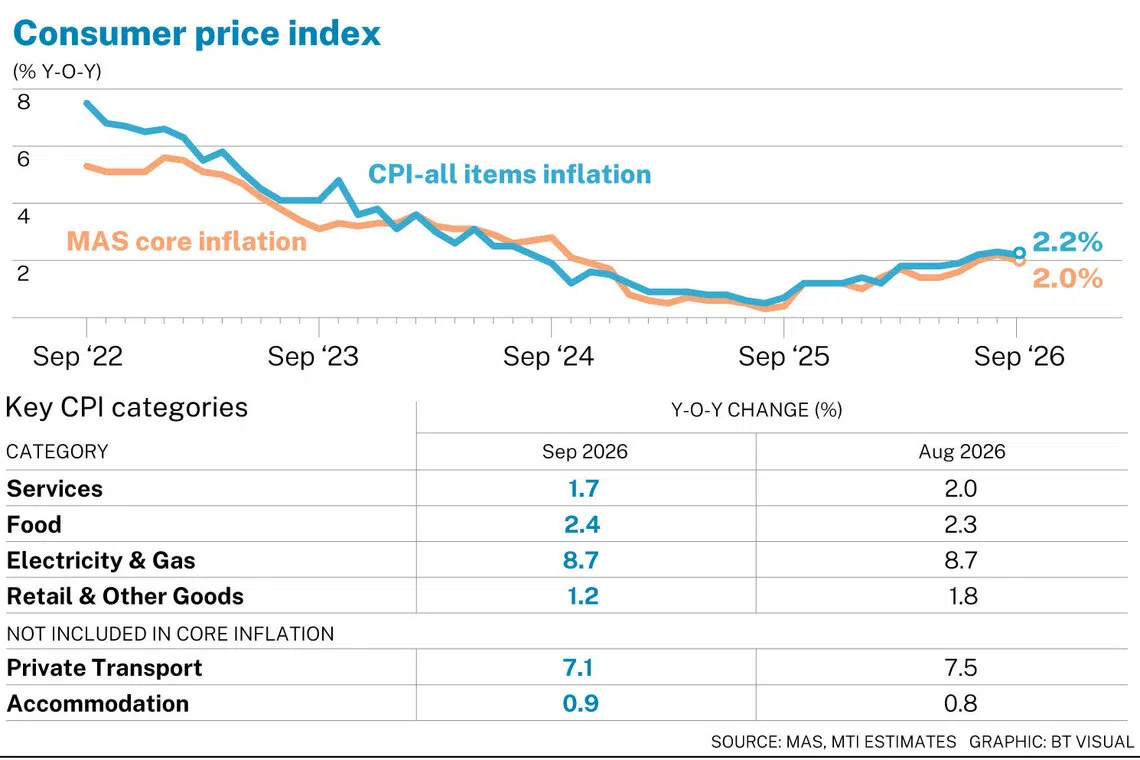
Services inflation eased due to a smaller increase in point-to-point transport service costs and a larger decline in telecommunication service prices.
Retail and other goods inflation moderated, as furniture prices declined and clothing prices rose at a slower pace.
Private transport inflation was lower due to a more gradual increase in car prices.
Meanwhile, electricity and gas inflation was unchanged as electricity prices rose at a similar pace in September as in August.
In contrast, accommodation inflation inched up as rents increased at a faster pace while food inflation rose due to higher inflation in both non-cooked food and food services.