

MAS holds monetary policy settings, pausing after two straight tightenings
Core inflation forecast for 2026 narrows to 1.5% to 2%; central bank sees price pressures easing from mid-2027

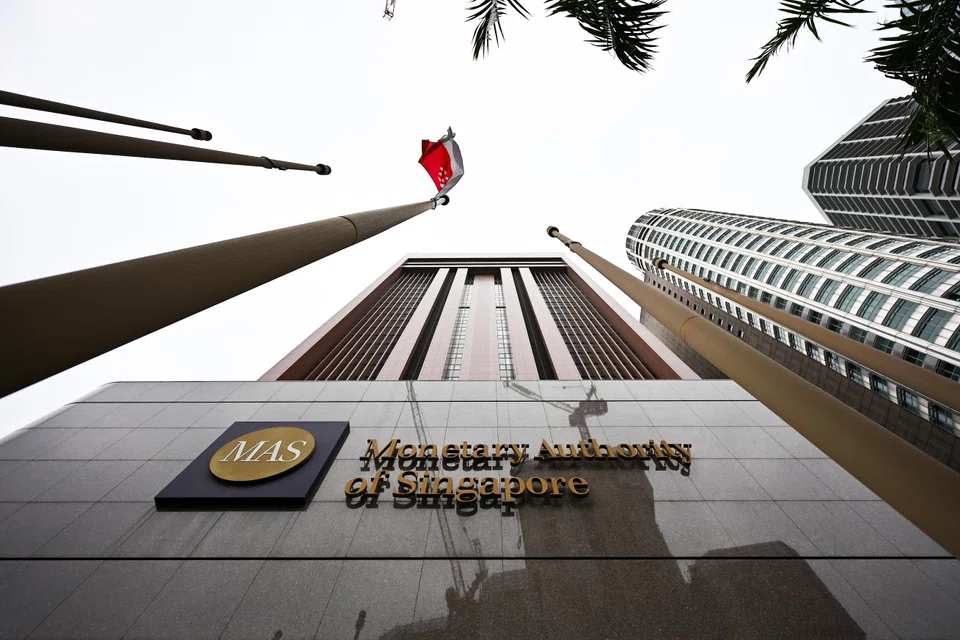
[SINGAPORE] The Monetary Authority of Singapore (MAS) kept monetary policy settings unchanged on Wednesday (Oct 14), pausing after two consecutive tightenings this year.
The central bank maintained the rate of appreciation of the Singapore dollar nominal effective exchange rate (S$NEER) policy band, with no change to the width of the band or the level at which it is centred.
MAS also narrowed its 2026 core inflation forecast to 1.5 to 2 per cent from 1.5 to 2.5 per cent, with headline inflation expected at around 2 per cent.
For 2027, both core and headline inflation are projected to average 1.5 to 2.5 per cent.
The decision surprised most economists, with 17 of 20 in a Bloomberg poll having forecast a steeper slope. Three predicted no change.
MAS said the current policy band “will allow the S$NEER to continue to strengthen and lean against the anticipated near-term rise in imported inflation, ensuring the gradual easing of inflationary pressures in 2027”.
It added that it “is well-positioned to respond effectively to any risk to medium-term price stability and will continue to closely monitor economic developments”.
MAS raised the slope of the S$NEER policy band in April, its first tightening since 2022, as higher energy prices from the Middle East conflict fed through to imported costs.
The central bank tightened policy settings again in July, but by a smaller margin. Analysts estimate the slope was lifted to 1.25 per cent at that meeting; it remains at the estimated level.
SEE ALSO



Since July, the S$NEER has strengthened modestly within the upper half of the policy band, MAS said.
Growth and inflation outlooks
Third-quarter growth was 5.4 per cent year on year, according to advance estimates from the Ministry of Energy, Trade and Industry (METI), led by robust expansions in technology-related sectors.
On a quarter-on-quarter seasonally adjusted basis, growth was 1.1 per cent, slightly slower than in the previous quarter.
METI will announce its 2026 and 2027 growth forecasts in November.
MAS said the economy “should continue to expand at a firm pace in the immediate quarters ahead, and moderate thereafter as the AI (artificial intelligence) cycle eases from its exceptional pace and global financial conditions tighten”.
The central bank expects the positive output gap this year to narrow through next year.
Core inflation rose to 2.1 per cent in July and August from 1.5 per cent in the second quarter, as higher import costs passed through to a broader range of goods and services.
Food inflation increased to 2.2 per cent from 1.9 per cent. Services inflation, however, came in lower than projected, held down by enhanced government healthcare subsidies and more intense competition in telecommunications services.
Energy commodity prices have risen anew since September and are projected to stay high in the near term, MAS said.
Stronger imported cost pressures will keep core and headline inflation slightly elevated in the coming months, it added.
Core inflation is then expected to ease “more discernibly from mid-2027” as import costs ebb and domestic price pressures stay subdued.
MAS said risks to inflation remain skewed higher. “For now, the risks to inflation remain tilted to the upside.”
A sharp and sustained surge in energy or food prices could lift import costs by more than forecast, while domestic inflation could stay elevated if spillovers from the AI boom broaden and unit labour costs rise faster.
On the other side, a sharper pullback in AI-related investment or higher-than-expected interest rates could weigh on growth, and Middle East energy supply could recover faster than projected.
Decoding Asia newsletter: your guide to navigating Asia in a new global order. Sign up here to get Decoding Asia newsletter. Delivered to your inbox. Free.
Copyright SPH Media. All rights reserved.






