

Economists raise full-year GDP forecasts after growth hits 5.4% in Q3, beating estimates
The manufacturing sector is up by 7.5% year on year in the 3 months to September, from 12.9% in Q2

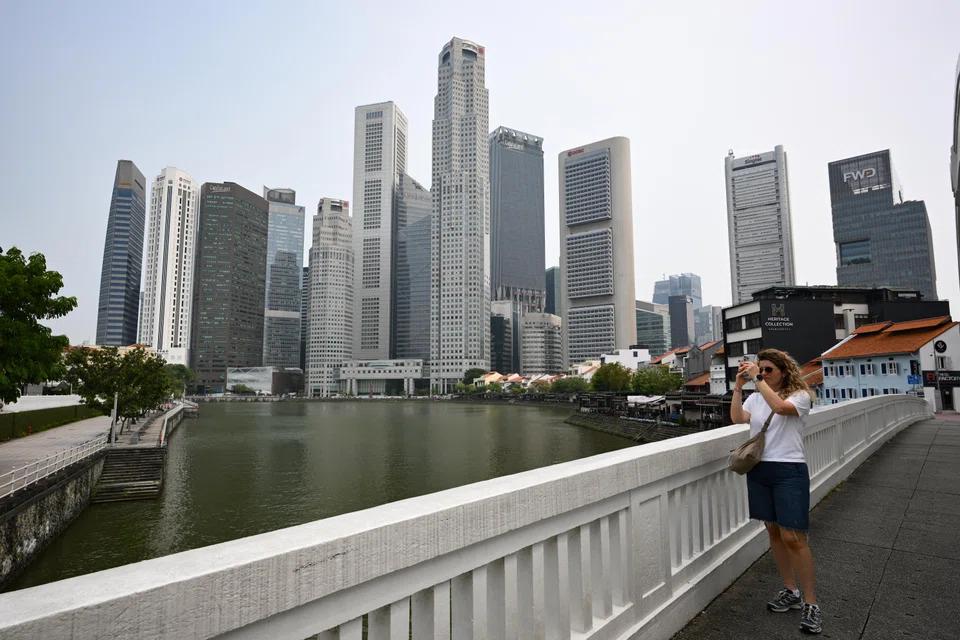
[SINGAPORE] Private-sector economists have raised their full-year 2026 gross domestic product growth forecasts, after the third-quarter figure surpassed consensus estimates and earlier data was revised higher.
The Republic’s economy expanded 5.4 per cent year on year in Q3, moderating from the previous quarter’s 6.2 per cent, advance estimates from the Ministry of Energy, Trade and Industry (METI) showed on Wednesday (Oct 14) morning.
This was higher than the 5.1 per cent consensus estimate, based on a Bloomberg poll of private-sector economists.
On a seasonally adjusted, quarterly basis, GDP rose 1.1 per cent, extending the 1.5 per cent growth in the second quarter.
Stronger growth expectations
UOB, DBS, OCBC and Maybank have raised their GDP growth forecasts for 2026; RHB has maintained its projection at 5 per cent, but with upside risks towards 5.4 per cent in 2026.
RHB’s group chief economist Barnabas Gan and associate research analyst Laalitha Raveenthar said the bank’s call was underpinned by the stronger-than-expected year-to-date performance and a sanguine outlook for the remainder of the year.
Growth has continued to be supported by sustained artificial intelligence related tailwinds, observers agreed.
The year-on-year Q3 outturn exceeded UOB’s 5.2 per cent forecast, while the first-half figure was upwardly revised, its associate economist Jester Koh said.
To reflect this, UOB has raised its 2026 GDP growth forecast to 5.7 per cent, from 5 per cent previously, exceeding METI’s official forecast range of 4.5 to 5.5 per cent.


DBS also raised its 2026 estimate to 5.7 per cent from 5 per cent, which senior economist Chua Han Teng and senior FX strategist Philip Wee said factors in the stronger-than-expected expansion in the first three quarters of 2026, as well as expectations for normalised but firm and above-potential growth in the coming quarters.
Maybank analysts Chua Hak Bin and Brian Lee similarly raised their projection to above the current official forecast, which they expect would be upgraded in November.
They now project full-year GDP growth of 5.6 per cent, up from 5.2 per cent previously.
OCBC chief economist Selena Ling said the headline growth moderation in Q3 reflects a normalisation in manufacturing expansion, though she also noted the resilient electronics performance.
Sectoral breakdown
Manufacturing rose by 7.5 per cent year on year in Q3, slowing down sharply from the 12.9 per cent expansion in the preceding quarter.
Still, given that GDP growth already averaged 6 per cent in the first three quarters of this year, risks to growth are firmly skewed to the upside, she said. She upgraded her full-year forecast to 5.5 per cent, from 5.2 per cent, bringing it in line with the upper end of the official range.
Commenting on the manufacturing sector’s performance in Q3, METI said that the growth “was supported by output expansions in the electronics, precision engineering, transport engineering and general manufacturing clusters, which outweighed output declines in the chemicals and biomedical manufacturing clusters”.
Maybank’s duo said electronics and precision engineering benefited from sustained worldwide spending on AI infrastructure and technologies.
The construction sector grew 8.8 per cent on the year, faster than the 6.1 per cent growth recorded in the preceding quarter, as both public and private-sector construction output increased.
The Maybank analysts flagged that ongoing transport, housing, semiconductor plant expansions and energy transition infrastructure likely underpinned the sector’s performance.
The overall services sector expanded 5.2 per cent year on year in Q3, the same pace as in Q2, led by wholesale trade and transportation and storage.
The wholesale and retail trade and transportation and storage industry, taken together, gained 8 per cent year on year, picking up from the 6.9 per cent growth of the preceding quarter.
Watchers noted the activity in the machinery, equipment and supplies segment of wholesale trade, amid continued AI-related tailwinds.
The information and communications, finance and insurance, and professional services cluster achieved a 4.3 per cent year-on-year expansion in Q3, easing from Q2’s 5.1 per cent growth.
The cluster comprising accommodation and food services, real estate, administrative and support services, as well as other services, rose 2.1 per cent on the year, slowing from 2.4 per cent in Q2.
Diverging performances
While sectors, especially those with AI-related activity, turbo-charged growth, some consumer-facing and other domestic services lagged, watchers noted.
Said Ling: “This divergence creates a dual-speed expansion where businesses linked to construction, trade and advanced electronics may continue to benefit from strong demand, while consumer-oriented sectors face a more challenging environment, especially on the domestic cost front and tightening financial conditions.”
Forward indicators remain constructive, with the September manufacturing and electronics Purchasing Managers’ Indexes (PMIs) improving, observers added.
But Ling said base effects are likely to weigh on growth momentum in H2 2026, considering that the global AI boom became entrenched in the second half of 2025.
Maybank’s duo believes GDP growth will remain resilient in Q4, with AI-related external demand bolstering activity in the electronics, precision engineering, wholesale trade and air transport industries.
The banking sector should benefit from solid credit demand from the strength of outward-oriented activity and infrastructure, and housing construction activity will likely remain robust, they said. But they believe that domestic conditions are less buoyant, given the softening labour market.
Meanwhile, the Monetary Authority of Singapore on Wednesday morning kept its Singapore dollar nominal effective exchange rate policy settings unchanged, bucking private-sector economists’ market expectations. The move came after two consecutive policy tightenings earlier this year.
Decoding Asia newsletter: your guide to navigating Asia in a new global order. Sign up here to get Decoding Asia newsletter. Delivered to your inbox. Free.
Copyright SPH Media. All rights reserved.
TRENDING NOW

Once staunchly pro-China, Malaysian Chinese businesses are now distancing themselves from Beijing

Looking beyond looming CEO succession, should UOB potentially pursue a transformative merger?

Could stablecoins be the future of money?

Grab CEO’s wife Chloe Tong on life with Anthony Tan and finding her purpose

