AI may boost individual productivity but undermine workplace innovation: panellists
It could lessen collaboration among colleagues and crimp the diversity of ideas within organisations

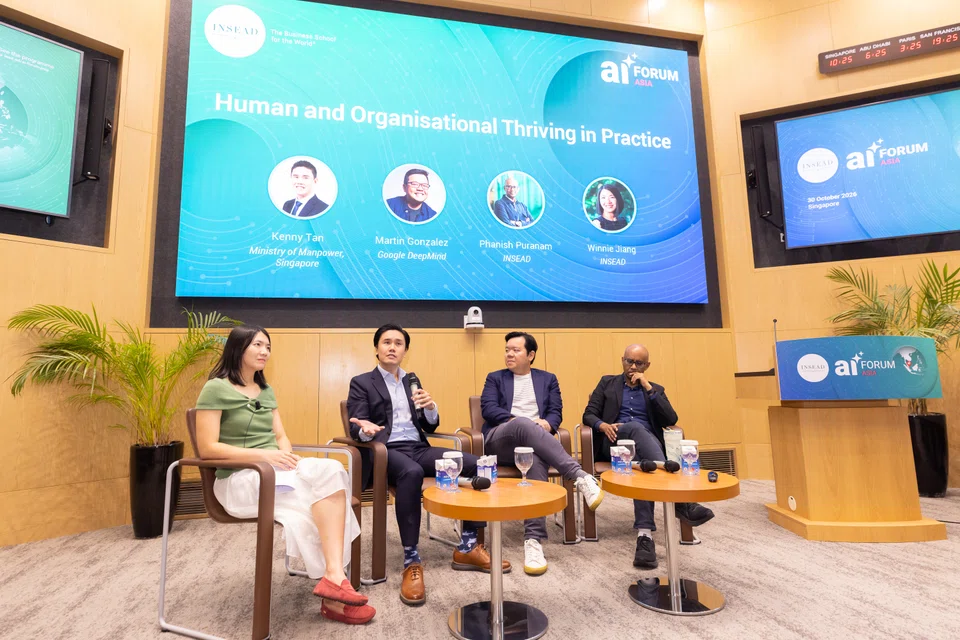
[SINGAPORE] Artificial intelligence may make employees more productive, but their growing reliance on the technology could also reduce workplace collaboration and undermine innovation, researchers have warned.
As workers increasingly turn to AI tools for answers instead of consulting colleagues, organisations risk losing the human interactions that foster creativity and transmit workplace culture, said Martin Gonzalez, head of organisational AI research at Google DeepMind.
He described this phenomenon as a “self-sufficiency spiral” during a panel discussion at the Insead AI Forum Asia on Friday (Oct 30).
Following the forum, Insead launched its Research Lab for Human and Organisational Thriving, backed by US$3 million in funding from Google.org and Google DeepMind.
Gonzalez, following through on the idea of a “self-sufficiency spiral”, said that new employees now ask AI chatbots questions, where they would previously approached their managers or colleagues.
This means they learn to work more independently, but he asked what organisations might lose as interactions between employees tail off.
Referring to exchanges and even disagreements among colleagues, he said: “Innovation emerges from a clashing of ideas. In the process of going about that painful kind of back-and-forth, you discover new ideas.”
Workplace culture is similarly transmitted through such interpersonal interactions, he added.
“When you have less interaction over time, how do you actually build culture and organisation? I think there are all these big questions that we need to be doing research on.”

The concern extends beyond workplace relationships to the diversity of ideas generated within organisations.
Another panellist, Phanish Puranam, a professor of strategy and the Roland Berger chaired professor of strategy and organisation design at Insead, said studies have found that while AI can improve the quality of ideas produced by individuals, it may also narrow the collective range of ideas.
“Individual users’ ideas get better. Collective pool of ideas shrink in diversity,” he said.
“That’s a collective action problem, which, in some sense, is more worrying.”
Gonzalez suggested that this could be because AI models tend to steer users towards established solutions, potentially resulting in different employees arriving at similar ideas.
This presents a challenge, Prof Puranam said, because the diversity of ideas is important for innovation, even as employees have strong incentives to use AI for immediate productivity gains.
Gonzalez cited preliminary findings from a randomised experiment involving teams undertaking brainstorming exercises, some assisted by AI agents.
Teams working with AI agents appeared to converge on ideas around eight minutes faster than those without them, but they explored a narrower range of possibilities and felt less ownership over the ideas generated.
Researchers are still collecting data on this thesis, he cautioned.
To preserve independent thinking, Gonzalez said he deliberately avoids using AI to produce the first drafts of his writing, preferring to develop his own ideas before using the technology to refine or challenge them.
Prof Puranam suggested that teams could use individually personalised AI tools rather than rely on a shared AI agent. This is because the tools adapt to each user’s context and may therefore generate a variety of responses to similar questions, helping to preserve diversity of thought.
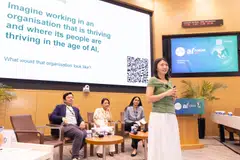
Winnie Jiang, the academic director of Insead’s Research Lab for Human and Organisational Thriving, described “thriving” as encompassing both learning and vitality – the sense of feeling energised and engaged in meaningful activity.
“Thriving is not simply about feeling good; it’s also about growing well,” she said.
The lab aims to advance research into what enables individuals and organisations to thrive amid technological change, including how more people can benefit from AI.
“We still have a lot to learn about what enables human organisations to thrive in the age of AI,” she said.
Its research will focus on three areas: learning, working and relating, and Jiang hopes to translate the findings into practical solutions for organisations, including those in Singapore.
Decoding Asia newsletter: your guide to navigating Asia in a new global order. Sign up here to get Decoding Asia newsletter. Delivered to your inbox. Free.
Copyright SPH Media. All rights reserved.