Manufacturing has thousands of jobs to fill. But can it shake its image problem?

As Singapore doubles down on advanced manufacturing, companies want to show job seekers that factory jobs have changed

Summarise
Low Youjin
Published Mon, Sep 7, 2026 · 07:00 AM
    • Singapore’s advanced manufacturing sector generated over S$135 billion in value in 2024, and S$800 million has been set aside for a  semiconductor research flagship.
    • Singapore’s advanced manufacturing sector generated over S$135 billion in value in 2024, and S$800 million has been set aside for a semiconductor research flagship. PHOTO: BT FILE

    [SINGAPORE] In Yantai in north-east China, some 6,000 km from Singapore, 26-year-old software engineer Xavier Loh was trying to reconcile three parties’ conflicting requests involving software controlling equipment to be used on board a ship.

    He had to find a solution everyone could accept – not merely rewrite the code.

    That may not sound like manufacturing, but the recent naval architecture and marine engineering graduate works for Nordic Flow Control, developing software that monitors water levels and controls valves aboard vessels, helping to keep them balanced and safe.

    The role is far removed from what his family imagined when he joined the manufacturer.

    “My mum was very worried about me,” the Singapore Institute of Technology alumnus told The Business Times. “All of them pictured repetitive factory work … and a lot of hard labour.”

    Instead, he spends much of his time adapting software to different vessels and customers’ requirements, with each project presenting different problems to solve.

    His experience points to a broader disconnect between what many Singaporeans think a manufacturing job looks like and the jobs that are increasingly being created in the sector.

    Where the jobs are

    That disconnect matters because Singapore continues to bet on manufacturing, which accounts for about a fifth of the country’s gross domestic product. The sector grew 12.2 per cent year on year in the second quarter of 2026.

    There were 8,500 manufacturing vacancies in March, the third-highest among broad sectors tracked in the government’s first-quarter labour market report.

    More jobs are in the pipeline. Investments secured by the Economic Development Board in 2025 are expected to create 15,700 jobs over five years, 37 per cent – more than a third – of them in manufacturing.

    An electronics and semiconductor career fair in January had nearly 1,000 openings.

    Singapore is continuing to invest in advanced manufacturing. The inaugural Research, Innovation and Enterprise (RIE) 2025 report said the sector generated more than S$135 billion in manufacturing value in 2024; RIE2030 will include S$800 million for a semiconductor research flagship aimed at anchoring high-value R&D and manufacturing in Singapore.

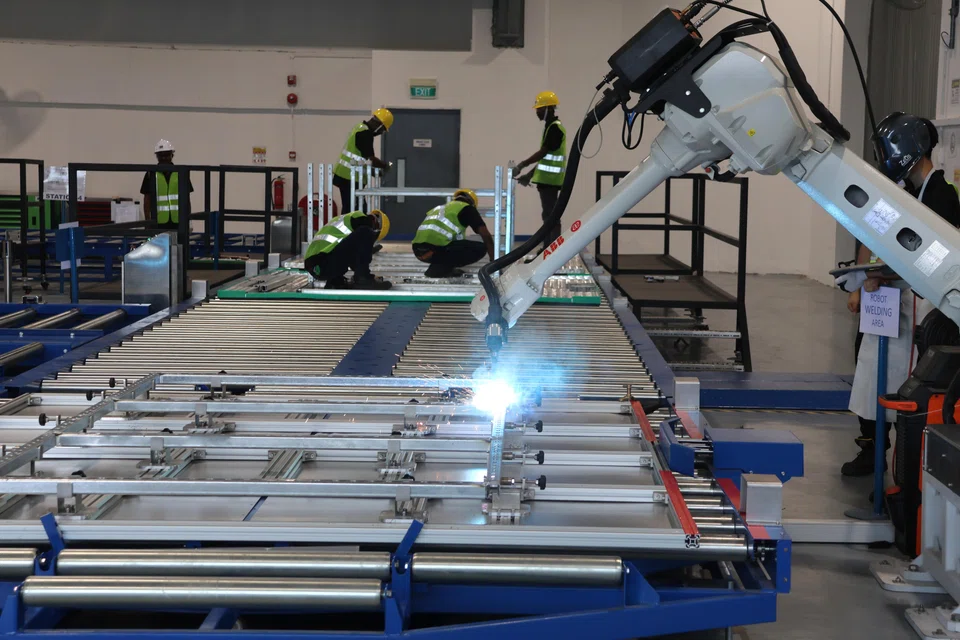
    The jobs are also broader than the traditional image of workers on a production line. The roles range from automation and AI to software, data and supply-chain planning.

    Yet getting Singaporeans to consider these opportunities remains a challenge.

    An ongoing challenge

    An analysis by the Singapore Manufacturing Federation (SMF) of 126 online discussions between 2021 and 2025 found that the three leading narratives about manufacturing were all negative:

    • The sector is where school under-performers end up;
    • Jobs in the sector could be replaced by automation; and
    • Such jobs are associated with poor work-life balance.

    SMF president Lennon Tan acknowledged that manufacturing has an image problem, and that the vacancies in the sector are not simply a result of insufficient talent, he said.

    “We do churn out enough engineers, but ultimately, how many of them land a manufacturing or engineering job? That’s always the challenge,” he said, noting that many young people are instead being steered by their parents towards fields like finance or IT. 

    Some concerns are grounded in the realities of manufacturing. Plants that operate around the clock require shift workers, and factories are typically located far from residential and commercial centres.

    Companies cannot simply advertise those drawbacks away.

    Tan said employers themselves need to offer “a job with dignity”, an attractive career pathway and a working environment that appeals to younger workers.

    Rolls-Royce said it remains able to attract fresh graduates into roles such as manufacturing and digital engineering, with many applicants already interested in aerospace. PHOTO: BT FILE

    Aerospace has an easier sell

    The recruitment problem is not uniform across manufacturing.

    Rolls-Royce said it remains able to attract fresh graduates into roles such as manufacturing and digital engineering, and many applicants are already interested in aerospace.

    Its spokesperson said aerospace has an advantage: its major companies are well-known and young people already find the industry interesting. 

    “I think the brand name helps,” said the spokesperson, “They see what we are doing and think ‘Hey, this is cool’, and they are happy to join us.” 

    Still, the spokesperson acknowledged that although the firm is able to recruit younger workers for white-collar positions, it is harder to woo local young people into technician roles, which involve shift work and can require specialised technical skills. 

    But attracting young workers is only part of the challenge. Keeping them in manufacturing requires companies to offer a longer-term career proposition. 

    Rolls-Royce said some of its engineers who joined after graduating have stayed for five to eight years, and opportunities to move across engineering disciplines and into areas such as account management, sales and commercial roles are available. 

    Technicians can also progress towards associate engineer roles and pursue further qualifications.

    For someone interested in how things work, the attraction of aerospace is also unusually tangible: Employees can apply what they learnt in school and “see whatever you have developed and created literally taking flight”, the spokesperson said.

    The question for the rest of manufacturing is whether it can build a similarly compelling proposition.

    Frencken Group president Dennis Au says technology is key to making manufacturing more attractive to young workers. PHOTO: BT FILE

    Not your old factory job

    Frencken Group president Dennis Au readily acknowledges the competition.

    “A factory environment is never as sexy as sitting in the LinkedIn or Amazon office,” he said. “We don’t have that, right? So we need to figure out other ways to make it attractive to them.”

    His pitch is technology. Frencken, he said, works at the “leading edge”, including in automation and AI.

    Au pointed to employees experimenting with AI tools to automate processes, with the work increasingly about improving and automating those processes. Contrast this with factories of the past, with their rows of operators working at machines.

    Applied Materials is seeing a similar shift. On its Tampines campus, robots, automated assembly and testing and AI-assisted quality inspection are used for the routine activities, freeing workers to troubleshoot problems and improve processes.

    “Automation does change the mix of roles and skills we need, but it does not reduce the need for talent,” said Brian Tan, its regional president for South-east Asia.

    This is because more sophisticated systems need people to operate, maintain and improve them.

    The changes are not confined to large advanced manufacturers.

    At See Hai Tat Medical Hall, which makes the Three Star Brand medicated oil, business development director Tan Yu Chuan said younger employees rotate through production processes and are exposed to planning, scheduling and forecasting.

    Some who started in design or brand development have moved into production roles, he said, which reflects the increasingly multidisciplinary nature of manufacturing. 

    “You do not need to be an engineer to build a career in this industry,” said Tan of Applied Materials. 

    “Semiconductor manufacturing has become increasingly multidisciplinary, and we need a curious mind, learning agility and a much broader range of capabilities to support it.”

    Applied Materials has thus hired people with backgrounds in science, software and data, alongside those in business and support functions.

    Singapore Manufacturing Federation president Lennon Tan says parents are a strong influence on their children’s career choices. PHOTO: BT FILE

    Changing perceptions

    For SMF, the next step is making more young Singaporeans – and their parents – aware of these possibilities.

    The federation is working with the Ministry of Trade and Industry to attract more science, technology and engineering students into manufacturing; digital campaigns are being planned from October until 2028, which will spotlight engineers who went on to become managers, entrepreneurs and business owners.

    Parents are part of the effort too. SMF’s research found they can strongly influence career choices.

    SMF’s Tan also believes manufacturing and engineering careers can offer some resilience as AI reshapes work, because experience and domain knowledge accumulate over time.

    “In manufacturing, your experience helps you become more entrenched in the sector. So you become more valuable as time goes by,” he said.