

NDR 2026: Parenthood policy reset is a window for rethink
New measures address economic concerns, must also respond to social changes
Annabeth Leow

SINGAPOREANS are generally a risk-averse lot – in a word, kiasu.
Given a culture that prefers to weigh costs and benefits before pursuing action, the decision to say no to having children has become framed as a rational economic choice.
In seeking to bring down the costs of parenthood – its direct financial burden, demands on time, and elevated housing and transport needs – the measures unveiled in this year’s National Day Rally make a commendable effort to address parents’ economic pain points.
Show me the money
But, with the Republic’s low birth rate ultimately an existential question around long-term social and economic sustainability, what’s at stake is also policymakers’ capacity to envision and react to the needs and ideals of a fundamentally different future Singaporean society.
Prime Minister Lawrence Wong on Sunday (Aug 23) announced ambitious enhancements to pro-parenthood policies – including a larger, cash-heavy SG Child Support Package that will provide funding of up to S$62,000 for each child from birth to age 17.
Public surveys have consistently put financial costs and economic security among the top barriers for childless individuals when it comes to family planning decisions.
These results suggest that satisfactorily assuaging couples’ monetary and time concerns could convince more Singaporeans to have their first child.
Indeed, higher cash incentives, more work-life balance and lower childcare costs were each cited by one-third of adults in a poll from YouGov in July as likely to encourage parenthood.
Singapore’s resident total fertility rate (TFR) is a figure with existential implications. The record low of 0.87 children per woman in 2025 raises the spectre of a population that cannot replace itself.



Besides the societal strain brilliantly depicted in Alfonso Cuaron’s dystopian film Children of Men, the economy faces inevitable suicide from a shrinking pool of workers and consumers.
Given that a healthy amount of net migration injects talent and wealth into the economy, it is neither necessary nor feasible to boost the TFR to the natural replacement threshold of 2.1 last recorded in 1975.
But the latest measures – which are hardly an insignificant investment for the state – could move the needle on TFR and births by encouraging a bigger base of families with one or two children, rather than concentrating undue attention on the minority with three or more.
Singapore’s vaunted tripartite model also allows other financial levers to be pulled – a useful approach, since policy improvements to work-life balance require private-sector buy-in.
For instance, the enhanced reimbursements for parental leave announced at the rally should give employers the wherewithal to deploy manpower more nimbly.
In line with earlier schemes such as the Ministry of Manpower’s Work-Life Grant and the NTUC U Flex Family-Friendly Grant, companies could be offered new grants and tax incentives to innovate future business models that promote growth by supporting workers.
Reimagining social structures
Singapore’s marriage and parenthood policy has long been shaped by expectations that made sense decades ago – but may not apply to changing household and living conditions.
Levy rebates for employing live-in migrant domestic help, for instance, may make less of an impact for a generation that prioritises limited personal space in smaller, costlier homes.
Billed as a policy “reset”, the rally’s pro-parenthood package offers long overdue recognition of social shifts that affect citizens’ family formation patterns.
Unlike the previous exclusion of the children of unmarried parents from the Baby Bonus Scheme’s cash gift, the new package makes no mention of marital status.
Notably, policymakers are now also introducing parity in the level of infant care and childcare subsidies available to working and non-working parents alike.
This marks a significant change from the earlier iteration, which allotted higher subsidies to working “subsidy applicants” – defined as mothers, unless children had single fathers.
Mothers are no longer assumed to be default caregivers who are at risk of leaving the workforce if they are not provided with adequate childcare support.
Instead, the new subsidy scheme better accommodates alternative family arrangements. For example, fathers may opt to take on the bulk of childrearing, or both parents could work on a flexible basis in a “1.5-income” household, rather than single or dual-income.
In other words, the evolving approach to infant care and childcare subsidies signals that the door is opening to an economy and a society where more diverse life models can co-exist.
But, despite progress made, some proposals could push the boundaries a bit further.
To be sure, the government moved last year to double paid paternity to four weeks and to introduce 10 weeks of shared parental leave.
Still, extending infant care subsidies – even as the duration of government-paid maternity leave has been kept unchanged at 16 weeks since 2008 – seemingly normalises the reliance on institutional caregiving for babies at an age where parents may prefer to be full-time caregivers.
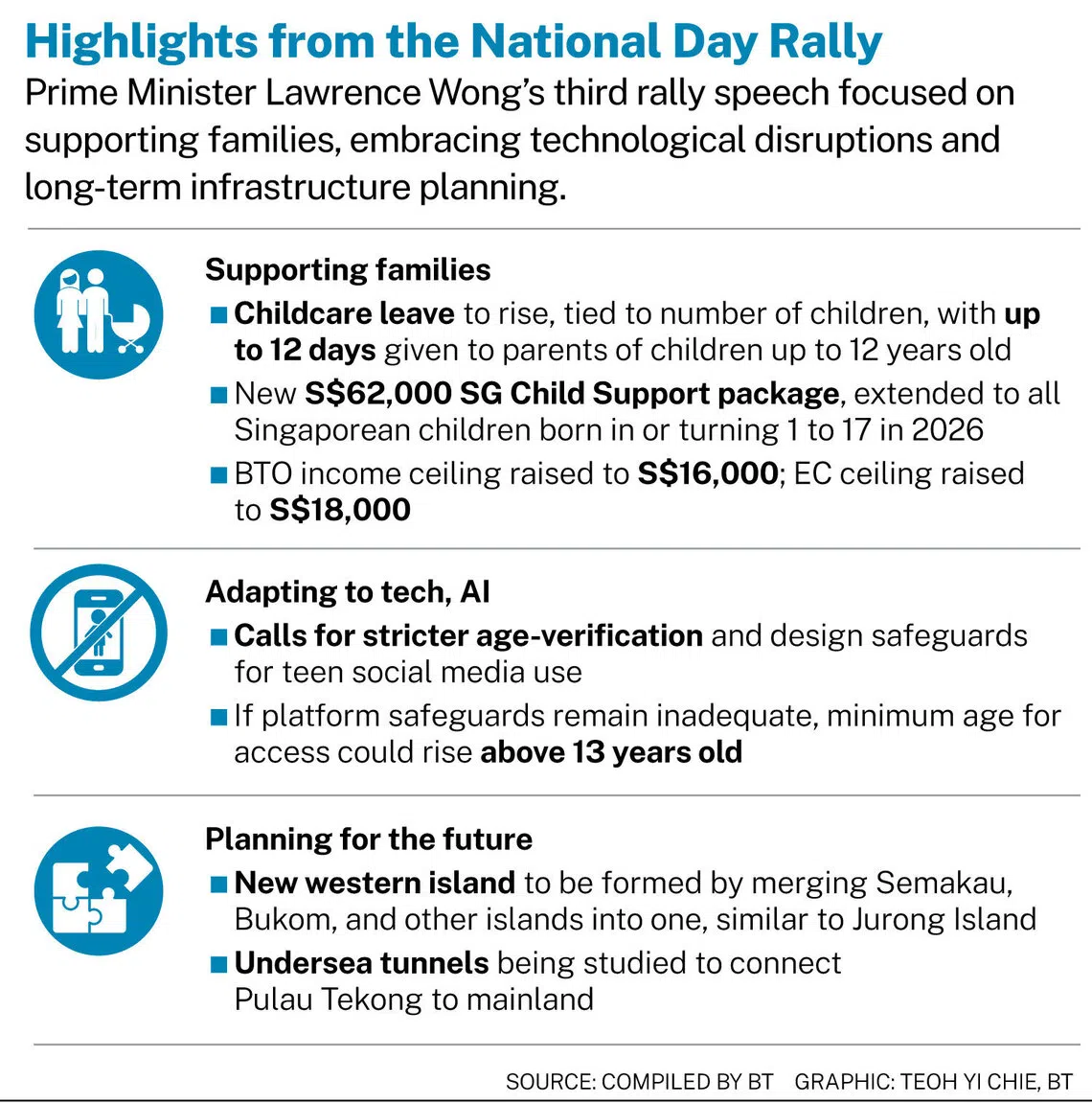
Meanwhile, extra Build-To-Order and Sale of Balance Flats ballots for certain categories of parents do go a long way to address concerns about housing access for growing families.
But the move also assumes young couples are buying their first and forever home together from the Housing and Development Board, when some newlyweds may already be 30-somethings in a private “shoebox”.
If the Marriage and Parenthood Reset Workgroup is serious about the reset button, then there needs to be better anticipation of and a faster response to 21st-century family structures.
The benefits that this National Day Rally’s parenthood package will afford parents and children are considerable and should be celebrated. But there is still some room to be much bolder.
Decoding Asia newsletter: your guide to navigating Asia in a new global order. Sign up here to get Decoding Asia newsletter. Delivered to your inbox. Free.
Share with us your feedback on BT's products and services
TRENDING NOW

S$8 billion wiped off OCBC value as shares slide 5.8% in heavy trade

Grab CEO’s wife Chloe Tong on life with Anthony Tan and finding her purpose

Brookfield denies accusation it cut Soilbuild out of Mapletree deal

8 public officers referred to police over property buys near unannounced MRT stations: Chan Chun Sing

