

Political salary framework is flexible, goes beyond numbers: Chan Chun Sing
Market benchmark remuneration widens field of leadership candidates, he adds
Annabeth Leow
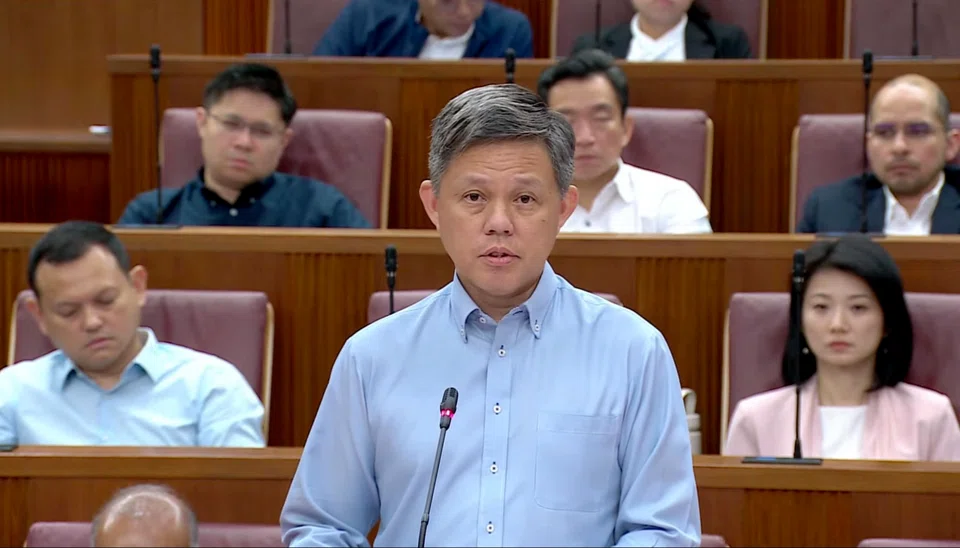
[SINGAPORE] Singapore’s political salary framework grants the flexibility needed to put together a varied and capable team of leaders, Coordinating Minister for Public Services Chan Chun Sing told Parliament on Thursday (Sep 10).
He added that while money should not be the primary consideration for political service, it may be a practical consideration and should be discussed “openly, honestly and frankly”.
“Beyond all the numbers, beyond all the formulas, it is about building a system to give future generations a better chance to assemble a strong team to take Singapore forward, come what may,” said Chan, who is also minister-in-charge of the public service.
How best to peg?
In the debate on the move to increase the salaries of political appointment holders, numerous MPs questioned pegging politicians’ pay to the highest private-sector Singaporean earners.
Chan replied that market benchmark remuneration can widen the field of potential candidates for political leadership, “to maximise our chances of success”, lest the government be constrained to choose from only those who can afford to step forward.
Still, he agreed with Nominated MP Kenneth Goh’s suggestion to look into benchmarking ministerial salaries against roles that require similar skills and carry comparable responsibilities, rather than the top 1,000 of citizens in the private sector.
“The top 1,000 was never intended to identify jobs comparable to the ministers. It served as a broad proxy,” said Chan. “We would like to find job roles that are more comparable, rather than just from a financial perspective.”
But he added that the task of identifying those roles might still limit the benchmark to a narrow group comprising positions such as corporate executives, doctors and lawyers.
Meanwhile, Chan noted that many capable citizens have built successful careers – both in Singapore and abroad – across a range of sectors, including academia and the social sector.
“Many of them are doing meaningful and exciting work, earning good incomes, and contributing without having to enter politics,” he said.
“But we all agree that political service asks something more from all of us.”
Top dollar not guaranteed
Asserting that pay does not compensate high-flyers for what they relinquish to enter politics, Chan added: “We have to be frank. Actually, the more political appointment holders are paid, the greater the scrutiny they will be under, the higher the expectations and demands.”
He also emphasised that not every minister will have their pay increased to the full reference salary of S$1.8 million, which will take effect from Oct 15.
Not only will serving ministers receive only a smaller one-off increment of up to 9 per cent, but the government is also widening the range of salaries centred around the benchmark.
“These widened salary ranges cater to three archetypes: the new entrant, the experienced contributor, and the established individual with unique qualities to add to our team,” he said.
Chan also pointed to the inclusion of a variable pay component, which takes into account both individual and national performance, in the ministerial salary structure.
For instance, a minister at the grade with a S$1.2 million reference salary will receive a fixed sum of about S$780,000, with the rest of the pay cheque not guaranteed.
As the latest salary review also included a change to the criteria used to determine the national bonus, Chan disclosed that the tightened income growth and unemployment targets would have cut the national bonus by about one month each year, if applied over the last decade.
“It means that the national bonus will weigh even more heavily on the socio-economic progress of Singaporeans rather than the more abstract GDP (gross domestic product) numbers,” he observed.
Keeping on track
The independent committee that reviewed political salaries also recommended looking into adding a quality-of-life indicator to the determinants of the national bonus.
Chan noted that such a metric must be measurable on a regular basis, adding: “Some of the factors are multi-year results rather than single-year results, and we certainly don’t want to set the wrong KPI (key performance indicator), to encourage or drive the wrong behaviour.”
He also acknowledged different opinions on whether the variable component should be higher, as in the private sector, or smaller, to reflect the nature of political service.
While the independent committee affirmed the present split, “we will continue to look at this as we gain more experience running this framework”, Chan said.
Separately, Chan said that the government will study how to delink mayoral pay and MP allowances from the ministerial salary benchmark, as recommended by the committee.
He emphasised that MPs receive allowances to conduct constituency work – not salaries – because they should have full-time jobs to better represent diverse backgrounds.
The allowances given to MPs to hire legislative and secretarial assistants was not changed in the salary exercise as they did not fall under the terms of the review, but Chan noted that “we will certainly look at how we can update this” as necessary.
Decoding Asia newsletter: your guide to navigating Asia in a new global order. Sign up here to get Decoding Asia newsletter. Delivered to your inbox. Free.
Share with us your feedback on BT's products and services

