Ministerial duties should not be compared with priorities, responsibilities in private sector: MPs
Potential political leaders have more than just money to lose, says Tan See Leng during House debate
Annabeth Leow &
Elysia Tan

[SINGAPORE] Members of Parliament questioned whether political officeholders’ roles could be fairly compared to that of high-flyers in the private sector, during the debate on the review of political salaries in Parliament on Thursday (Sep 10).
The discussion followed Prime Minister Lawrence Wong’s announcement on Tuesday that the salaries of political appointment holders will be going up after the government accepted the recommendations of an independent committee.
The reference salary for a starting-grade minister is being raised from S$1.1 million to S$1.8 million, although PM Wong stressed that current ministers will only get an initial one-off adjustment of up to 9 per cent.
Singapore’s political salaries are benchmarked against the median income of the top 1,000 Singapore citizen earners, with a 40 per cent discount to reflect the ethos of public service.
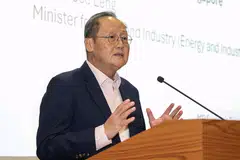
But Minister for Trade and Industry (Energy and Industry) Tan See Leng said that political salaries could still fall short of private-sector pay – and potential leaders have more than just money to lose.
Better comparators
In his speech during the debate, Workers’ Party chief Pritam Singh noted that most ministers are former public servants, rather than hailing from the private sector.
This consideration is “often overlooked when the focus is on ensuring that individuals drawn from the private sector can receive a competitive salary as ministers”, he said, as he proposed that ministerial salaries instead be based on the pay of public-sector appointees.
Similarly, Nominated MP Azhar Othman asked why political compensation is tied to the apex of the private sector, which he said exists to maximise shareholder value.
“But the government is not a corporation. The government’s mandate is fundamentally different from that of a private equity firm,” he added.

Azhar, who is executive chairman of Enercon Asia Group, also pointed to salaries in other governments of nations with comparable standards of living and governance as stronger comparators.
Similarly, Nominated MP Kenneth Goh highlighted that more than half of the comparator group is made of senior managers, over a third work in financial services, and the remainder are professionals.
“My question is why income should determine membership in the comparator group in the first place,” said Goh, suggesting an approach that compares against roles which reflect the skills, judgment, complexity and weight of responsibility expected of political officeholders.
Relatedly, the benchmark should also consider the representativeness of a single year’s income of their expected salary over time, he added.
Yeo Wan Ling (Punggol GRC) was among the People’s Action Party MPs who supported the government’s acceptance of the independent review recommending the salary adjustments.
“But a benchmark must still have a credible basis, and Singaporeans are entitled to scrutinise it,” she noted. “A wage framework does not make a number right simply because a formula exists. What matters is whether there is a credible basis behind it.”
More money elsewhere
In his speech, Dr Tan said that “no realistic level” of ministerial salary could have matched what he was earning before he joined the government in 2020, and that he could have gone on to earn.
“The reality is, that money being my primary consideration, I would have never entered politics,” he said.
He also flagged the longer hours, heavier responsibilities and constant scrutiny. If entry into public service comes at too high a personal cost for too many capable Singaporeans, Singapore’s leadership talent pool will narrow over time, Dr Tan said.
“Ultimately, public service is a high calling, but even callings require deliberate choices.”
He believes the fundamental question is whether Singapore can continue to have people of ability, integrity and experience from every walk of life in political service.
The experiences of entrepreneurs, finance professionals and rapidly rising mid-career executives could benefit Singaporeans if they chose public service, said Dr Tan.
While they would have “enough runway” to learn the ropes from their seniors if they join politics in their prime, he added that opportunity costs – including a financial hit from potentially lower salaries – could cause them to walk away.
Other concerns
Beyond the calculation, MPs also raised other issues about the salary increases.
For instance, with ministerial salaries last reviewed in 2017, Yeo flagged “the long gap between reviews”. Some workers have asked whether it would be better to review salaries more regularly, rather than wait “and have a much larger headline number”, she noted.
Separately, Singh noted that remuneration for community-related roles such as MPs and mayors might be delinked from political officeholders’ in future. He asked the government to explain the scope, role and function of mayors, and whether their office would be retained.
Decoding Asia newsletter: your guide to navigating Asia in a new global order. Sign up here to get Decoding Asia newsletter. Delivered to your inbox. Free.
Copyright SPH Media. All rights reserved.