

Singapore factory output growth eases to 13% in May; electronics to remain key driver
Output in the key electronics sector is up 35.8%, easing from April’s 40.3% increase

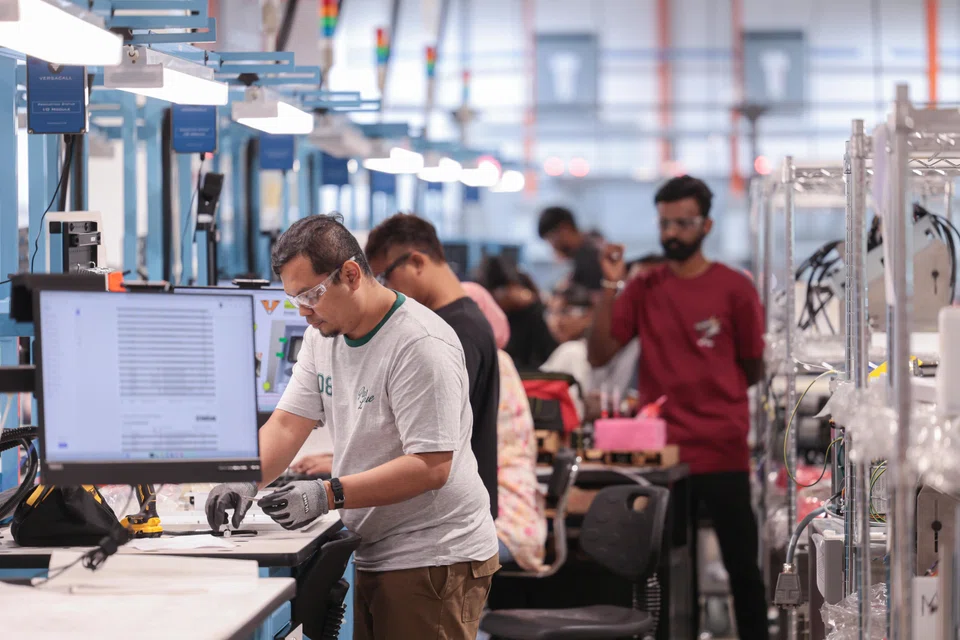
[SINGAPORE] Singapore’s manufacturing sector is expected to remain supported by its strong electronics cluster in the coming months, even as overall factory output growth eased to 13 per cent year on year in May, from April’s revised 16.5 per cent.
Figures released by the Economic Development Board (EDB) on Friday (Jun 26) fell short of the median forecast of 17.5 per cent growth by private-sector economists polled by Bloomberg.
Even so, the linchpin electronics cluster remained the manufacturing sector’s strongest performer; its output rose 35.8 per cent, though this was slower than April’s 40.3 per cent surge.
Performance across the remaining clusters was mixed – precision engineering and general manufacturing grew, and biomedical manufacturing, chemicals, and transport engineering contracted.
Excluding the volatile biomedical manufacturing cluster, manufacturing output rose 17.7 per cent year on year, a slowdown from April’s revised growth of 20.2 per cent.
However, on a seasonally adjusted, monthly basis, output fell 0.7 per cent in May, against April’s revised figure of 6.2 per cent expansion. Excluding biomedical manufacturing, output rose 3.1 per cent, versus the revised 6.3 per cent increase in the previous month.
AI tailwinds
Economists expect the electronics cluster to remain the key driver of Singapore’s manufacturing sector in the coming months, underpinned by sustained demand for artificial intelligence-related products.
Standard Chartered economists Edward Lee and Jonathan Koh said electronics output moderated slightly in May, but remained well above first-quarter levels.
DBS senior economist Chua Han Teng said that the global AI-driven technology cycle, “which has supercharged Singapore’s stellar electronics performance in the past few quarters”, appears to have further room to run.
SEE ALSO


Referring to Amazon, Microsoft, Google, Meta, and Oracle, he added: “Sustained capital spending commitments by major hyperscalers to ramp up AI infrastructure will continue to underpin demand for Singapore’s memory chips, server-related products and semiconductor equipment.”
UOB and Maybank expect AI-related tailwinds to be in play through at least the third quarter and into the second half of 2026, respectively.
Nevertheless, Maybank economist Brian Lee noted that May’s manufacturing growth cooled despite a pickup in non-oil domestic exports (NODX), with manufacturing output expanding 13 per cent year on year versus inflation-adjusted, or real, NODX growth of 31.8 per cent.
He said this suggests “manufacturers may be drawing down on existing inventories to fulfil orders” – possibly a reflection of disruptions in the the supply chain and the extended supplier delivery lead times linked to the Gulf conflict
Lee said production may have been constrained in a reflection of supply chain disruptions and extended supplier delivery lead times related to the Gulf conflict.
He added that May’s purchasing managers’ index pointed to a build-up in order backlogs, slower supplier deliveries and rising input costs despite robust demand.
On the impact of the current US-Iran interim peace agreement, DBS’ Chua said the interim peace deal has reduced the risks of escalating input costs, persistent supply chain disruptions and significantly weaker external demand.
He added that, as maritime traffic through the Strait of Hormuz gradually recovers, the chemicals cluster should receive “crucial relief” from improved availability of imported energy and commodity inputs, potentially supporting a rebound in output in the coming months.
StanChart’s Lee and Koh said supply chains were likely to continue recovering, but cautioned that uncertainty remained elevated.
On Thursday, the Singapore-flagged container ship Ever Lovely was damaged by an unknown projectile off the Omani coast in the Strait of Hormuz, underscoring the lingering risks to shipping in the region.
The incident came after more than a week of relative calm in the strait, following a memorandum of understanding between Teheran and Washington to halt the conflict.
Performance by cluster
The strongest-performing electronics cluster was led by growth in infocomms and consumer electronics (59.2 per cent), followed by semiconductors (37 per cent) and other electronic modules and components (16.8 per cent). This was partially offset by a 5.6 per cent decline in computer peripherals and data storage.
The precision engineering cluster recorded the second highest year-on-year rise in May, at 32.2 per cent.
Within this cluster, machinery and systems rose 38.9 per cent, and the precision modules and components segment, 8.6 per cent.
Output in the general manufacturing cluster rose a modest 1.8 per cent, driven by gains in miscellaneous industries (5.6 per cent) and food, beverages and tobacco (0.7 per cent). These rises were offset by a 10.1 per cent decline in printing.
Biomedical manufacturing contracted 24.2 per cent, the steepest among the clusters. Pharmaceuticals shrank by 41.6 per cent and medical technology, by 18.2 per cent.
The chemicals cluster fell 11.5 per cent, with declines across petroleum (-12.3 per cent), petrochemicals (-42.5 per cent) and specialties (-2.8 per cent). The sole segment that grew was others (17.1 per cent).
The transport engineering cluster contracted 5 per cent, as growth in the land segment (22.9 per cent) was offset by declines in the marine and offshore engineering (-8.4 per cent) and aerospace (-6.3 per cent) segments.
Decoding Asia newsletter: your guide to navigating Asia in a new global order. Sign up here to get Decoding Asia newsletter. Delivered to your inbox. Free.
Copyright SPH Media. All rights reserved.
TRENDING NOW

LTA proposes combining car COE categories, adding rebate-surcharge system

StarHub to acquire MyRepublic’s mobile business amid ongoing telco consolidation

DBS, OCBC, UOB rout lops billions off STI as inflation, rate concerns spook investors

Grab CEO’s wife Chloe Tong on life with Anthony Tan and finding her purpose

