

A bumpy road ahead for some of Singapore’s fresh graduates in their job search
What employers want, and the nature of junior work itself, is changing

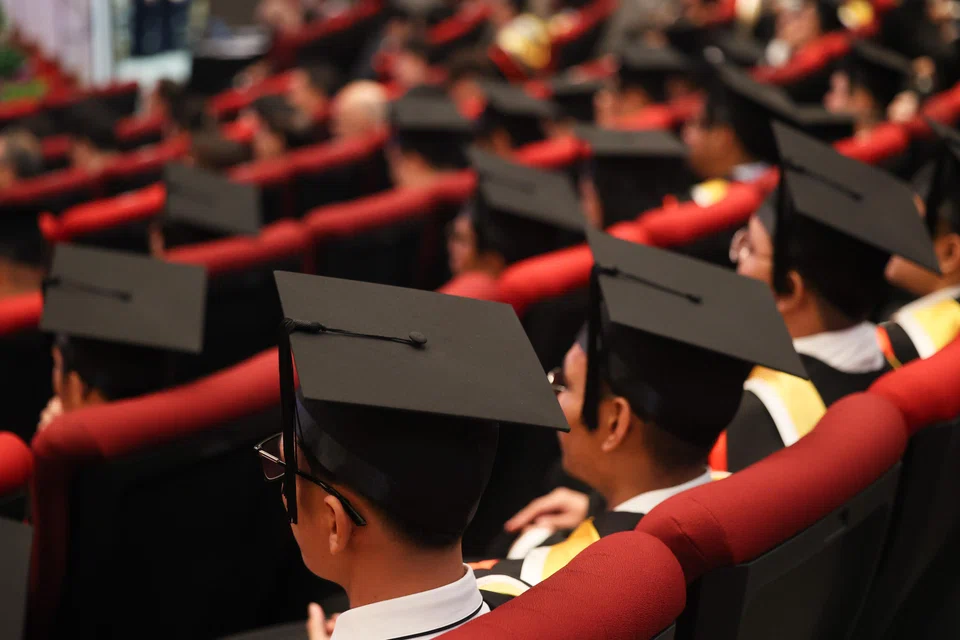
Fresh graduates in Singapore are entering a tougher job market, even as employers continue to have entry-level positions to fill. At the same time, employers are looking beyond academic qualifications, while artificial intelligence is beginning to reshape entry-level work.
In a three-part package, The Business Times examines the changing graduate job market, how students are preparing themselves for work, and what it means for the role of universities.
[SINGAPORE] The road to employment is getting bumpier for some of Singapore’s university graduates.
Earlier in October, Acting Minister for Manpower Jasmin Lau said in Parliament that “fresh graduates are taking longer to secure their first full-time job compared to a few years ago” due to softer hiring conditions in certain sectors.
Separately, although the latest data relates to 2025, the Joint Autonomous Universities Graduate Employment Survey 2025 indicated that it was getting harder to secure employment within six months of graduating.
Released in March, the survey showed some 88.9 per cent of graduates secured employment within six months in 2025, down from 92.9 per cent in 2023.
Meanwhile, the proportion of graduates who applied for full-time permanent jobs but did not receive a single offer within six months of graduation more than doubled to 8.5 per cent in 2025 from 4.1 per cent in 2023.
The labour market that fresh graduates are entering in 2026 is showing further signs of softening, going by the Ministry of Manpower’s (MOM) second-quarter labour market report released in September.
While the report had described the number of entry-level professional, manager, executive and technician (PMET) vacancies as “broadly stable and sizeable”, it had nonetheless fallen to 31,700 in June 2026, from 32,800 three months earlier.
Anecdotally, some fresh graduates reported sending out dozens of job applications before securing a position. Their experiences raise a question: To what extent is artificial intelligence making it harder to find a suitable job?
Jobs available, but not always a match
One explanation is that available jobs may not always match what graduates are looking for.
Citing findings from MOM’s 2025 School-to-Work Transition Study, The Straits Times reported in July that among university graduates who rejected a job offer, 31 per cent did so because the pay was too low, while 26.7 per cent were waiting for a better offer.
Similar mismatches can occur over the type of work graduates are willing to take on.
The Business Times previously reported that Singapore’s manufacturing sector has thousands of vacancies to fill, in areas such as semiconductors and aerospace. Still, companies struggle to attract younger jobseekers because of lingering misperceptions of manufacturing work.
But a mismatch of jobs and people tells only one aspect of the story. Employers are also looking beyond academic qualifications when deciding whom to hire.
MOM’s occasional paper on overqualification in Singapore, published in April, said academic qualifications were not the primary consideration listed under 79.6 per cent of vacancies in 2025.
Instead, employers prioritised relevant experience (48.2 per cent) and skills and abilities (20.1 per cent).
More than qualifications
Yet, that does not mean grades, degrees or fields of study have “become irrelevant”, said Sally Lee, head of people and admin at the Institute for Human Resource Professionals.
But AI has affected the scope of many junior-level jobs.
“Many activities traditionally assigned to junior employees such as basic research, summarisation, drafting, information processing, routine analysis and certain forms of coding, can increasingly be supported or automated,” she noted.
As a result, she said entry-level roles may need to be redesigned to focus more on reviewing outputs, interpreting information, handling exceptions, engaging stakeholders and exercising judgment.
Hence, employers are using different ways of assessing applied capability and potential beyond looking at the paper qualifications.
For instance, Lee said internships, industry projects and work-study experiences “provide useful evidence of how a graduate applies knowledge, solves problems and works with others”.
But she cautioned against expecting fresh graduates to arrive as finished products.
“There is an important distinction between being ready to contribute and being fully job-ready,” she said.
Employers can reasonably expect graduates to have strong foundational knowledge, learn quickly and be willing to contribute from day one, she added.
However, she stressed that hiring managers should not expect them to possess the same organisational knowledge, professional judgment or industry experience as more seasoned employees.
Not displaced, just redesigned
AI is another factor.
MOM’s inaugural report on adoption of the tech among companies, released in April, found that adoption was highest in information and communications (74.1 per cent), professional services (57.5 per cent), and financial and insurance services (56.4 per cent).
These include sectors that are popular among graduates. Financial services, along with IT and telecommunications, were the top two career choices respectively among Singapore respondents in CFA Institute’s 2025 Graduate Outlook Survey.
While MOM’s report found “no indication of widespread job displacement” from AI, it cited jobs being reshaped instead.
Among companies that had adopted AI, 18.9 per cent had redesigned jobs, while 13.9 per cent created new AI-related roles.
Graduates, however, appeared more apprehensive about its impact. CFA Institute’s survey found that 47 per cent of Singapore respondents believed AI and automation would make it more difficult to secure their desired job.
The skill ladder problem
The concern has also been raised by Prime Minister Lawrence Wong, who said on Oct 12 that AI could break the “bottom rung” of the career ladder, leaving young workers without sufficient training.
The government is exploring whether new schemes are needed to encourage companies to train and mentor them.
Phanish Puranam, professor of strategy and the Roland Berger chaired professor of strategy and organisation design at Insead, said: “Expertise is built by climbing from simple tasks to complex ones over years. If AI performs the simple tasks, the lower rungs disappear, and the ascent to senior judgment is severed.”
Calling this the “skill ladder problem”, he added that companies will need to redesign entry-level roles so that AI helps develop junior employees, rather than simply doing the work for them.
“Firms should configure AI so that early-career staff still think the problem through, then use the system to check and extend their reasoning,” he said. “That preserves the developmental function junior work has always served.”
The importance of developing judgment is also reflected in how universities are thinking about preparing students for an AI-enabled workplace.
Universities that spoke to BT said even as they incorporate AI into their curricula, students still need strong foundations in their respective disciplines, alongside the ability to critically assess information and exercise judgment over AI-generated work.
At the same time, internships and other forms of work experience may become more important in helping students develop that judgment.
Prof Puranam said such experiences expose students to real-world context, feedback and consequences that cannot be fully reproduced in the classroom.
“Universities build durable capacities, and workplaces provide the situated practice that converts capacity into judgment,” he said.
TRENDING NOW

Far East Organization’s The Serra Residences sells less than a quarter of units released at average S$3,460 psf

MAS, SGX must address our IPO problem

Once staunchly pro-China, Malaysian Chinese businesses are now distancing themselves from Beijing

Stocks to watch: Bumitama Agri, Wee Hur Holdings, Indofood Agri Resources

