Good business publications must provide trust, judgment and perspective: Jeffrey Siow
In the next 50 years, BT has the chance to become an institution through which the world understands South-east Asia, says minister

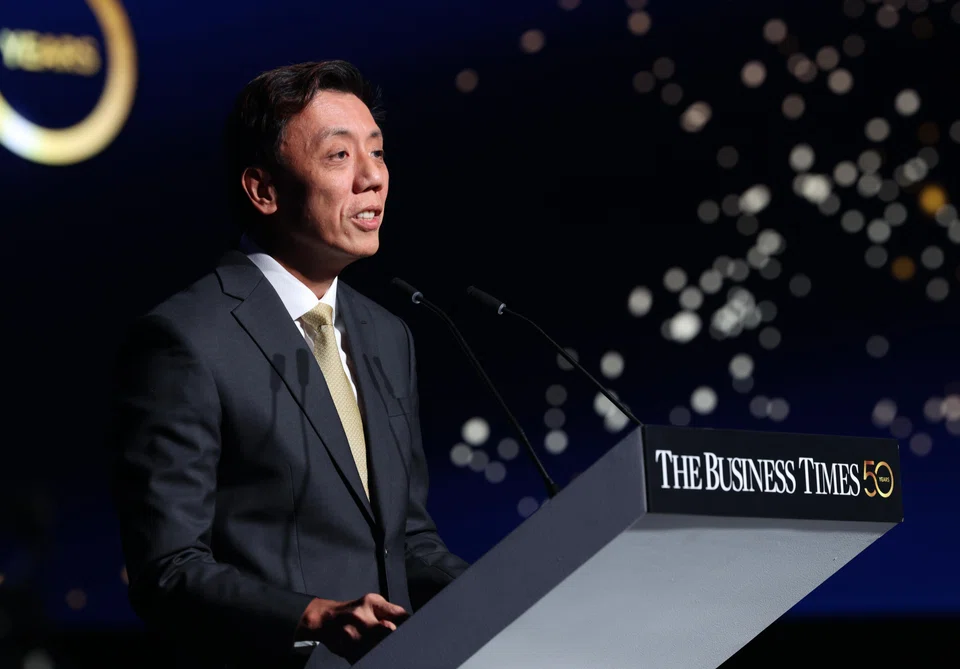
[SINGAPORE] The value of a good business publication lies in its trust, judgment and perspective, said Minister for Transport and Second Minister for Finance Jeffrey Siow at The Business Times’ 50th anniversary dinner on Thursday (Oct 1).
“For its first 50 years, BT chronicled Singapore’s emergence as a global business and financial centre,” he said.
“In your next 50, you have the opportunity to do something larger: to become one of the institutions through which the world understands Singapore and South-east Asia.”
Giving the keynote address at the dinner held at Marina Bay Sands, the event’s official venue, Siow said that information is now abundant and anyone can publish to a global audience, but there is more noise to cut through.
“The premium is not simply about access to information or speed of publication,” he added.
Value of verified information will grow
Trust is fundamental to all journalism – but is especially important in business and financial journalism, he said.
Such news is often instantly acted upon, and can affect how an investor deploys capital, how a company responds to a new regulation, or how a business assesses a market, so inaccuracy has serious consequences.
The value of verified information will grow, in a world where rumours can spread quickly and plausible-looking posts can be easily generated by artificial intelligence, he said.
An established newsroom like BT, where the facts have been checked, sources have been tested, and different perspectives have been considered, has an advantage.

Referring to judgment, Siow pointed out that while facts are the foundation of truth, readers need help deciding which ones matter.
In helping a business leader in Singapore decide what a change in US trade policy means for their supply chain, how AI may change their industry, or what interest rate movements mean for financing, journalism adds value beyond reporting, he said.
BT also goes on the ground, bringing the business community together through awards, round-tables and dialogues. Journalists can thus keep a close eye on what is top of mind for companies, entrepreneurs and investors.
These insights then feed into products, such as its Decoding Asia series, a newsletter which curates key regional developments. Siow said: “The products demonstrate good judgment: deciding what deserves attention, supplying the context, and helping readers see the larger pattern.”
Finally, perspective is key, with publications’ influence stemming from understanding their own economies and regions deeply, and using that knowledge to interpret developments beyond them.
“Every serious international publication sees the world from somewhere,” Siow said, highlighting the Financial Times in London, The Wall Street Journal in New York, and Nikkei in Tokyo.
“BT has the opportunity to do the same from Singapore and South-east Asia,” he said.
He noted that there is a “real need for this”, with South-east Asia’s growing importance to the global economy. Global businesses are looking more closely at South-east Asia for their next opportunities, he added.
And as the 11 Asean economies are at very different stages of development, offering different advantages, the minister said that a business publication that has knowledge of individual markets, businesses and people on the ground is valuable.
“BT is well placed to provide this perspective, and has in fact begun moving in this direction,” the minister said.
BT Global was launched in January this year, specifically to cover regional and international developments through a South-east Asian lens. Overseas views of BT’s coverage have more than doubled since, compared with the same time last year, to around 35 million views.
Next 50 years
In a separate speech at the dinner, BT editor Chen Huifen recalled that “Singapore’s economy was still finding its shape” when the paper launched in 1976.
“Our stock and commodities markets were young, and we were only beginning to position ourselves as a forex centre.”
BT became the ledger of record for Singapore business, she said. But as the economy matured, BT then needed to become interpreters, not just recorders.
Today, readers say they rely on BT for decision-making, trend analysis and strategic foresight at work, and thinking through wealth, career and life outside the office, Chen said.
They also want information in forms beyond writing, with visual journalism, video and audio helping them to make sense of complex ideas – which she said BT is building for.
They also shared that BT’s authority comes from local nuance, and it “should claim the space of authoritative, Asean-focused coverage, while keeping Singapore as (its) core”.
This is where BT is headed, Chen said. Total overseas traffic for the Decoding Asia newsletter increased more than twofold to 35 million page views in the first eight months of this year. Meanwhile, overseas unique users reached 25 million.
“With tens of thousands also subscribing to our new newsletter, these metrics tell us there is a growing appetite for a trusted regional business voice.”
She added: “We will keep South-east Asia as our anchor. But our ambition, over time, is to distill business news from around the world through the lens of this region.”
This will mean being more selective, sharpening focus on themes such as capital and markets, tech and AI, trade and supply chains, energy transition and demographic changes, which matter most across South-east Asia.
BT will also invest further in newsletters, communities and events, to deepen relationships with readers. Complementing its reporting, it will also build a broader portfolio of products, including proprietary data.
At home, BT’s journalism will continue to support the next stage of growth in its capital markets and broader business ecosystem, Chen noted. And across the region, it hopes to fill a real gap by providing consistent, insight-driven coverage of South-east Asia’s key markets.
“We don’t know exactly what South-east Asia’s business landscape will look like in another 50 years, and we won’t pretend we do,” she said. “But we intend to be there – still asking what it means, and what comes next – for Singapore, and now, for the region it sits in.”
Explore 50 years of stories that shaped Singapore’s business landscape at bt.sg/bt50
Decoding Asia newsletter: your guide to navigating Asia in a new global order. Sign up here to get Decoding Asia newsletter. Delivered to your inbox. Free.
Copyright SPH Media. All rights reserved.