

Ministerial pay rise not a lure into politics, but inaction would leave Singapore to ‘suffer the consequences’: PM Wong
Failing to keep salaries competitive could leave the Republic short of good leadership, he adds


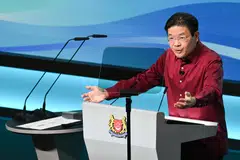
[SINGAPORE] The move to increase ministerial salaries is not to incentivise people into politics, but failing to keep political salaries competitive could, over time, leave Singapore short of the leadership it needs, said Prime Minister Lawrence Wong.
Closing the debate on the review of political salaries in Parliament on Thursday (Sep 10), he said the criticism that the ruling People’s Action Party (PAP) was “buying” candidates rested on a mistaken premise.
Competitive salaries do not entice people into politics, he argued, adding that they simply remove a financial obstacle for those who already want to serve.
“No one should enter politics for the money,” he told the House.
“Motivation to serve, responding to the call, must come first,” he added.
“We have to persuade good people that Singapore needs them, that the work matters, that they can make a difference. Then, if someone is prepared to step forward, remuneration becomes a practical consideration.”
Yet, PM Wong warned that the consequences of getting the salary framework wrong would have dire consequences for Singapore – even if these are not immediate.
The government does not stop functioning because good people opt out of politics, he said, but the effects build up gradually through successive rounds of recruitment and leadership renewal.
“Over 15, 20, 25 years, the difference will be visible in the quality of political leadership, in the decisions the government makes and, eventually, in the quality and effectiveness of the civil service as well,” said PM Wong.

“By the time such deterioration becomes obvious, rebuilding the system will be much harder, perhaps even impossible.”
Scrutinising the benchmark
Responding to Workers’ Party (WP) chief Pritam Singh’s observation that joining the Cabinet from the public sector can, for some, “potentially open the door to a wage increase”, PM Wong pointed out that ministerial salaries remain lower than those of the most senior civil servants and judges.
Permanent secretaries and appellate judges, whose salaries are set under separate frameworks, are now paid more than even the revised MR4 ministerial benchmark for starting-grade ministers of S$1.8 million.
This is because political office continues to carry “a more substantial discount”, PM Wong said. In fact, many civil servants who enter politics end up with a pay cut rather than a pay rise, and would have likely earned more had they stayed in the public sector and performed well, he added.
The MR4 reference benchmark drew questions during the nearly four-hour debate. Several MPs questioned whether pegging the benchmark to the top 1,000 Singaporean earners was still appropriate, and whether it had pushed the reference salary too high.
Nominated MP Azhar Othman questioned why political pay should be tied to the apex of the private sector.
“The private sector exists to maximise shareholder value,” he said. The government, unlike a private equity firm, has a fundamentally different mandate, he added.
Labour PAP MP Yeo Wan Ling, while backing the government’s acceptance of the review, said a “benchmark must still have credible basis, and Singaporeans are entitled to scrutinise it”.
She flagged the near-decade gap since the last review in 2017 as a reason to consider recalibrating the salary framework more regularly.
In his response, PM Wong noted that the existing formula has been tested through three independent reviews since 2012, all of which reached broadly the same conclusion.
He also argued that the dispute in frameworks was less consequential in practice than it appeared. Within this term of government, ministerial MR4 salaries would move initially to S$1.2 million and, by the end of the term, to S$1.35 million.
Furthermore, using WP’s alternative formula of pegging ministerial pay to a multiple of an MP’s salary would “arrive at a similar figure”, PM Wong noted. An inflation-only adjustment, meanwhile, would produce a higher figure of S$1.5 million.
Misleading comparisons
Turning to why Singapore cannot simply look to other countries that pay their ministers less, PM Wong noted that headline salary comparisons between countries are misleading.
Many overseas systems bundle in pensions, allowances, hosting and post-office arrangements that never show up in the published salary, he said.
Further, political responsibilities in other countries are often spread across national, regional and local government, unlike Singapore’s single, concentrated administration.
He also noted that ministers elsewhere often serve shorter stints and lean more heavily on the civil service to carry the policy agenda, whereas Singapore’s ministers are expected to master their portfolios, lead their ministries and drive reforms from the front over the longer term.
Responding to calls for greater public disclosure on how individual ministers are assessed and paid, PM Wong said that performance should not be reduced to a popularity contest.
He explained that he assesses ministers on their overall record over time rather than on any single speech or controversy, in consultation with the deputy prime minister, the two senior ministers and the coordinating ministers.
Why the increase now?
As for questions on the timing of the increase, PM Wong argued that there would never be a politically convenient moment to adjust salaries.
The government had already deferred a review in 2017 and again in 2023, he noted, and any further delay would only widen the gap between the benchmark and prevailing pay levels.
Although the conflict in the Middle East diverted the committee’s work earlier this year, Singapore’s domestic economic situation has since stabilised, thus prompting the decision to proceed now rather than wait for a better moment that might never come.
Further, he reiterated that the government has opted for a one-off adjustment of up to 9 per cent for existing officeholders, rather than moving them straight to the new benchmark, after which future increases will be tied to individual performance.
“If every difficult circumstance becomes a reason not to act, then we will keep putting the issue off,” said PM Wong. “And there will come a point where restraint ceases to be prudence and becomes neglect.”
Decoding Asia newsletter: your guide to navigating Asia in a new global order. Sign up here to get Decoding Asia newsletter. Delivered to your inbox. Free.
Copyright SPH Media. All rights reserved.

