‘Muted’ outlook for Singapore’s manufacturing sector in 2026: SMF chief
The federation rolls out initiatives to help manufacturers embrace Industry 5.0 as predicted growth slows and geopolitical risks intensify
Jermaine Fok
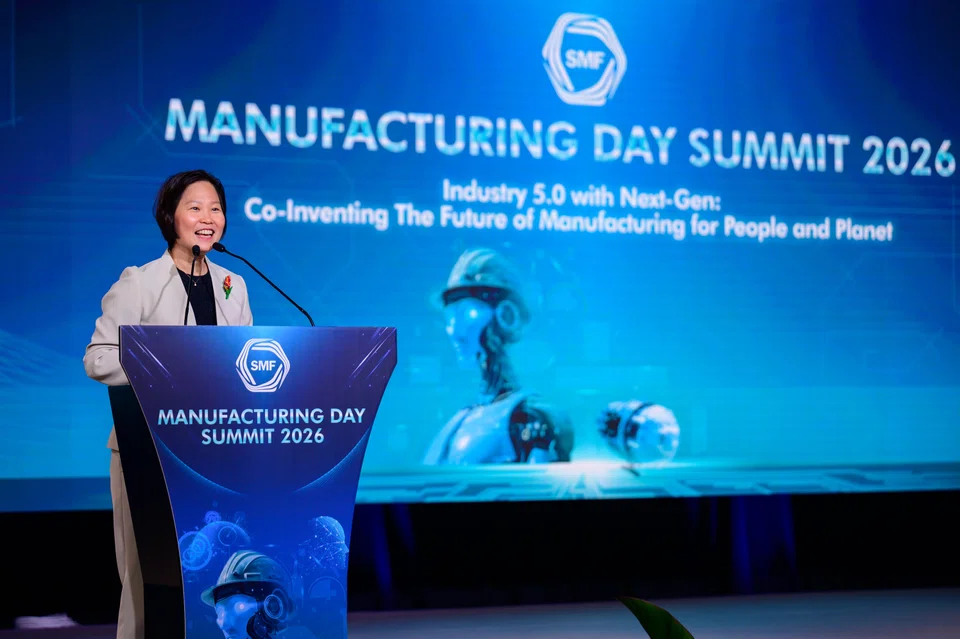
[SINGAPORE] Even after a strong performance last year, the outlook for Singapore’s manufacturing sector in 2026 is “muted” as companies grapple with geopolitical tensions, shifting trade dynamics and global supply chain pressures.
This was according to the Singapore Manufacturing Federation (SMF), whose president Lennon Tan on Friday (Jan 30) noted that the sector’s growth this year is projected to come in at between 1 and 3 per cent – compared with 8.7 per cent in 2025 – amid potential new tariffs and deepening geopolitical fractures.
SMF said that companies now face evolving challenges, including the need to balance technological advancement with workforce readiness, safety and sustainability.
“We cannot build Industry 5.0 with yesterday’s skills,” Tan said at SMF’s Manufacturing Day Summit, held at the Sands Expo and Convention Centre.
Against this backdrop, SMF unveiled a series of initiatives to help manufacturers “harness advanced technologies, human-centric approaches and sustainable practices in the Industry 5.0 era”.
The event was attended by Minister of State for Trade and Industry Gan Siow Huang and Indonesia’s Vice-Minister of Industry Faisol Riza.
“The factories of the future will require a very different workforce from those of the past. Therefore, to remain globally competitive, we must continually empower our workforce to upskill and reskill.”
Minister of State for Trade and Industry Gan Siow Huang
In her speech, Gan said that the efforts to grow Singapore’s manufacturing sector would focus on three main pillars: building strong regional partnerships, embedding sustainability into operations, and nurturing talent.
One measure is the launch of a comprehensive playbook to guide manufacturers looking to set up and operate in the Johor-Singapore Special Economic Zone (JS-SEZ). Established in January 2025, the zone aims to strengthen cross-border collaboration by streamlining the movement of people and goods between Singapore and Johor.
In a media statement, Tan said that the playbook is intended to support companies with faster decision cycles, clearer investment pathways, and increased confidence in executing cross-border setups.

SMF noted that this resource consolidates information on regulations, talent mobility, infrastructure developments and available support channels, enabling companies to plan and operate more effectively across both markets.
An artificial intelligence (AI)-enabled chatbot, trained on JS-SEZ materials, will be launched within the next two months to complement the playbook. It will provide timely updates on regulatory changes, incentives and ecosystem developments.
At the summit, Gan highlighted the growing importance of regional cooperation as supply chain disruptions and geopolitical risks increasingly shape business decisions. “Working together with regional partners becomes essential to unlock new opportunities for growth and strengthen resilience,” she added.
To further support cross-border expansion, SMF also signed a memorandum of understanding (MOU) with the Industrial Estates Association of Indonesia to deepen collaboration in industrial estate development and facilitate cross-border business activities.
Talent development
Beyond regionalisation, talent development remains a priority as automation and AI reshape manufacturing roles.
Gan said that there is a need to tap the efficiency of automation while complementing human capabilities in areas such as “quality control and problem-solving”.
As part of its initiatives to support workforce transformation, SMF’s Advanced Manufacturing Training Academy also signed an MOU with the Agency for Science, Technology and Research on a manufacturing leadership programme.
To be launched in March, the pilot edition will be tailored for women leaders in companies under SMF’s Women in Manufacturing Committee. The programme aims to equip participants with the skills to strategise and lead AI-enabled, value-centric transformation while advancing leadership diversity in the sector.
“We can expect robots working alongside humans at more workplaces,” Gan explained. “The factories of the future will require a very different workforce from those of the past. Therefore, to remain globally competitive, we must continually empower our workforce to upskill and reskill.”
Decoding Asia newsletter: your guide to navigating Asia in a new global order. Sign up here to get Decoding Asia newsletter. Delivered to your inbox. Free.
Share with us your feedback on BT's products and services