Singapore to make bid to host international tribunal for investor-state disputes
The Multilateral Investment Tribunal is still being negotiated at the UN’s trade law body

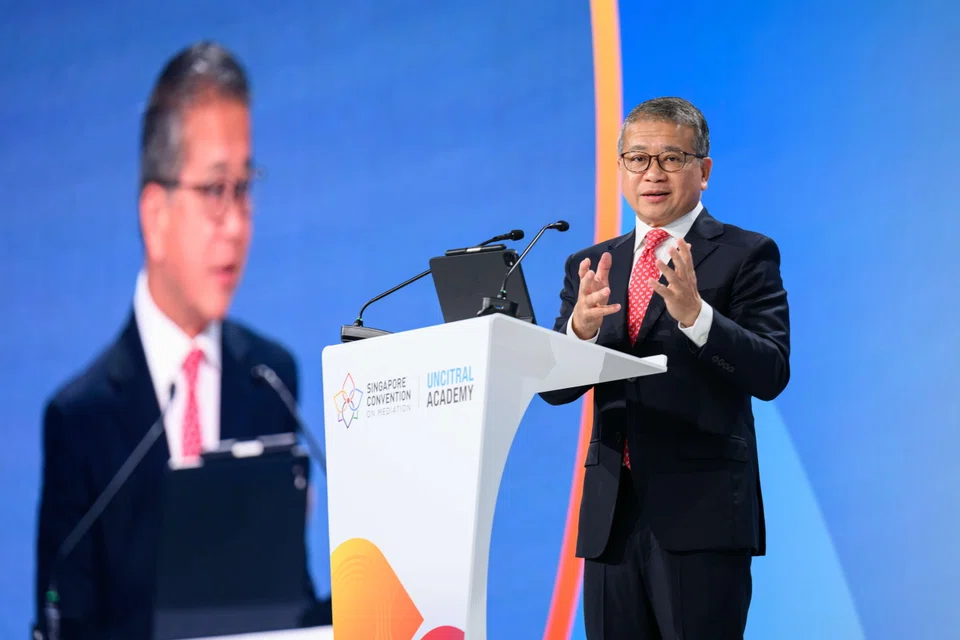
[SINGAPORE] A new international tribunal hearing disputes between foreign investors and states is in the works, and Singapore will put in a bid to host it, said Minister for Law Edwin Tong on Tuesday (Aug 25).
The Multilateral Investment Tribunal (MIT) is designed to replace the current system of ad hoc arbitration for investor-state disputes. It is still being negotiated by member states of the United Nations Commission on International Trade Law (UNCITRAL).
The push for a standing tribunal stems from a rise in treaty-based investor-state cases and mounting criticism of the existing arbitration system over inconsistent rulings and questions over the independence of arbitrators.
The tribunal has been under discussion at UNCITRAL’s Working Group III since 2017.
Negotiators are currently working from draft statutes for both the tribunal and a related appellate mechanism, with the working group to address outstanding procedural issues at the next meeting scheduled in October.
Speaking at the UNCITRAL Academy Conference, Tong noted that more than half of all known treaty-based investor-state cases since 1987 have been filed in the last decade.
“Yet, the framework meant to resolve these disputes has itself come under serious strain, marked by inconsistent decisions, concerns about regulatory chill, and persistent questions about arbitrator independence and impartiality,” he said. “The legitimacy of the system is being strained at precisely the moment it is needed most.”
The urgency for a trusted investment dispute settlement system has grown more pressing as governments increasingly intervene and regulate high-stakes issues such as public health, energy security, climate change and national security.
“As states act, disputes will follow,” said Tong. “The question is not whether investment disputes will arise, but whether there is a credible, trusted institution to resolve them.”

A well-designed tribunal could offer greater coherence, predictability and legitimacy while preserving flexibility for states with differing needs, he added.
Singapore’s pitch
Singapore is well-positioned to host the tribunal as it offers a neutral and stable jurisdiction, firmly grounded in the rule of law, said Tong.
The Republic also has a mature dispute resolution ecosystem, spanning arbitration, mediation and adjudication, and is backed by a legal services sector with international reach.
Singapore has previously developed its dispute resolution infrastructure through institutions such as the Singapore International Arbitration Centre, the Singapore International Commercial Court and the Singapore International Mediation Centre.
Singapore is also “well positioned and connected to the constituencies that the tribunal will serve”, he said.
The city-state sits at the heart of Asia, and has steadily deepened links with the developed and developing world, through its extensive network of trade and investment agreements, growing economic partnerships, and expanding diplomatic presence.
“We can offer a location that is neutral, international and connected, one that can serve states and investors from developed and developing economies alike,” said Tong.
The government will anchor its bid with a dedicated tribunal building equipped for hearings, and to house tribunal members, the registry and supporting facilities.
Singapore will also commit financial contributions to a fund to support participation by developing and least-developed countries, and to underwrite services such as translation and transcription, said the minister.
Further details of the bid will be announced later.
A new stage for Singapore
Toby Landau, head of chambers, London, at Duxton Hill Chambers (Singapore Group Practice), said hosting the MIT would not compete with Singapore’s existing dispute resolution infrastructure such as the Singapore International Arbitration Centre and Singapore International Commercial Court.
Instead, he said, it would put the Republic on the international dispute resolution stage in a new way, as the investor-state field is distinct from commercial arbitration.
He noted that investor-state disputes arise under an estimated 3,000 investment treaties worldwide, and can involve very large sums, with investors increasingly using such claims to challenge state regulatory decisions.
These are sensitive issues that the current arbitration-based model has struggled to adequately address, given criticisms over its lack of accountability.
While Singapore is the first country to publicly announce its intention to bid for the MIT, Landau expects strong competition for the seat.
Nevertheless, he argued there is a broader case for the centre of gravity in international investment law to shift towards Asia, given that a large share of global investment treaties involve Asian states and the region has become a growing focus of international economic activity.
Disputes involving Asian parties are therefore more likely to arise, he said, and it makes less practical sense for such cases to be routed through European institutions by default.
While the investor-state field is new territory for Singapore, the country’s established legal profession and judiciary give it a credible foundation to expand into this area, Landau said.
A successful bid would thus not only address gaps in the investor-state dispute system but would also position Singapore at the centre of a significant and growing area of international legal activity, benefiting both local and international practitioners.
New international law centre
Separately, Tong also announced that the Ministry of Law and the National University of Singapore will jointly set up a Centre for Arbitration and International Dispute Resolution, to be led by Professor Stavros Brekoulakis.
The centre will conduct research on issues including transparency, professional governance and investor-state dispute settlement, and will run a new advanced-studies programme for arbitration practitioners.
It adds to the university’s existing international law research infrastructure, which includes the Centre for International Law, established in 2009 to support research and training in areas such as investment law, ocean law and international dispute resolution.
“Singapore has benefited greatly from an international system in which disputes can be resolved according to rules, rather than power,” said Tong.
“We want to contribute to keeping it strong, trusted and relevant, build thought-leadership and engage in forward thinking research on how to sustain the rules-based framework, re-inventing and evolving, to support the needs of tomorrow.”
The new advanced-studies programme is aimed at practitioners who already have meaningful experience in international arbitration and are looking to deepen that expertise, rather than an entry-level course, said Tong.
Admission will be selective, with intentionally small class sizes and a curriculum that combines demanding theoretical grounding with practical training.
Participants will engage directly with arbitrators, counsel, and academics from around the world, with an emphasis on skills such as managing complex proceedings, advocacy, strategy, and procedural judgment.
Tong added that the programme is also intended to build a professional network among participants that endures beyond the course itself.
“Our aspiration is simple, that this becomes one of the programmes experienced arbitration practitioners across the region aspire to attend,” he said.
He also hopes the programme and the centre’s research efforts would reinforce each other over time, with practitioners bringing real-world problems that inform new research.
Decoding Asia newsletter: your guide to navigating Asia in a new global order. Sign up here to get Decoding Asia newsletter. Delivered to your inbox. Free.
Copyright SPH Media. All rights reserved.