

Singapore can ‘make a good living’ in a multipolar world if US and China don’t collide: PM Wong
He also said companies or individuals ‘abusing’ Singapore’s position as a trusted business hub is a real concern
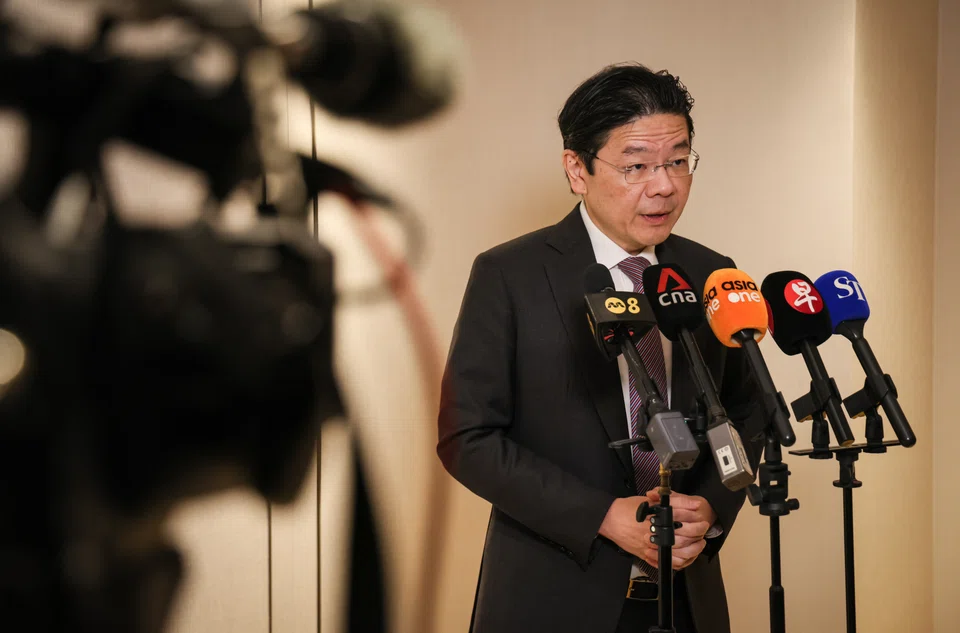
[BEIJING] As long as the United States and China do not collide with one another, Singapore will be able to “make a good living for ourselves” doing business with countries globally, said Prime Minister Lawrence Wong.
He added he does not believe the two superpowers will clash, which leaves Singapore room to navigate a complex global environment.
PM Wong was speaking to Singapore journalists in Beijing on Saturday (Nov 21) as he wrapped up a four-day visit to China that began with his arrival in Shenzhen on Wednesday for the 33rd Asia-Pacific Economic Cooperation (Apec) Economic Leaders’ Meeting.
He later met Chinese President Xi Jinping and Beijing party secretary Yin Li on Friday, and Chinese Premier Li Qiang earlier on Saturday.
He was asked how the Megaspeed case involving Nvidia chips could affect Singapore’s artificial intelligence (AI) cooperation with China and its ability to maintain strong economic ties with both China and the US.
In his response, PM Wong said how the world’s two largest economies navigate this space with regards to technology involving AI and semiconductor chips is “between the two of them”.

He noted both US President Donald Trump and Chinese President Xi Jinping have met several times to advance these discussions, and he hopes they can “continue the positive momentum” that has been established.
“Where Singapore is concerned, we just want to stay friends…and be able to do business with both sides,” said PM Wong.
He added that he had “very good meetings” with both Trump and Xi this week, and that both leaders understand where Singapore’s position is.
SEE ALSO
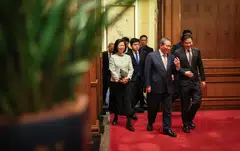
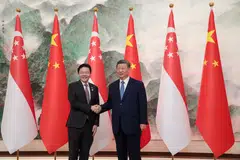
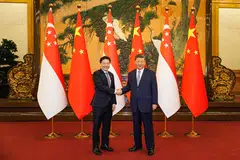
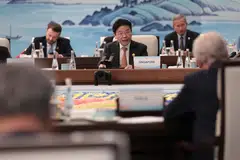
PM Wong added Singapore and China have found ways to work together that benefit both countries as China’s priorities have shifted over the decades.
For instance, the two countries have agreed to deepen cooperation on practical uses of AI in daily life and at work to help businesses operate more efficiently and benefit people in both countries.
‘Singapore-washing’ a real concern
PM Wong acknowledged that the risk of companies or individuals “abusing” Singapore’s position as a trusted business hub to circumvent US export controls “is a real concern for us, especially when it comes to semiconductor chips”.
Still, he stressed that Singapore attracts “many genuine investments from China”, which not only deploy technologies in the Republic, but add value to the economy.
“They are employing Singaporeans, so it’s a tremendous plus for Singapore,” he said.
On Nvidia chips, PM Wong said the US understands Singapore’s position that it has visibility over how the chips are used when they are imported and deployed locally.
Singapore-based data centre operator Megaspeed is under US investigation over whether it diverted advanced Nvidia chips to China in breach of US export controls.
“So that is not the concern. Their concern is when chips are registered for sale in Singapore, but are transshipped or re-exported to other countries,” he said.
However, the volume of such trades is “far bigger” than the chips used in Singapore itself, and that in some instances, shipments do not even land in Singapore, but just pass through to other countries directly .
While Singapore has “no control, no visibility” over how these chips are used in their destination countries, Singapore knows these are issues important to Washington.
“We are discussing how best we can be helpful, including by sharing information, so that they can do their own enforcement,” said PM Wong.
“But at the end of the day, these discussion are ongoing, what matters to us is that we are able to get the chips we need for Singapore’s legitimate needs,” he added.
“And given our strong, enduring relationship with the US, I believe we will be able to do so.”
China-Singapore FTA upgrade
Asked for more details about the launch of the China-Singapore Free Trade Agreement (FTA) 4.0 upgrade that was announced on Friday, PM Wong said the upgrade is not meant to target any specific sector or product.
“But it really helps to facilitate more cross-border flows of data and ease of doing business across the two countries,” he said.
With the FTA upgrade covering the digital economy and government procurement, PM Wong said he hopes businesses on both sides will find it easier to interoperate with more opportunities for companies in China, as well as in Singapore.
“On technology, yes we are concerned that the US-China competition and rivalry will result in more and more of a bifurcation in the technologies that countries are able to access and use,” he said.
While he hopes this will not happen, he acknowledges that it “may well be inevitable” for very high-end technologies. This could then force countries to decide on one or the other.
“We hope in Singapore that, aside from these sensitive high-tech areas, there will be many other aspects of technology where countries are free to use either US, Western, or Chinese technologies,” he said.
“There should not be exclusive arrangements or restrictions imposed on countries.”
He cited Singapore’s autonomous vehicle projects with China’s WeRide and Pony AI and the US’ Waymo as examples of how the Republic can stay open to technologies from different countries and use those that best suit its needs.
Asean chair priorities
Referencing his speech at the Apec summit on Thursday, where he urged economies not to divide into competing blocs, he said not everything has to be viewed through the lens of the US-China competition.
In fact, he said “many countries want to move forward and to find ways to cooperate” and that there are many opportunities to do so, especially when Singapore chairs Asean in 2027.
Asean is discussing possible summits and free trade agreements with the European Union and Canada, he said, adding that next year marks 50 years of Asean-EU dialogue relations.
PM Wong also pointed to opportunities for Asean to deepen ties with the Gulf Cooperation Council and India.
As Asean chair, PM Wong said Singapore is also committed to doing its part to further advance the relationship between Asean and China.
Aside from China, he said Singapore wants to help Asean “grow into an economic center in its own right” and build ties with partners across the world.
Build bridges, not barriers
Turning to the historic trilateral summit between China, US and Russia, PM Wong said it is “always good when leaders come together” to build bridges, rather than to raise barriers.
Still, he said views by some political observers that this may create a new Group of two or three is “may not always be so helpful”.
“At the end of the day, no single country, neither will two or three countries alone decide on everything for countries everywhere,” he said.
“The world is too complex, and there are too many things happening for any one, two or three countries to decide the fate of all of us.”
Decoding Asia newsletter: your guide to navigating Asia in a new global order. Sign up here to get Decoding Asia newsletter. Delivered to your inbox. Free.
Copyright SPH Media. All rights reserved.
TRENDING NOW
Could Jensen Huang work for Elon Musk? It would be ‘a titanic ego death match’, says biographer
What shattered Crystal Jade? How the culinary empire shrank from 120 to just 9 outlets
Vietnam’s Long Thanh airport hits new snag as airlines seek to delay moving operations
Beyond the greenback, Vietnam’s big borrowers turn to Asian-currency bonds

