Singapore exports tipped for slower growth after worse-than-expected contraction in July
But some economists believe the relatively lower US tariff rate that the Republic faces, along with growing electronic demand, could mitigate any slowdown

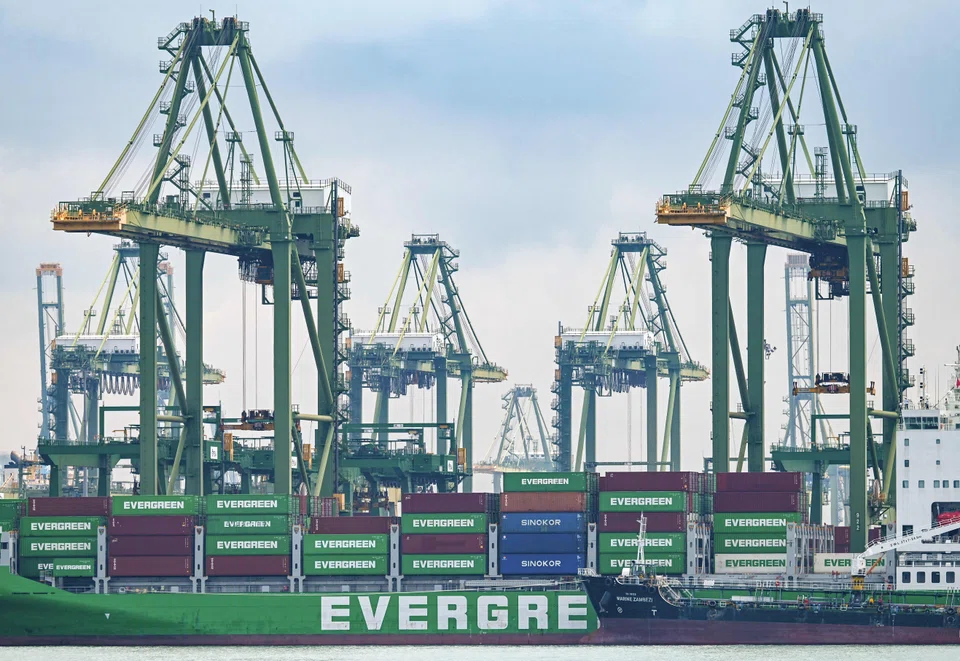
[SINGAPORE] The Republic is poised for slower export growth in the second half of 2025, economists said, after last month’s numbers came in worse than expected.
Non-oil domestic exports (NODX) shrank 4.6 per cent year on year in July, in a sharp contrast from the revised 12.9 per cent jump clocked in June, data from Enterprise Singapore (EnterpriseSG) showed on Monday (Aug 18).
The decline was also deeper than the 1 per cent contraction that private-sector economists polled by Bloomberg were expecting.
“While the NODX underperformance was partly due to the high base in July last year, particularly for pharmaceuticals, nevertheless, the tariff headwinds are mounting,” said OCBC chief economist Selena Ling.
In particular, exports to the United States, one of Singapore’s key markets, contracted by 42.7 per cent year on year, an acute worsening from the 4.8 per cent decrease in June. This was attributed to lower shipments in typically volatile pharmaceuticals, specialised machinery and food preparation.
Overall, NODX to six of Singapore’s top 10 markets contracted. These were – in addition to the US – China, Indonesia, Thailand, Malaysia and Japan.
“Given that there was already sustained NODX weakness for key markets like the US and selected Asean markets prior to the implementation of the US’ reciprocal tariffs on Aug 7, this does not bode well amid the anticipated fading of front-loading effects for the remainder of this year,” Ling said.
“For China… the road ahead may remain uncertain given the extension again for the 90-day US-China trade truce which points to a prolonged negotiation process,” she added.
UOB senior economist Alvin Liew noted that, in contrast, NODX to East Asian markets such as Taiwan and South Korea remained “quite robust”, “likely reflecting spillovers from structural artificial intelligence-related demand”.
RHB group chief economist Barnabas Gan cited several risks that could slow NODX momentum.
The global tariff situation remains volatile, while Singapore’s structural exposure to semiconductor and pharmaceutical exports could leave it vulnerable, he said.
Meanwhile, the unwinding of front-loading trade “poses both a technical drag and a sentiment overhang”, with a “payback” expected in H2, as inventories normalise and external demand softens.
DBS senior economist Chua Han Teng noted that non-oil re-exports, despite surging 22.1 per cent year on year in July, were off the peak of April’s 39.3 per cent and are likely to continue easing in the coming months.
UOB’s Liew believes the eventual “payback” may be more pronounced in trade-related services – such as wholesale trade, as well as transport and storage – rather than in the manufacturing sector.
This is because front-loading seems to be “more pronounced” in electronics exports and re-exports, and less so in non-electronics exports and overall manufacturing.
“Any further growth drag in these sectors is likely to stem from weaker demand due to the tariffs, as well as the additional risks of US tariffs on semiconductors and pharmaceuticals,” he said.
July’s performance brings Singapore’s year-to-date NODX to 3.6 per cent, which sits above the official full-year forecast range of 1 to 3 per cent that the authorities reiterated just last week.
OCBC’s Ling said her outlook of 2 per cent assumes that NODX would contract in H2.
“At this juncture, while the US baseline reciprocal tariff of 10 per cent for Singapore looks unlikely to change, the looming storm is over possible tariffs for semiconductors and pharmaceuticals,” she said.
UOB’s Liew said he is keeping his forecast at 1 to 3 per cent “but with reduced confidence over (his) projections given the fluid and uncertain tariff situation”.
Bucking the trend, Maybank economists Chua Hak Bin and Brian Lee kept their forecast at 4 per cent, adding that the decline in NODX is “unlikely to persist, given the abnormally high base for last July’s out-turn”.
Electronics demand remains strong on the back of broadening artificial intelligence demand, they added, even if export growth may lose some momentum after reciprocal tariffs for the region kicked in on Aug 1.
“Relatively lower US tariffs, with Singapore facing the lowest US reciprocal tariff in Asia, the extension of the US-China tariff truce and broadening global artificial intelligence demand will mitigate the payback and severity of the second-half export slowdown,” said the duo.
They believe US multinational corporations in Singapore such as Micron and GlobalFoundries would also likely be exempted from sectoral tariffs, since companies that have “committed to build” in the US would be spared.