

Singapore factory output growth accelerates to 6.1% in October
RHB upgrades its IP growth forecast for 2026, Barclays raises GDP projection

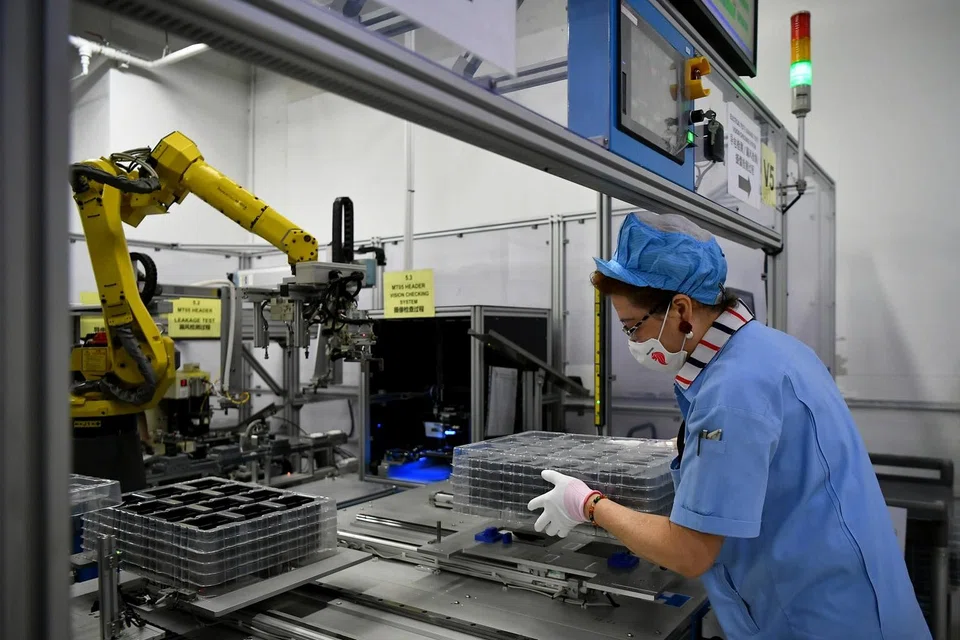
[SINGAPORE] The Republic’s factory output growth picked up to 6.1 per cent year on year in October, from 5 per cent in September, based on data released by the Economic Development Board (EDB) on Thursday (Nov 26).
The print – markedly higher than the Bloomberg consensus estimate of 2.2 per cent – came on the back of sustained global artificial intelligence-related tailwinds.
Excluding the volatile biomedical manufacturing cluster, output grew 12.1 per cent year on year, accelerating from September’s revised 10.9 per cent expansion.
On a seasonally adjusted, month-on-month basis, output expanded 7.1 per cent in October, reversing from September’s revised figure of a 3.2 per cent decline.
Excluding biomedical manufacturing, output went up 7.3 per cent on a monthly basis, in a turnaround from the 4.8 per cent fall in September.
RHB upgraded its full-year 2026 manufacturing growth forecast to 10 per cent, reflecting the robust 10.1 per cent growth recorded in the year to date.

The bank’s group chief economist Barnabas Gan and associate research analyst Laalitha Raveenthar said: “This is also consistent with our recent upward revision to Singapore’s 2026 gross domestic product growth forecast to 6 per cent.”
Given the stronger-than-expected industrial production print, Barclays also upgraded its economic growth forecasts. It raised its GDP growth prediction to 6.2 per cent for 2026, from 5.7 per cent.
For 2027, it hiked the forecast to 4.5 per cent, from 4 per cent.

Brian Tan, RHB’s head of non-China emerging markets Asia economics research, said: “We continue to expect the AI boom to drive headline GDP growth – masking limited improvements in more domestic-facing sectors, especially as AI adoption poses new challenges to the labour market.”
Noting the positive start to the final quarter of 2026, UOB associate economist Jester Koh said the out turn supports the bank’s forecast of 5.7 per cent year on year GDP growth for Q4.
It recently upgraded its 2026 GDP growth forecast to 6.1 per cent, from 5.7 per cent, he noted.
DBS senior economist Chua Han Teng remarked that the manufacturing sector’s outlook remains constructive at end-2026, supported by robust AI-related demand, underpinned by the strong AI infrastructure build-out led by US hyperscalers.
Forward-looking indicators remained encouraging as of October 2026, he added.
Both DBS’ Chua and UOB’s Koh highlighted continued strength in the electronics new-export orders sub-index of Singapore’s manufacturing purchasing managers’ index.
This, along with declining inventory levels, support manufacturing activity in the months ahead, said Koh.
Chua also noted the optimism among electronics and precision engineering firms for October 2026 to March 2027, in an Economic Development Board survey.
RHB’s duo foresee electronics and precision engineering underpinning manufacturing growth into 2027.
“The AI-driven technology cycle continues to support demand for semiconductors and related equipment, underpinned by sustained investment in AI infrastructure and data centres,” they said.
Still, economists warned that AI-driven expansion will moderate next year.
“Downside risks to the global AI cycle include tighter financial conditions and US-led regulatory measures, amid closer investor scrutiny of returns on AI investment,” Chua said.
Koh pointed to easing capex growth by major US hyperscalers affecting AI-related tailwinds in H2 2027.
“(This) could be further weighed by higher global interest rates, risks of tighter AI regulation following the Democratic sweep in the US mid-term elections, tariff risks and heightened focus on AI monetisation among firms,” he said.
RHB’s economists similarly noted that “stretched valuations, inventory adjustments or tighter financial conditions” could prompt hyperscalers to scale back capital expenditure.
“Recent signs of exuberance in equity markets have also raised questions about the sustainability of the AI investment boom,” they said.
“Crucially, the extent to which current AI investments translate into tangible productivity gains will determine whether the cycle can deliver a more durable boost to economic growth and generate positive spillovers to electrical and electronic goods exports and manufacturing activity.”
Performance by cluster
Within the manufacturing sector, all but two of the six clusters recorded output growth on a year-on-year basis in October.
Precision engineering led the growth, with output for the cluster rising 54.1 per cent. This was led by higher production of semiconductor equipment in the machinery and systems segment, EDB said.
The precision modules and components segment also recorded higher output of industrial rubber goods, precision metal components and dies, moulds, tools, jigs and fixtures.
The linchpin electronics cluster expanded 6.6 per cent, with all segments increasing amid sustained artificial intelligence-related demand.
Chemicals output grew 4.4 per cent, reversing from a 4.6 per cent decline in September. This was on the back of a higher output of fragrances in the “Other chemicals” segment and increased production of industrial gases, chemicals and food additives in the specialities segment. The petroleum segment also recorded higher production of refined products.
Conversely, the petrochemicals segment declined amid softer demand and feedstock supply disruptions that continued to constrain production, EDB noted.
General manufacturing industries grew 0.5 per cent. The miscellaneous and printing segments recorded output declines, with the former reflecting lower production of structural metal products and furniture.
But the cluster’s output was supported by higher production of milk powder and beverage products in the food, beverages and tobacco segment.
On the other hand, transport engineering contracted 5.3 per cent. It was weighed down by lower shipyard activities and weak production of oil and gas field equipment in the marine and offshore engineering segment.
Conversely, the land and aerospace segments expanded, with the latter supported by higher production of aircraft parts and engine maintenance, repair and overhaul.
Industrial production in the volatile biomedical manufacturing cluster dropped 35.8 per cent, due to lower production of biologics and a change in mix of active pharmaceutical ingredients in the pharmaceuticals segment.
Decoding Asia newsletter: your guide to navigating Asia in a new global order. Sign up here to get Decoding Asia newsletter. Delivered to your inbox. Free.
Copyright SPH Media. All rights reserved.
TRENDING NOW

Nvidia halts chip shipments to 4 countries in South-east Asia, including Singapore: FT

Should Keppel swoop in to snare Mapletree Investments?

OCBC opens 100-tonne gold vaulting facility to meet growing institutional demand

‘Very disappointed’: Singapore disagrees with US tariff rationale, to seek lower levies

