

Singapore rolls out S$900 million support package for businesses, households in light of Iran war
The package includes higher government risk-sharing for loans, a one-off SME cash grant and rental support for stalls

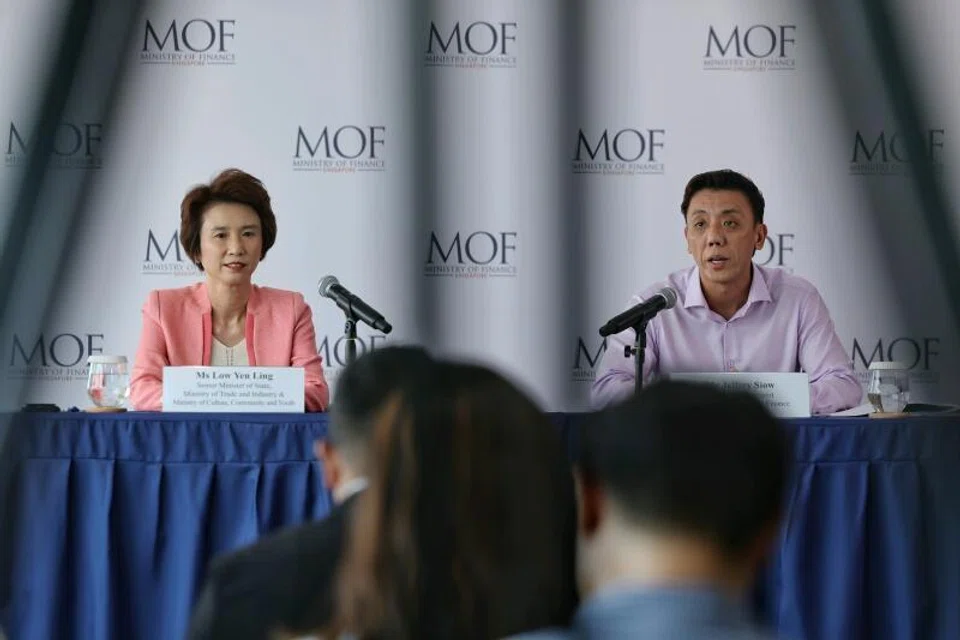
[SINGAPORE] A fresh S$900 million in support is being rolled out to help businesses and households cope with cost pressures from the ongoing conflict in the Middle East.
“We believe this is the right response, given the economic conditions today,” said Second Minister for Finance Jeffrey Siow at a press conference on Wednesday (Jul 29).
But the global situation remains fluid, and the government is in close touch with trade associations and businesses, unions and workers, as well as grassroots leaders and residents, he added.
“If circumstances change, we stand ready to respond.”
The new package takes into account both economic uncertainty and feedback from businesses, he said.
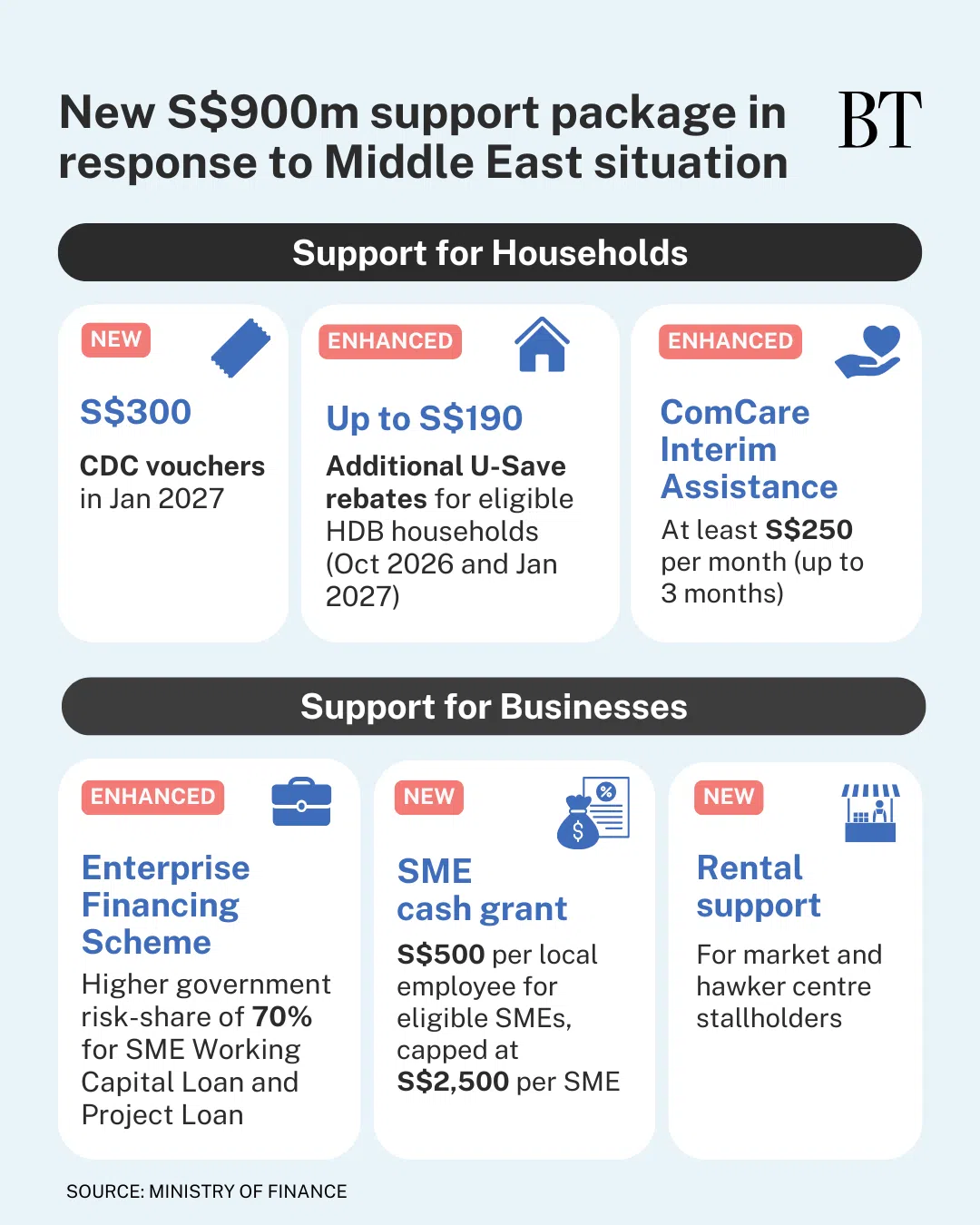
About a third of the funding will go to businesses. This comprises enhancements to the Enterprise Financing Scheme (EFS), a one-off cash grant for small and medium-sized enterprises (SMEs), and rental support for market and hawker stallholders.
Households will get more CDC Vouchers and U-Save rebates, and ComCare Interim Assistance is also being enhanced.
This is the second tranche of assistance measures in response to the conflict, following a S$1 billion support package announced in April.
The measures in that first package included a higher corporate income tax rebate and an expanded Energy Efficiency Grant for businesses, as well as targeted support for workers affected by rising fuel costs, such as platform workers and private-hire drivers.
“Fragile” situation
At one point, there were fears that the Iran conflict would escalate further and severely disrupt shipping, noted Siow. While this worst-case scenario was avoided, “the situation remains fragile”, he said.
While there was previously some hope of the Strait of Hormuz reopening, fighting has since flared up and shipping through the Persian Gulf remains disrupted, he added.
“A durable ceasefire between the US and Iran is proving difficult. Uncertainty in the region will persist for some time.”
Global energy prices are expected to remain high, meaning more expensive petrol, diesel, electricity and certain imported goods, he said.
Singapore’s economy “has held up better than expected”, but performance across the economy has been uneven, he noted. Greater cost pressures are felt by businesses that are more exposed to supply disruptions and energy costs, especially SMEs.
This second package aims “to support households and businesses through this period of uncertainty”, said Siow.
Greater government risk-sharing
The government understands that many businesses “are concerned about higher operating costs and their cash flow”, said Senior Minister of State for Trade and Industry Low Yen Ling. The aim is to help them manage near-term costs while supporting long-term business adjustments.
First, the EFS will be enhanced, with the changes applying from September 2026 to March 2027.
For the EFS-SME Working Capital Loan for operational cash flow, the government will share 70 per cent of the risk, up from 50 per cent currently.
For the EFS-Project Loan that finances secured overseas projects, government risk-sharing will also increase to 70 per cent, up from 50 per cent now.
In addition, the loan’s coverage will be extended to cover domestic projects for local construction firms.
“This will make it easier for them to secure financing to manage higher costs amid a challenging environment,” said Low.
Help for small businesses
Another support measure for businesses is the new SME Cash Grant 2026, for active SMEs with at least one local employee.
This is a one-off cash grant of S$500 per local employee, capped at S$2,500 per SME. Eligible sole proprietorships, partnerships and limited-liability partnerships with at least one local owner, but no local employees, will get a flat S$500.
There is no need to apply for this grant, which will be disbursed automatically in November.
Finally, there will be rental support for stallholders in markets and hawker centres managed by the government or government-appointed operators.
Cooked-food stalls will receive S$1,200 in total, while market stalls will get S$600 in total. This will be disbursed over six months, from September to February.
About 15,200 stalls are expected to benefit, comprising 6,900 cooked-food stalls and 8,300 market stalls. Stallholders have highlighted to the government that they face higher costs of raw materials, packaging and utilities, said Low.
“We are keeping a very close watch on how our businesses fare and we stand ready to provide additional targeted support when needed, as the situation evolves,” she said.
Asked about the contrast with April’s package, which had broad-based measures for businesses, Siow noted that the priority at the time was speed – to get assistance out as soon as possible.
With this latest package, however, there is an opportunity to be more focused and targeted, he said. This includes helping SMEs, which have “less buffer” to cope with cost increases.
To fund this additional support, the government will work within its approved budget for this financial year, in the first instance. If a supplementary budget is needed, approval will be sought at a later date.
Timely measures
Business groups welcomed the package as timely, saying it would help ease near-term cost pressures and cash flow constraints, although they noted that longer-term structural challenges remain.
“Cash flow is the lifeblood of every business,” said Singapore Business Federation chairman Mark Lee, who added that the measures would provide “breathing space” for SMEs, preserve business activity and help companies retain workers.
Lee, who is also a Nominated Member of Parliament, said the enhanced EFS would help companies meet working-capital needs and continue taking on projects and orders.
He added that extending the EFS-Project Loan to domestic construction projects was particularly relevant, given the sector’s upfront costs and long payment cycles.
The Association of Small and Medium Enterprises (ASME) shared a broadly similar view. Its president, Ang Yuit, said the enhanced financing support would mainly benefit businesses with viable projects and immediate working-capital needs.
However, given current borrowing costs, firms would remain selective about taking on loans unless they were confident of generating returns, he said.
As for the one-off SME Cash Grant, SBF’s Lee said that while modest, it would provide direct and automatic support to smaller businesses without adding to their debt burden.
Ang, meanwhile, described the payout as largely “symbolic”, saying the maximum S$2,500 grant was not intended to turn around businesses already under severe financial strain.
Rather, it acknowledged the costs of employing local workers and sent a signal to employers not to “be too quick to let them go” should economic conditions deteriorate further.
While welcoming the package, Ang said businesses would also benefit from longer-term measures to address underlying cost pressures, citing support to improve the energy efficiency of existing equipment as one example. ADDITIONAL REPORTING BY LOW YOUJIN
Decoding Asia newsletter: your guide to navigating Asia in a new global order. Sign up here to get Decoding Asia newsletter. Delivered to your inbox. Free.
Copyright SPH Media. All rights reserved.
TRENDING NOW

Once staunchly pro-China, Malaysian Chinese businesses are now distancing themselves from Beijing

Looking beyond looming CEO succession, should UOB potentially pursue a transformative merger?

Could stablecoins be the future of money?

Grab CEO’s wife Chloe Tong on life with Anthony Tan and finding her purpose

