


From colour separation house to creative producer: Allegro Print finds its niche with experimentation
The printing company’s clientele tends to be craftier and more particular about quality
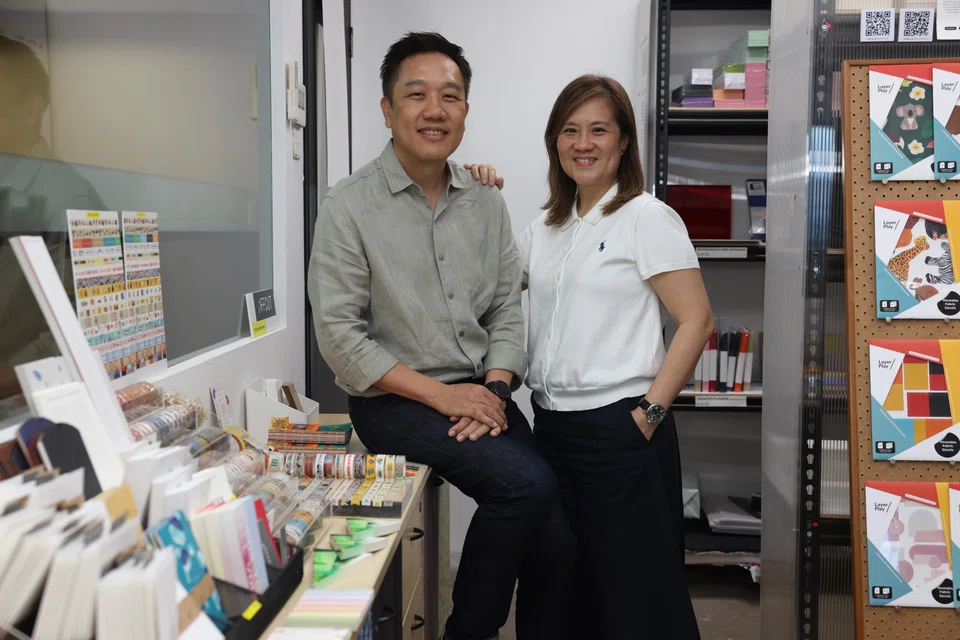
[SINGAPORE] Allegro Print has weathered many storms over its 27-year history – everything from its colour separation business becoming obsolete, to numerous technological disruptions and the impact of the Covid-19 pandemic.
Each crisis, however, presented the local printing company with new opportunities, leading it to find its niche as an innovative print house that often dabbles with experimentation.
Executive director Ho Yeow Liang said: “A lot of creative designers approached us to do crafty books, so we became known in the market.”
On top of commercial printing, Allegro also prints displays and books for clients ranging from museums to government agencies to independent magazines.
“Instead of being seen as a print manufacturer, we want to position ourselves as an innovative, creative producer,” said Ho.
Founded in 1999, Allegro has four brands – Layer Play, Oolors, Offcut and All-Book-S – under its name, in addition to the parent company’s own brand.
The firm, which has 18 staff, posts about S$2 million to S$3 million of revenue each year, at a growth rate of 3 to 5 per cent. Around 70 per cent of revenue comes from its main business, while the rest is from its wallpaper business Layer Play.
Becoming a one-stop printer
Allegro experienced its first crisis just a few years into its establishment, when it pivoted to become a one-stop printer.
The company started as a colour reproduction house, Strategic Colour Press, before rebranding as Allegro Print in 2002.

Ho’s wife Merlyn Tay, founder and executive director of Allegro Print, said: “We saw that (these services) would become obsolete, and the printer would eventually absorb colour separation into the printing business.”
The duo noted that colour separation is a technically demanding and precision-driven discipline. This knowledge gave Allegro a foundation to become more innovative in its future work.
After the rebranding, Allegro started doing conventional printing, such as brochures and flyers. However, it soon faced yet another crisis – disruptions from technology.
Ho said: “LED screens took away a lot of business. Apps replaced coupon vouchers. The business was disrupted, and it forced us to think about what to do next.”
The couple decided they needed a change in mindset. Clients that had been turned away from conventional printers started to approach Allegro, which decided to experiment to accommodate their requests.
Becoming an innovative and creative producer
Allegro started taking on projects using complex materials, and worked with galleries and museums to print books, pamphlets and displays.
“There’s a joke – if you want to print something weird, look for Allegro Print,” said Ho.
The couple noted that its clientele tends to be craftier and more particular about quality. The company is often approached for more unconventional projects because it can print on different substrates such as acrylic and fabric.
“We became more than just a print manufacturer. We pivoted and became more like a print consultant,” he said.
With only one machine in its office in Tai Seng, Allegro specialises in high-quality but smaller print runs.
“We aren’t going for a 10,000 or 20,000 (unit) print run. We can do very small print runs, which was the initial objective when Tay started the business, because there’s already a lot of big printers out there,” said Ho. “I call it low volume but high variety.”
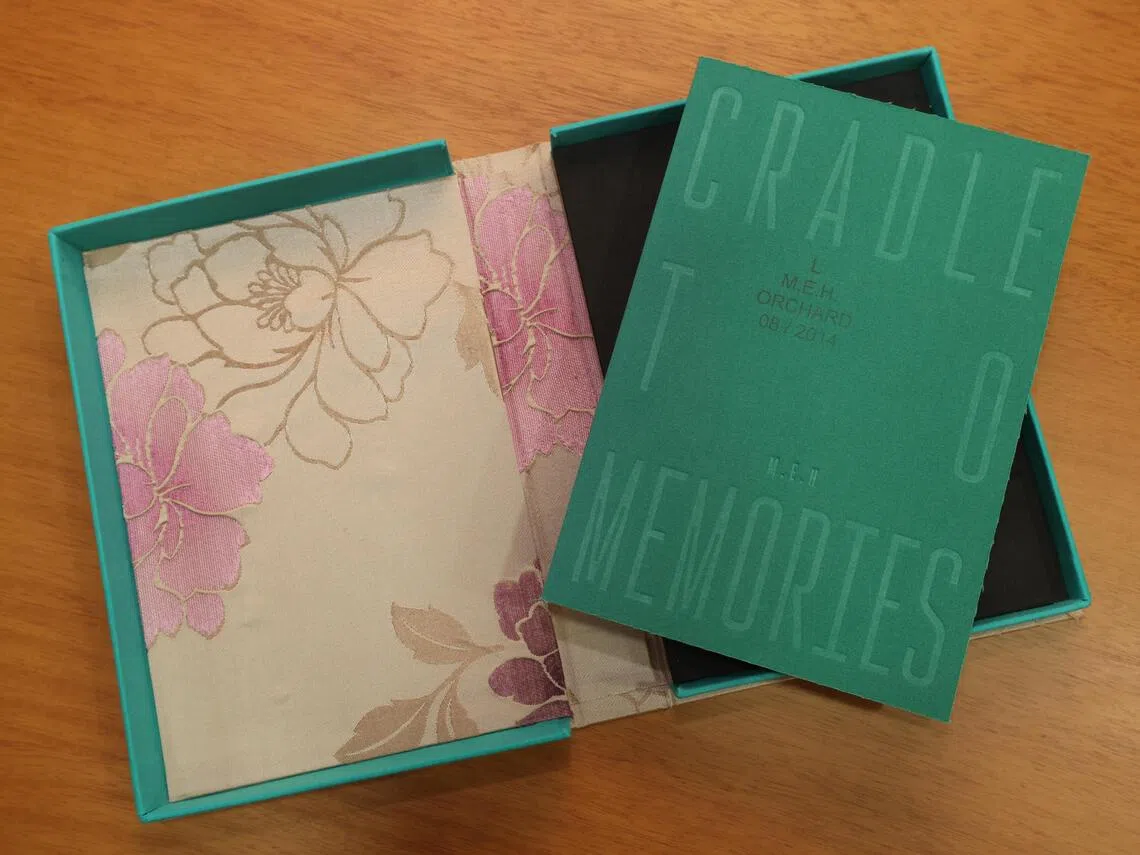
For example, Mount Elizabeth Hospital asked Allegro to use discarded curtains and hospital gowns as covers for their books. Using trial and error, and to make sure the glue did not seep through the fabric, Allegro eventually produced the book – albeit after three years.
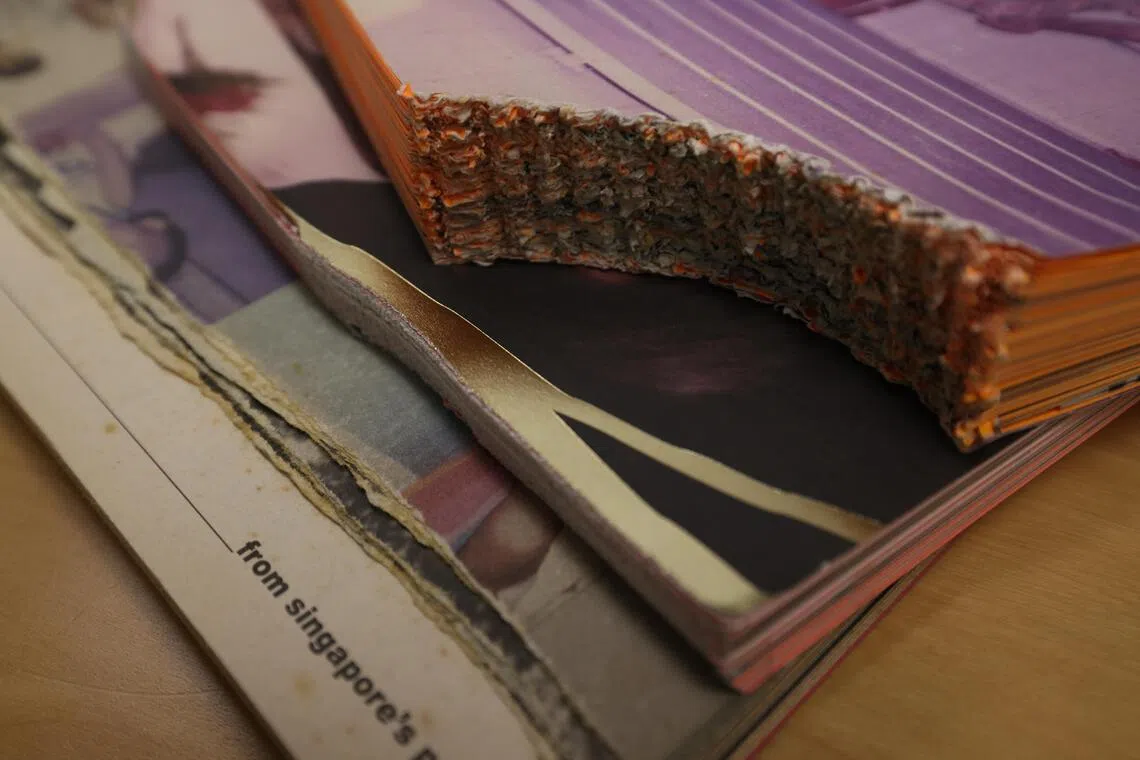
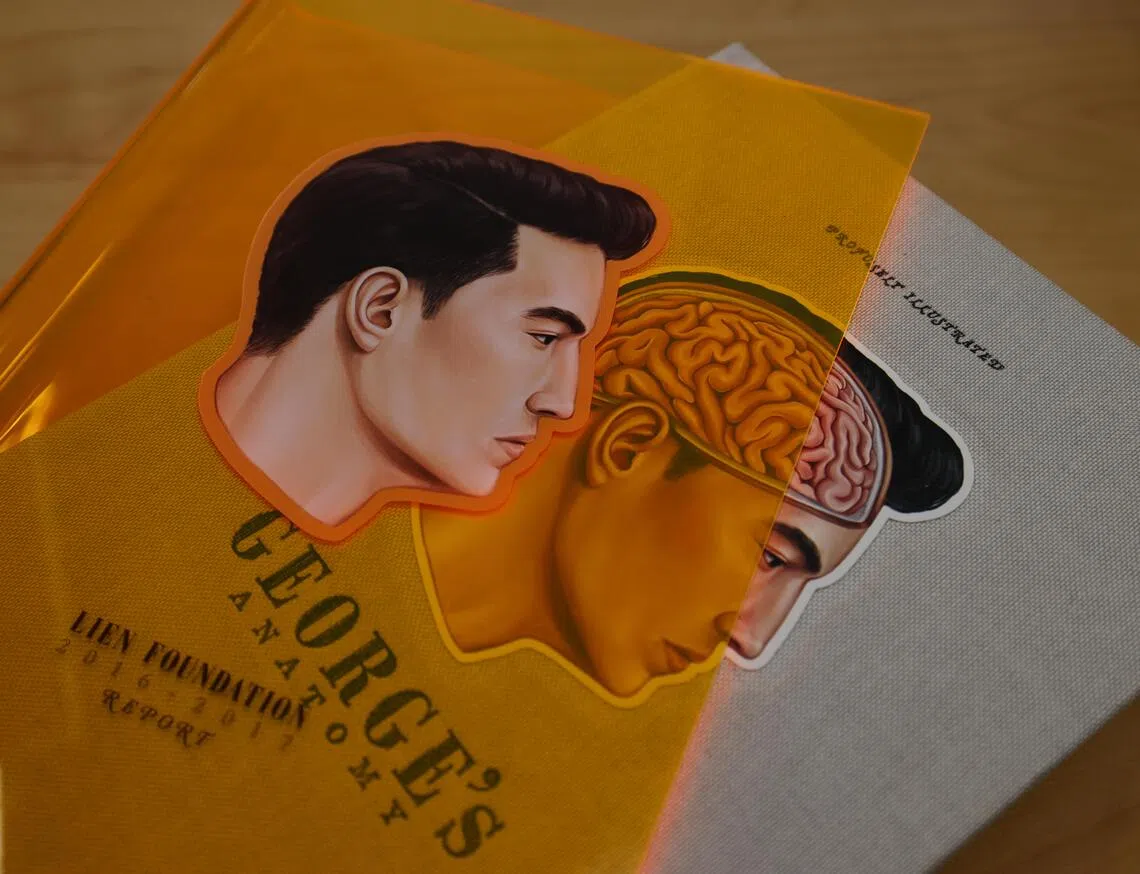
Other examples include a book that looks like it has a bite in the corner, and a book with an acrylic cover that hides the anatomy print on the front page. Most of these projects cannot be fully automated, and manual work is required.
“But these are the types of projects that we’ll take on, because through all these experiments, the ideas will come. By doing this and testing everything, it’s an experience gain,” said Tay.
The couple noted that what has sustained Allegro’s business is its “willingness to try”, relationships with clients, trust and “being curious”.
Similarly, many customers had requests for customised wallpapers, which also involved experimentation as custom prints were often outsourced. Layer Play started in 2015 to focus on bespoke interior decor.
“For wallpaper, we are the first in Singapore to do this kind of custom print, where we work with artists to curate a library of designs,” said Ho.
Opportunities from the pandemic
Covid-19 initially presented yet another crisis for the company – since printing was not an essential service, Allegro had no business for two months, Ho recalled. Many of its regular clients such as museums and theatres were shuttered for a long time.
The couple said that they “did not see the light at the end of the tunnel” and felt “a lot of anxiety”, but decided to turn to e-commerce as Allegro received government grants.
During the pandemic, they launched three brands under the Allegro parent company – Oolors, Offcut and All-Book-S.
Ho said: “The philosophy behind this decision was that we just had to try. If we don’t try, we wouldn’t know the outcome. You cannot stay put and hope for the best.”
Oolors was created due to demand for custom-created stationery, such as wrapping paper and cards. It collaborates with artists and hosts its products on e-commerce platform Shopify.
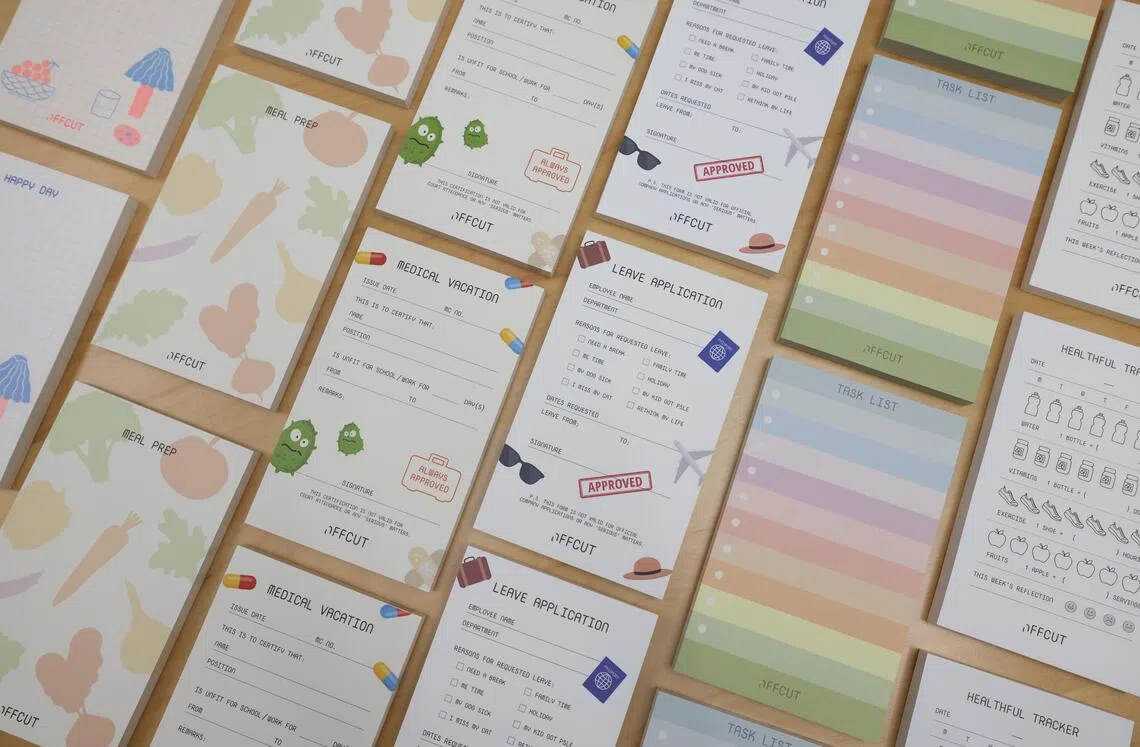
Offcut is also a stationery brand, but its products are made entirely from leftover paper from Allegro’s production.
Lastly, Allegro created All-Book-S to sell books printed by independent publishers and creators, who often approach the firm to print only 100 to 200 copies. Ho usually prints additional copies to sell online, since the cost per unit goes down.
Although these three brands do not contribute much to Allegro’s revenue, they help with branding. The company often participates in pop-up events to sell All-Book-S and Offcut products, and introduce customers to the parent brand.
Several of Allegro’s brands have received interest from overseas. Layer Play works on projects that are exported to South-east Asia, while All-Book-S has collaborated with creators from New Zealand and Switzerland.
Allegro is actively building its reach in Europe, the Middle East and South-east Asia.
Meanwhile, it also intends to target large enterprises which still print annual reports but in smaller quantities due to sustainability concerns.
“How we want to differentiate ourselves is we don’t just want a pure certificate that shows we are sustainable – instead, we have a product,” said Ho, referring to Offcut.
“We want to show large enterprises that they are working with someone (that’s) actually practising sustainability.”
Decoding Asia newsletter: your guide to navigating Asia in a new global order. Sign up here to get Decoding Asia newsletter. Delivered to your inbox. Free.
Copyright SPH Media. All rights reserved.
TRENDING NOW

If Europe goes to war, the fallout will be felt in East Asia

Stocks to watch: Seatrium, MIT, Keppel Reit, Clint, UI Boustead Reit, Digital Core Reit, ST Engineering

Chairman’s role in spotlight with raft of proposed new rules for Singapore boards

Mapletree Industrial Trust posts 6.6% drop in Q2 DPU to S$0.0297

