
Are public sector jobs truly an ‘iron rice bowl’?

Straight to your inbox. Money, career and life hacks to help young adults stay ahead.
[SINGAPORE] A year ago, Sarah (not her real name) attended an interview for a policy officer role at a government ministry.
Part of the reason was that she had known government jobs to be “iron rice bowls”, a Chinese term for occupations with guaranteed job security.
So she was surprised when she was told the role was not permanent but a three-year contract, and that this was “standard practice” in the public service.
Then, on Jul 15, the Government Technology Agency announced that it retrenched 93 officers as part of its transition to a new operating model. About 300 workers are expected to be affected over the next two years.
The news came as a shock, given how rare public sector layoffs are in Singapore.
The last publicly reported retrenchments in the civil service date back to between 2006 and 2010, when 20 officers left under the Special Resignation Scheme, according to a written parliamentary reply in November 2011, CNA reported.
That rarity has reinforced the belief that public service jobs are iron rice bowls. The government has also stressed that the GovTech layoffs were a special case and not part of a broad-based exercise.
But if contract hiring is standard practice, is the idea of the public-sector iron rice bowl outdated?
Contract hiring isn’t new
In 2025, Coordinating Minister for Public Services Chan Chun Sing provided figures showing that most new public service hires were placed on contracts rather than permanent terms.



In response to a parliamentary question by Workers’ Party MP Andre Low, Chan said the public service recruited about 14,000 officers a year between 2020 and 2024.
The majority – around 76 per cent – of these appointments were on contracts of service.
Among those who joined the civil service on such contracts in 2020 and 2021, about 45 per cent were subsequently emplaced, or converted to permanent terms. Another 28 per cent left within two years.
The remainder may still have been under consideration for emplacement, left after more than two years, or been hired for fixed-term projects.
These figures cover the civil service, which comprises officers working in government ministries. They exclude public officers in statutory boards and the uniformed services.
The Public Service Division does not track the proportion of contract officers who are emplaced in statutory boards.
But contract hiring is not a recent development.
Between 2007 and 2009, 12,090 civil servants were hired on contracts, accounting for 56 per cent of all civil service recruitment during that period.
In 2012, then deputy prime minister Teo Chee Hean explained that the arrangement gave ministries and new officers time to assess whether they were a good fit before making a permanent commitment.

“The contract arrangement serves as a gracious way for officers who do not have a good job fit to exit. Their departure can then be tied to the end of their contracts rather than a failure to be confirmed, or for them to resign after a short period of service.”
Contract officers also receive the same service benefits as permanent officers, he added.
No guarantee of conversion
Jack (not his real name), 31, was similarly surprised when he was offered a three-year contract instead of a permanent position when he joined a statutory board late last year.
Like Sarah and other interviewees, he requested not to be named as he is not allowed to comment publicly on such policies.
His idea of an iron rice bowl was further challenged when he saw a more senior colleague – an assistant director – leave after not being converted at the end of his contract.
“It came as quite a shock, because to me at least, his work ethic was pretty good, and he was quite meticulous and a hard worker,” Jack says.
The incident made him concerned for his own position.
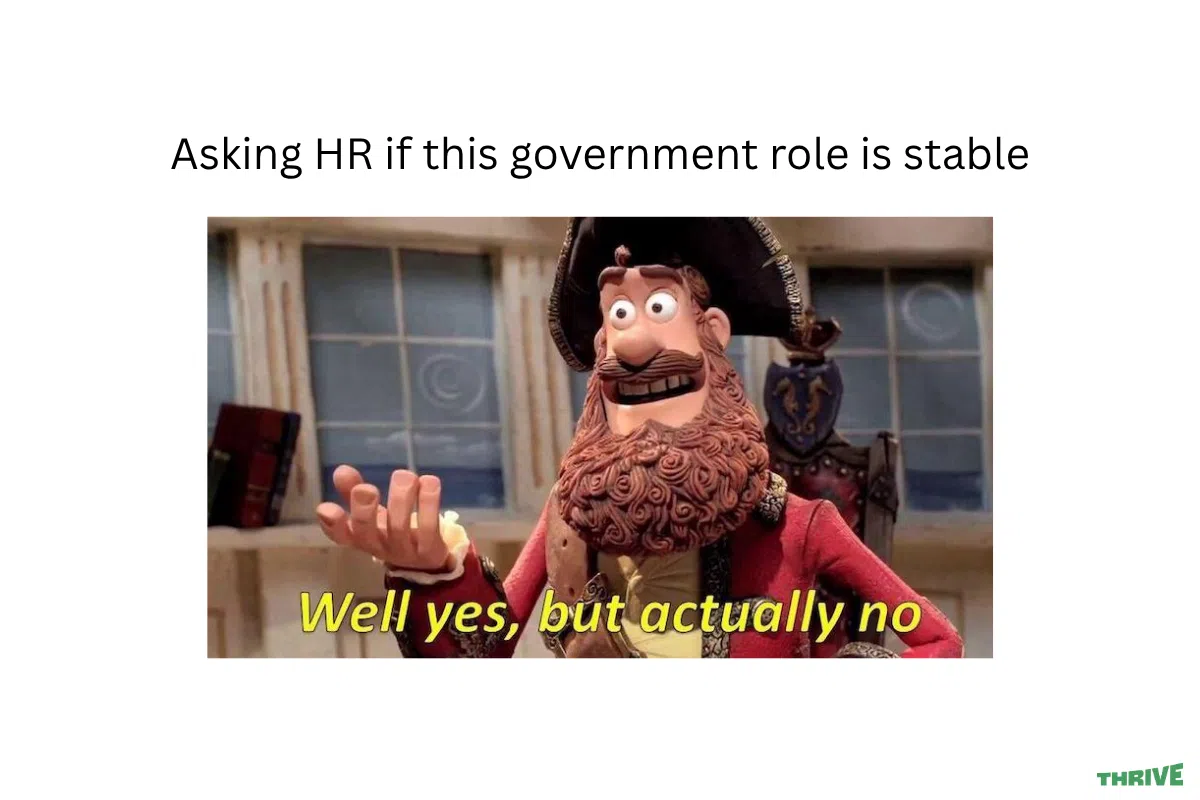
“I was thinking to myself, how should I perform then? Was what I was doing now good enough? What other things was my boss looking out for?”
“From conversations with my supervisors, they said that they were looking for someone assertive and willing to do more than their usual work scope.”
He adds: “So even if you’re excellent at a task… that is no longer the baseline for conversion.”
He also notes that some may mistakenly believe that joining the public sector guarantees career stability or that they can afford to relax after securing a role.
Having come from the private sector, Jack says his environment at the statutory board as a new entrant is no less competitive. With no guarantee that he will be converted to permanent staff, he feels pressure to go above and beyond to prove himself.
Anthony (not his real name) was also surprised when he was offered a one-year contract to work in human resources at a ministry.
Although he had applied partly for the job security, he felt the arrangement was a fair trade-off, because he believed the public sector tends to front-load benefits.
“You start off quite well compared to the private sector, even if the long-term trajectory may not be as steep,” he said.
Still, the uncertainty of a contract role weighed on him. “It made me feel like I should keep an eye on the job market, just in case things didn’t work out,” he said.
Sarah, who applied for the policy officer role, eventually accepted the offer after the recruiter explained that the three-year contract was essentially a substitute for a probation period.
“There are no material differences even though I am on contract. My pay and annual leave policies (are the same as permanent employees), so it wasn’t much to worry about.”
‘Iron talents’
Recruitment consultant Joyce Goh, who regularly receives manpower requests from public-sector clients, says contract hiring is indeed common.
But she adds that such arrangements should not be confused with gig or freelance work. Contract workers are still employees with CPF contributions and statutory employment protections.
“The idea of the public service as an ‘iron rice bowl’ has gradually changed,” says the general manager at recruitment agency Cornerstone Global Partners (CGP). “Today, no organisation – public or private – is completely insulated from changes in technology, skills and operating needs.”
The prevalence of contract appointments also reflects a broader shift towards a more flexible workforce while continuing to provide structured employment, she adds.
Her advice: Don’t rely on the stability of the organisation. Continue building your skills, stay open to new responsibilities and understand how your role is changing.
“Today, job security comes not only from where we work – it also comes from keeping ourselves relevant.”
Sean Wong, director at CGP, adds that while private organisations have to answer to shareholders, government organisations must also exercise prudence in the interest of taxpayers.
In a fast-changing economic climate, all organisations – including governments – must exercise agility, he says.
“Instead of ‘iron rice bowl’ jobs, perhaps we could pivot our thoughts to how to be ‘iron talents’.”
Decoding Asia newsletter: your guide to navigating Asia in a new global order. Sign up here to get Decoding Asia newsletter. Delivered to your inbox. Free.
Copyright SPH Media. All rights reserved.