

‘Baptism of fire’: Andre Khor on leading Singapore refiner Aster through an energy crisis
Growing up the son of a steel labourer taught him the value of hard work and dignity, which he applies to the business today

The strategies and stories that shape today’s leaders.
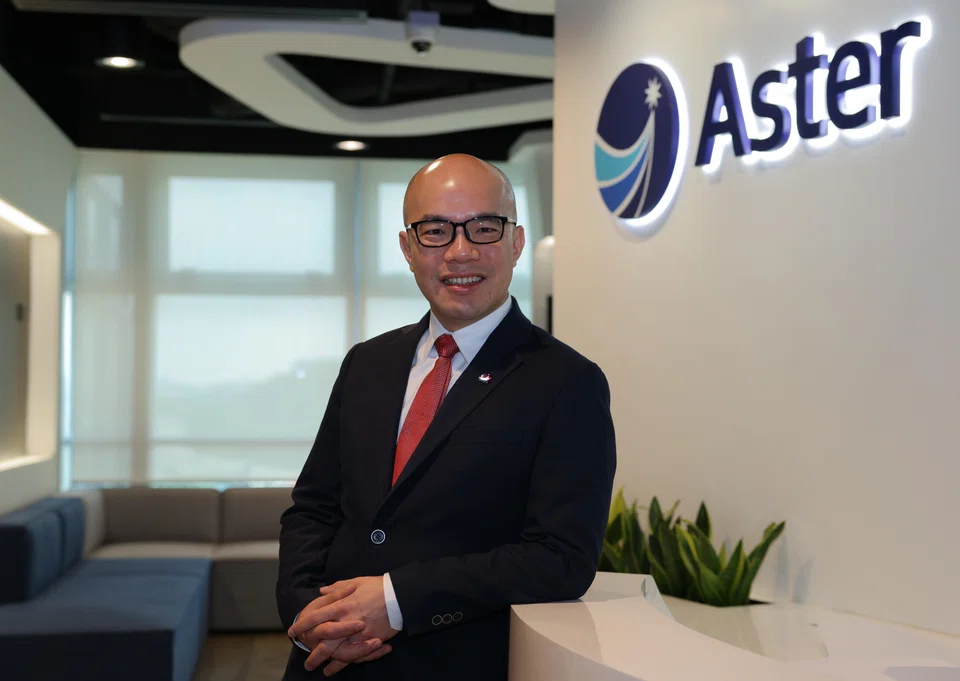
[SINGAPORE] Less than a year after Aster Chemicals and Energy took over the oil refinery on Singapore’s Pulau Bukom, the company was thrust into a full-blown global energy crisis.
To adapt to the uncertainties, its deputy CEO Andre Khor is taking on what he calls a “startup mindset”.
Before the Middle East war, over 70 per cent of Aster’s crude supply came through the Strait of Hormuz.
Within 48 hours, it had to hunt for alternative supplies – which it has since secured from locations as far as West Africa, South America and Canada.
“It’s almost a baptism of fire, close to our first anniversary, to really test a new system in a new environment,” Khor mused in an early-June interview with The Business Times.
The company in March declared force majeure on supplies – a move that many in the industry made to excuse themselves from contractual obligations under the circumstance of war.
But he highlighted: “We have been able to maintain run rates of 70 to 80 per cent, whereas other plants and refineries have had to load down or even shut down.”
This year’s volatility has not quelled his appetite for growth opportunities.
“We continue to stay the course, because we are investing through the cycle. We are here to build an institution to focus on long-term resilience,” said the Malaysian native with more than two decades of experience in the energy and commodities sectors.
Agility is key
Aster is 20 per cent-owned by commodities giant Glencore, and 80 per cent owned by Indonesian energy and chemicals player Chandra Asri, where Khor is also chief financial officer.
The 45-year-old has been at the forefront of Aster’s string of deals in Singapore.
In April 2025, Aster completed its acquisition of Shell’s refinery and ethylene cracker on Pulau Bukom and chemical plants on Jurong Island.
The process was “competitive”, and due diligence itself took close to a year, said Khor.
A month later, Aster agreed to acquire the polyethylene manufacturing operations of Chevron Phillips Singapore Chemicals.
Thereafter, it announced the purchase of a condensate splitter facility – a simpler form of a refinery – that was half-owned by petrochemicals player PCS.
In October 2025, Chandra Asri announced that it had signed a deal to acquire ExxonMobil’s Esso retail fuel station network in Singapore. The deal was completed in January.
This deal spree has required significant integration of both labour and resources.
Aster added 1,600 staff in Singapore, had to novate more than 800 contracts and move over 300 IT applications.
While acquisitions typically result in layoffs, Aster has avoided retrenching staff. “We are focused on protecting jobs and ensuring a smooth transition,” Khor noted.
The deals came as both the refining industry and petrol kiosk business were under significant pressure, even before the Middle East crisis.
When asked why Aster doubled down when other players were retreating, Khor replied: “The energy transition is happening, but it will not be linear. From that perspective, there’s still a very important role… for the refineries to be able to contribute towards transportation fuels (and) plastics and chemical products that are the basic building blocks of industry.”
Path to leadership
Khor grew up in Penang, Malaysia, where his father was a steel factory labourer who taught him “the value of dignity and hard work”.
Scouting was another formative experience; trekking through and camping in the jungle as a teenager taught him discipline. Khor attained the title of a “King’s Scout”, the highest scouting award in Malaysia.
He went on to win a Shell scholarship, earning a Bachelor’s degree in finance, accounting and management with first class honours from the University of Nottingham, UK.
Khor noted that the scholarship “really changed the trajectory” of his life: “When I was growing up, (university) was not automatic and attainable if you didn’t have the means for it.”
Entering the workforce, he spent over a decade with Shell in Kuala Lumpur, Manchester, London, Melbourne and finally, Jakarta, where he was finance director of the company’s Indonesia business.
He then joined palm oil giant Golden Agri Resources as chief financial officer of its trading business unit, overseeing teams not just in Indonesia and Singapore, but also Italy, China and India.
These experiences paved the way for him to join Chandra Asri in 2018.
The company, which operates Indonesia’s largest integrated petrochemical complex, was “very ambitious to grow”, Khor recalled.
In 2021, Chandra Asri raised US$1.1 billion in a rights issue, which provided the resources for it to build a second petrochemical complex in Indonesia.
“But then Covid happened, the Russia war (on Ukraine) happened. As a result of that, the projected prices of the petrochemical complex increased significantly. That’s where we took a pause and pivoted the strategy to look at programmatic mergers and acquisitions (M&As),” said Khor.
In 2024, he moved to Singapore and continues to be based here with his wife and three sons – 16-year-old twins and a 12-year-old.
Khor believes that the pivot has paid off: The company now has exposure to two countries instead of one, and across a broader range of businesses, from upstream refinery and chemicals all the way down to retail.
Citing the age of the “polycrisis”, Khor emphasised: “It’s very important to be agile, to be focused on execution… We don’t know all the answers but we keep going forward.”
Not a ‘flash in the pan’
When asked if there are plans for an initial public offering for Aster, Khor said that the company is “open to opportunities”, but not seeking to be a “flash in the pan” with a quick listing.
He summarised his strategy with the acronym ROAR: rejuvenate the core, orient towards sustainability, accelerate M&A and integration and re-imagine business models.
Sustainable aviation fuel is one area of experimentation. In January, Aster teamed up with Keppel to explore developing a Jurong Island plant to produce up to 100,000 tonnes of the fuel a year.
Aster has a separate partnership with startup Aether Fuels to build South-east Asia’s first plant converting waste industrial gases into green fuel for airplanes.
Another focus is sustainable base oil production. In April, Aster said that it is looking into building a Singapore facility that converts used motor oil into high-grade base oils.
Given the wide range of Aster’s ongoing projects, Khor’s days are filled with a gamut of responsibilities.
As he summed up: “The days are long, but good.”
Three questions with Andre Khor, deputy chief executive of Aster
Q: Was there a pivotal moment in your career or personal life that changed your approach to leadership?
Coming from humble beginnings, having that scholarship was quite a game changer, in the sense of changing (my) trajectory. Hence, (I focus) on the importance of hard work, of really never taking things for granted, treasuring every opportunity, working for it, but also (being) cognisant that success is not just by one individual; there’s many other factors.
Q: What is one piece of “unconventional wisdom” you swear by, but which most business schools would tell you is wrong?
I believe in “completed staff work”. It’s a military concept in which … rather than just going to a superior with a problem, it’s to really push yourself to understand the problem, be able to deconstruct your options, think about the downside risks and then make a clear decision … such that when it comes to your leader, (he) just has to say yes or no. It’s that sense of full end-to-end ownership and clarity, which I believe is important in getting stuff done.
Q: When you feel burnout creeping in, what is your non-business-related “panic button” activity or routine that reliably resets your focus?
I’m the proud father of three boys and (have a) very supportive wife… When you go home, you’re no longer the deputy CEO, you’re just a father and they just want to play with you; they just want to spend time together. That’s something that helps me reset and gives me perspective.
TRENDING NOW

Analysts cut DBS target price on lower 2027 earnings, but see buying opportunity after share price slide

China Investment Corp, PGIM’s 50% stake in Nex mall up for sale; asking about S$1.2 billion
Nvidia CEO Jensen Huang drops from world’s top 10 richest after chips sell-off

OCBC wealth clients turn defensive amid market volatility as Q3 profit rises 3%

