‘Biggest paradigm shift since WWII’: Global CEO panel discusses new world order with AI, sees opportunities
Speakers describe the future as volatile; opportunities are in resilience, globalisation, broad adoption of AI

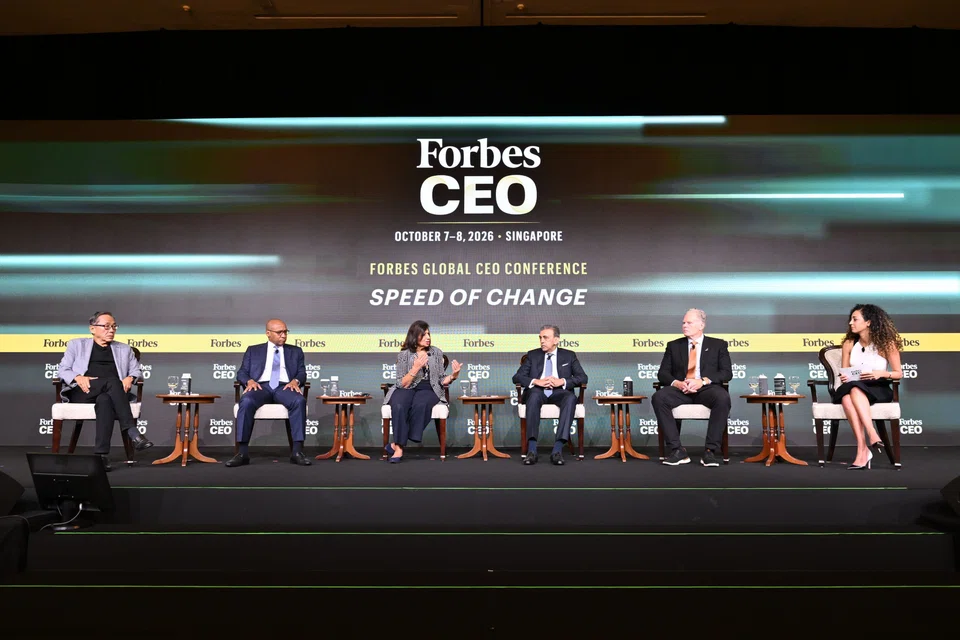
[SINGAPORE] The world order is being reshuffled and everyone needs to be prepared, speakers said at the session “A Brave New Risky World” at the Forbes Global CEO Conference at Shangri-La Singapore on Wednesday (Oct 7).
Ho Kwon Ping, founder and executive chairman of Banyan Group, said: “We are probably going to be witnessing the biggest paradigm shift in the world that we have seen since World War II ended, and I think we are going to see a confluence of three factors that is accelerating this massive paradigm shift.”
He named three factors: civilisational reset, climate change and artificial intelligence, adding that the world would go through its most massive change over the next 25 years.
Smaller countries in the world, Ho noted, could benefit when the rule-based order changes from Western civilisational dominance – which has been the case for the past 100 years.
Kiran Mazumdar-Shaw, founder and chairperson of Biocon, said that India is another country that is positioning itself as an emerging technology partner of the world and actively strengthening bilateral alliance with key partners.
Meanwhile, V Shankar, co-founder and CEO of Gateway Partners, said that the Middle East is rebounding despite the uncertainties in the past months due to the war.
“If you look at the passenger arrivals in the month of August, it’s almost at 85 to 90 per cent of pre-war levels,” he pointed out, adding that expats are still staying in the region.
The region remains a big source of capital for the world, with three or four of the top 10 sovereign wealth funds being based there, he said. This is supported by a huge post-war infrastructure build-out and strong quality of leadership, which is building partnerships with countries around the world, he noted.
Scepticism towards AI
PwC’s AI survey this year found that 56 per cent of companies get zero financial returns or cost benefit from AI.
Mohamed Kande, global chairman of PwC, said that most of the executives are seeing few financial returns from AI as they regard it as a technology project or transformation, instead of a business transformation.
This led to most use cases to be on the productivity side, which are absorbed within organisations.
“We are finding out that a lot of the companies were just not ready to reap the benefits from AI because the business and technology infrastructure of this company (had) limited governance, no digital system or enterprise resource-planning system to host data,” he said.
Kande added that the pull-through in the AI ecosystem on the physical side has also been massive.
Ho, pointed out, however, that infrastructure such as data centres is mainly driven by capital.
“Most of the data centres that are being set up around Asia are, in fact, set up by large funds where a lot of people have invested into the private equity companies… and they are only contracted to sell to the AI companies themselves with contracts which are relatively easy to break,” he explained. “I am just waiting to see that when this data centre boom finally fizzles out, which country is going to be left with the most stranded assets.”
The benefits of AI are unquestionable, said Ho, but people have to be careful about the current boom because it will lead to a physical and investment bust.
However, he noted that the rest of the technology will continue to benefit the world, calling them “two separate issues”.
Looking ahead
Panellists described the future as volatile but saw opportunities in resilience, evolving globalisation and broad adoption of AI.
Kande said that capital flow remains strong among businesses, with corporations staying resilient and adapting across supply chain issues.
Richard Smith, FedEx’s chief operating officer, international, and CEO, airline, echoed the view, noting that the business has gone through many changes over the years. Being able to adapt and improvise is key for businesses.
Mazumdar-Shaw said that biotechnology and biology is another space that will be transformed by AI, benefiting from accelerated drug innovation. However, it could also pose a risk by enabling the design of new viruses or pathogens that could be an existential threat for human beings.
Panellists overall felt that guardrails and regulations have become key in ensuring AI is put to good use.
“Despite all the turmoil and the disruptions we are seeing today, I see a huge new transformative opportunity for the world. I think there can be geopolitical peace in a very different way,” noted Shankar.
Decoding Asia newsletter: your guide to navigating Asia in a new global order. Sign up here to get Decoding Asia newsletter. Delivered to your inbox. Free.
Copyright SPH Media. All rights reserved.