

DBS downgrades SGX to ‘hold’, lowers target price to S$20
Easing growth momentum in equities and derivatives has left the stock’s valuation looking ‘lofty’

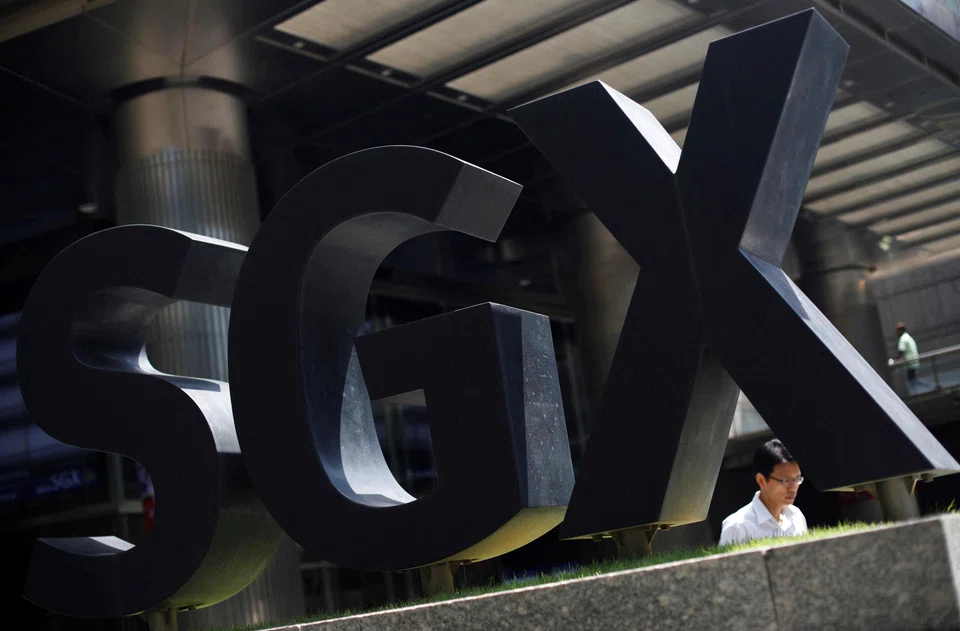
[SINGAPORE] DBS Group Research has downgraded Singapore Exchange (SGX) to “hold” from “buy” and lowered its 12-month target price to S$20 from S$26.40.
On Tuesday (Oct 13), analyst Lim Rui Wen said the downgrade reflected easing growth momentum in both equities and derivatives after two years of record performance, leaving the stock’s valuation looking “lofty” ahead of SGX’s first-half results. The bourse operator’s 2027 financial year began on Jul 1.
Based on SGX’s closing price of S$20.73 on Monday, the revised target price implies a downside of about 3.5 per cent.
DBS lowered its earnings per share estimates by 4 to 5 per cent till FY2028, placing its forecasts about 4 per cent below the market consensus.
The new target price is based on 25 times the projected FY2028 price-to-earnings ratio, which is one standard deviation above SGX’s historical forward multiple.
Lim noted that while securities trading activity remains healthy compared with historical levels, sequential momentum had begun to flatten.
Securities daily average value rose 33 per cent year on year to S$2 billion in the first quarter of FY2027, but fell 8 per cent quarter on quarter from S$2.2 billion in the fourth quarter of FY2026.
Monthly turnover has fluctuated since May. It fell from S$2.4 billion to S$2.1 billion in June and S$2 billion in July, before rising to S$2.2 billion in August and again declining to S$1.9 billion in September.
The brokerage also raised concerns over the quality and sustainability of equity turnover, citing an increasingly narrow market rally.


As at September 2026, the benchmark Straits Times Index (STI) had gained 32 per cent year on year. It outperformed the FTSE ST Mid Cap Index, which fell 4 per cent, and Small Cap Index, which rose 9 per cent.
Trading has become increasingly concentrated in large-cap financial stocks. The banking index rose 58 per cent, while Singapore’s three local banks accounted for about 33 per cent of market turnover in September, up from 26 per cent a year earlier.
STI constituent stocks accounted for 80 per cent of total trading volume in September, up from 77 per cent in the same month last year.
Without broader market participation from mid and small-cap segments, further expansion in securities turnover may prove difficult to maintain, Lim said.
Slowdown seen
Growth in SGX’s derivatives business has slowed following two consecutive years of double-digit expansion.
Derivatives daily average volume (DDAV) increased 5 per cent year on year in Q1 FY2027, slowing from growth of 17 per cent in FY2025 and 14 per cent in FY2026.
Quarter on quarter, DDAV fell 11 per cent to 1.4 million contracts. In September, DDAV was broadly unchanged year on year at 1.4 million contracts, despite rising 7 per cent month on month.
Performance across derivatives asset classes was mixed. While the volume of foreign exchange (FX) futures surged 51 per cent year on year in Q1 FY2027, that of equity index futures increased just 1 per cent, while volumes in metals and dry-bulk commodity contracts dropped 29 per cent.
In absolute terms, the 9.2 million contract increase in FX futures accounted for more than the net 3.5 million contract gain across SGX’s total derivatives portfolio.
Lim said that because SGX operates on a relatively fixed cost structure, any ongoing deceleration in transaction volumes could cap operating leverage and weigh on earnings.
Recurring revenue from market data and connectivity, together with the expanding FX business, will provide some baseline support.
Potential rerating catalysts that could revive the stock include further capital-management initiatives and additional details regarding the Central Provident Fund Board’s new investment scheme slated for 2028.
Conversely, slower-than-anticipated turnover and trading volumes across asset classes remain the main downside risks.
Decoding Asia newsletter: your guide to navigating Asia in a new global order. Sign up here to get Decoding Asia newsletter. Delivered to your inbox. Free.
Copyright SPH Media. All rights reserved.
TRENDING NOW

Once staunchly pro-China, Malaysian Chinese businesses are now distancing themselves from Beijing

Looking beyond looming CEO succession, should UOB potentially pursue a transformative merger?

Could stablecoins be the future of money?

Grab CEO’s wife Chloe Tong on life with Anthony Tan and finding her purpose

