South Korea’s Kospi index tumbles over 5% as Asian stocks retreat
The broader MSCI gauge of Asian shares slides 0.6%
ASIAN stocks fell as South Korean chipmakers tumbled, while oil declined and Treasuries rose after US President Donald Trump said fresh US-Iran talks would begin on Monday (Aug 3) – boosting optimism that the two sides will reach a deal to reopen the Strait of Hormuz.
Brent for October slid as much as 7.3 per cent to US$81.55 a barrel after Trump said he would agree to call off a massive attack on Iran as allies in the Middle East, including Saudi Arabia, asked him to pursue a deal instead.
Oil was also weighed down by another small increase by major Opec+ nations to their production quotas.
Treasuries rose across the curve as oil’s decline eased inflation concerns. The benchmark 10-year yield dropped four basis points to 4.69 per cent, after rising to the highest since January 2025 last week. Gold climbed as much as 0.5 per cent to around US$4,070 an ounce.
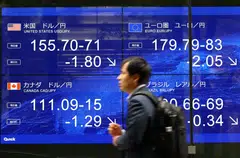
The yen strengthened for a fourth day, building on its intervention-led gains late last week.
Japan’s currency advanced as much as 1.4 per cent to 155.23 per US dollar with traders remaining on alert for further coordinated intervention. Bloomberg’s gauge of the US dollar fell 0.2 per cent, with the yen contributing the most to that move.
Monday’s market gyrations came after days of escalating tensions that saw the US threaten to hit the Islamic Republic “very hard” in a bid to end a conflict now in its sixth month.
A supply squeeze triggered by the war drove up fuel costs, stoking fears of another inflation spike and unsettling investors.
Focus is also returning to the artificial intelligence theme after a week of violent swings culminated in a sharp rebound for chip stocks after a rout in chip stocks earlier.

“If we get something concrete on a peace deal, or more importantly the reopening of the strait of Hormuz, then we could see some strong relief rallies across the market,” said Nick Twidale, chief market analyst at AT Global Markets.
“For now it feels we will continue to see volatility across different markets, especially as AI trade remains the dominant theme for equities.”
A regional gauge of chip stocks fell 1.2 per cent as Samsung Electronics and SK Hynix both tumbled more than 8 per cent, offsetting gains in Japanese semiconductor companies such as Renesas Electronics and Kioxia.
Alibaba Group rose 6.5 per cent in Hong Kong after releasing its latest flagship artificial intelligence model, with performance claims putting it alongside global leaders like Anthropic’s Fable.
On Friday, China’s DeepSeek rolled out a public beta application programming interface, or API, for its flagship AI model, V4 Flash, touting advancements in agentic abilities.
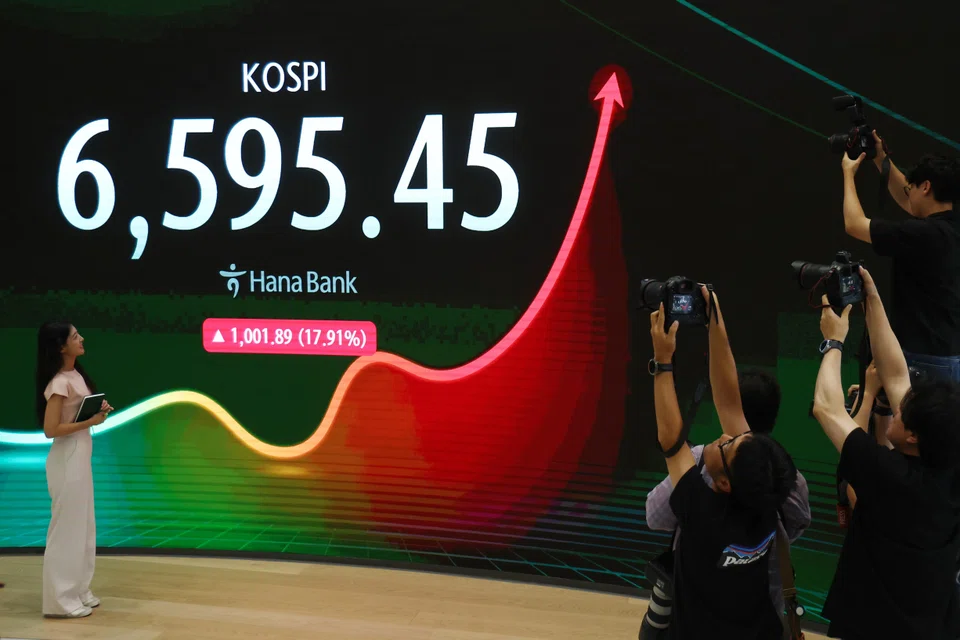
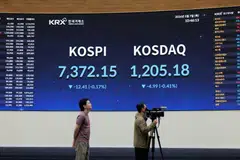
South Korea’s Kospi Index, a bellwether for AI investments, fell more than 5 per cent, after surging a record 18 per cent on Jul 31. With the Nikkei 225 Stock Average also slipping, the broader MSCI gauge of Asian shares lost 0.6 per cent.
Among other main market moves, the S&P 500 futures rose 0.6 per cent as at 1.59 pm Tokyo time.
Japan’s Topix fell 1.2 per cent, the Shanghai Composite dropped 0.6 per cent, while Australia’s S&P/ASX 200 and Hong Kong’s Hang Seng were both little changed.
Japan’s Ministry of Finance said it conducted a yen-buying operation on Jul 31, US time, in coordination with the US Department of Treasury and would not hesitate conducting further joint intervention. Bessent also pointed to a US Federal Reserve facility Japan could use.
The US Treasury may be using euros rather than US dollars to fund its yen purchases to avoid weakening its own currency and casting doubt on its strong greenback policy, according to strategists.
“For a week probably, we can see more choppiness and probably more temporary yen strengthening,” said Julia Wang, North Asia chief investment officer at Nomura International.
“But we do think this does not change the actual direction for dollar-yen and probably will continue higher once the intervention is behind us.” BLOOMBERG
Decoding Asia newsletter: your guide to navigating Asia in a new global order. Sign up here to get Decoding Asia newsletter. Delivered to your inbox. Free.
Share with us your feedback on BT's products and services