STI drops 0.7% after US markets tumble on rate, inflation uncertainties
DBS, OCBC and UOB are all down

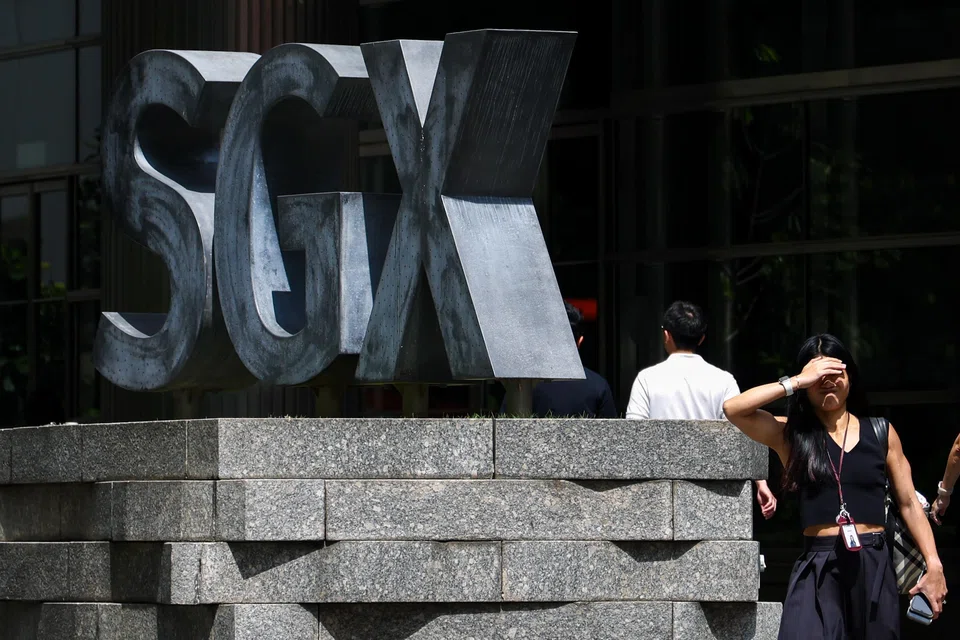
[SINGAPORE] The Straits Times Index (STI) declined by more than 1 per cent on Thursday morning amid declining investor sentiment, as US markets wobble due to inflation fears and a hawkish Federal Reserve chair.
The benchmark index fell to an intraday low of 5,638.94, then pared some losses to close 0.7 per cent or 39.61 points lower at 5,673.58.
Across the broader market, gainers trailed losers 272 to 328, after 1.2 billion securities worth S$2.3 billion changed hands.
The local banks all ended lower. DBS lost 0.2 per cent to S$74.85, OCBC fell 2.3 per cent or S$0.68 to S$29.10, and UOB was down 0.02 per cent at S$43.88.
Keppel hit an intraday low of S$11.35 in the afternoon, after reporting a 59 per cent drop in its H1 net profit. The counter closed 4.3 per cent or S$0.52 lower at S$11.48.
AEM Holdings and UMS dropped significantly in early trade, down 6.4 per cent and 3.2 per cent, respectively. By close, AEM was 3.7 per cent lower at S$7.57, and UMS dropped 0.9 per cent to S$2.17.
Energy plays had a mixed showing, with Oiltek down 0.7 per cent and RH PetroGas rising 2.4 per cent.
The Dow Jones Industrial Average closed over 1,000 points lower on Wednesday, cementing its most significant decline since April 2025, while the S&P 500 logged its lowest level this month.
Key regional indices were mixed. Hong Kong’s Hang Seng Index gained 0.2 per cent, Japan’s Nikkei 225 rose 0.7 per cent, South Korea’s Kospi was down 1.2 per cent and the FTSE Bursa Malaysia KLCI advanced 0.3 per cent.

This came as Fed chair Kevin Warsh kept rates unchanged in the 3.5 to 3.75 per cent range, which markets interpreted as a renewed emphasis on price stability, but rejection of any implicit inflation target above 2 per cent as a more hawkish signal.
James Ooi, market strategist at Tiger Brokers, said the retreat from providing forward guidance gives the Fed greater policy flexibility.
However, it also leaves investors with less clarity on the policy path ahead.
“That uncertainty could translate into higher market volatility,” he said in a Tuesday note. “Expectations of a September rate hike implied by futures markets should be viewed more as a reflection of investor sentiment rather than a definitive forecast of how FOMC (Federal Open Market Committee) members will ultimately vote.”
Decoding Asia newsletter: your guide to navigating Asia in a new global order. Sign up here to get Decoding Asia newsletter. Delivered to your inbox. Free.
Copyright SPH Media. All rights reserved.