

STI’s 10 best-performing stocks for Q4 and 2025
The index could hit 5,000 points by end-2026 and 10,000 points by 2040, experts say

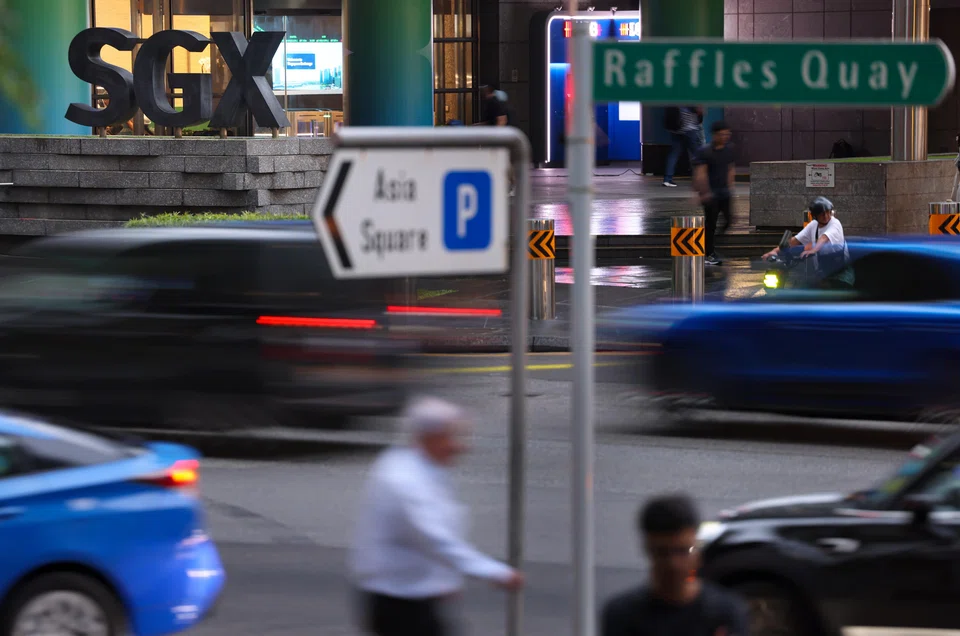
[SINGAPORE] Singapore’s benchmark index, the Straits Times Index (STI), has made notable gains in 2025 and set multiple new records – advancing 22.7 per cent through the year and 8 per cent in Q4 alone.
These gains have led experts to believe that the blue-chip barometer could hit 5,000 points by end-2026 and 10,000 points by 2040, based on historical return patterns.
The STI, which tracks the performance of the top 30 companies on the Singapore Exchange (SGX), is largely driven by Singapore’s three banks – DBS, OCBC and UOB, which constitute around half of the index’s market capitalisation as at December 2025. Its top 10 constituents account for around 78.1 per cent of the index by weight.
According to global index provider FTSE Russell, the STI recorded total returns of 28.6 per cent for 2025, its best performance in at least a decade.
The Business Times takes a look at the STI constituents that raked in the greatest total returns in Q4 and 2025, based on Bloomberg data.
Top performing STI stocks for 2025
1. DFI Retail Group
For 2025, the supermarket and retail store operator ranked first among STI counters in terms of year-to-date total returns, at 103 per cent.
DFI , which has been associated with well-known supermarket brands such as Cold Storage and Giant, posted a 38.9 per cent rise in underlying profit to US$105 million for its H1 ended June, although its revenue fell marginally.
Profit growth for the half year came on the back of lower financing costs and improved showings across its associates and segments, the group said.
The company has a dividend yield of 2.7 per cent and a market capitalisation of S$6.9 billion, as at Dec 31.
In March, DFI agreed to sell its Singapore food business – which included 48 Cold Storage and 41 Giant stores – to South-east Asian retail conglomerate Macrovalue (Malaysia) for S$125 million. This came alongside its plans to pivot its Singapore operations towards the Guardian and 7-Eleven businesses to enhance growth and returns.
A member of Jardine Matheson Group, the company unveiled in December a new dividend policy that raised its payout ratio to 70 per cent, alongside a strategic road map to achieve double-digit growth.
DFI is primarily listed in London with secondary listings in Singapore and Bermuda.
2. ST Engineering
ST Engineering ranked second among STI counters, with total year-to-date returns of 84.7 per cent for 2025. The company has a market capitalisation of S$26.3 billion and dividend yield of 2 per cent.
In November, ST Engineering recorded 9 per cent year-on-year growth in revenue to S$9.1 billion for the nine months ended September. With newly clinched contracts for Q3 2025 totalling S$4.9 billion, its contract wins for the nine months ended Sep 30 stood at S$14 billion.
The group has been embroiled in the fallout from a fatal cargo plane crash in Kentucky in November. Its US subsidiary, VT San Antonio Aerospace, was one of several firms named in a lawsuit, which alleged that the maintenance, repair and operations company was negligent in maintaining the 34-year-old aircraft that crashed.
ST Engineering said in December that it expects a positive net profit for FY2025 and H2 2025, on the back of strong base operating performance.
3. Jardine Matheson Holdings
The Hong Kong-based conglomerate ranked third among STI counters, posting total year-to-date returns of 75.2 per cent for 2025.
With a 3.3 per cent dividend yield, its market capitalisation is S$26.1 billion.
In November, Jardine Matheson reported that its Q3 2025 performance was in line with expectations. The group had US$25 million in net debt as at end-October.
Its bid to privatise and delist its hotel subsidiary Mandarin Oriental, at US$3.35 apiece, attained shareholder approval in December.
The London-listed conglomerate also plans to pay out up to US$250 million to shareholders via a share buyback scheme proposed in November.
4. UOL Group
The property developer came in fourth among STI counters, with year-to-date total returns of 74.6 per cent for 2025. Its dividend yield is 2.1 per cent and its market capitalisation is S$7.4 billion.
UOL in August posted 58 per cent earnings growth for H1 2025, with S$205.5 million net profit. The improved bottom line was due to robust showings across its property development and property investment segments, alongside other gains.
In September, UOL agreed to sell Kinex Mall, a freehold retail asset along Tanjong Katong Road, for S$375 million. The divestment is part of its ongoing portfolio reconstitution strategy, the group said.
BT reported in August that UOL was named by analysts – including CGS International, Citi and DBS Research – as a top pick among Singapore-listed developers, due to its diversified portfolio and ability to yield recurring income.
UOL was Singapore’s largest developer by market capitalisation as at August. It is the parent of Singapore Land Group.
5. Hongkong Land
Property investment, management and development group Hongkong Land recorded total year-to-date returns of 63.9 per cent, with a 3.3 per cent dividend yield.
Its underlying profit for Q3 2025 fell 13 per cent on the year amid lower contributions from its Hong Kong office portfolio and pre-opening costs of its prime properties in China, said the group in November.
A member of the Jardine Matheson Group, Hongkong Land has a market capitalisation of S$19.3 billion.
Its subsidiary Sageland agreed to sell a one-third stake in Marina Bay Financial Centre (MBFC) Tower 3 to Keppel Reit for S$1.45 billion.
In December, Hongkong Land unveiled a new S$8 billion real estate fund – the Singapore Central Private Real Estate Fund – which is focused on managing prime commercial property assets in Singapore. It also announced its injection of stakes in One Raffles Quay and MBFC Towers 1 and 2 into the fund.
The group has a primary listing on the London Stock Exchange and secondary listings in Singapore and Bermuda.
6. City Developments Limited (CDL)
Property conglomerate CDL posted total returns of 59.9 per cent for the year to date for 2025, with a dividend yield of 1 per cent. Its market capitalisation is S$7.1 billion.
The group and its joint ventures logged S$313.2 million in Singapore sales for Q3 2025 – a 48.7 per cent decline from the year-ago period. It sold around 88 units in the quarter ended Sep 30, down from 321 previously, it said in a November operational update.
With capital recycling as a strategic focus, CDL is in the process of selling waterfront mall Quayside Isle @ Sentosa Cove, the sole retail property in the enclave, for S$111 million.
CDL also made 2025 headlines following a high-profile dispute between its executive chairman, Kwek Leng Beng, and his son, Sherman Kwek, the company’s chief executive. The public feud culminated in the elder Kwek moving to sack his son and filing a lawsuit, which was eventually dropped.
CDL is part of Hong Leong Group.
7. Keppel
Global asset manager Keppel posted total year-to-date returns of 58.5 per cent for 2025, with a dividend yield of 3.3 per cent. Its market capitalisation is S$18.5 billion.
In July, Keppel posted a 24.2 per cent hike in H1 earnings to S$377.7 million for the half year ended June, fuelled by improvements from its real estate segment. This was despite revenue falling 5.2 per cent year on year.
Keppel also unveiled plans to divest and monetise around S$14.4 billion in non-core assets from its portfolio by 2030. This comes as the assets in question are no longer aligned with its asset-light, recurring income-focused strategy, said its CEO Loh Chin Hua in July.
Its proposed S$1.43 billion sale of M1’s telco business to mobile network operator Simba Telecom comes under its monetisation plans.
The fund manager said on Jan 1 that it is on track to surpass its S$100 billion funds under management target by end-2026; its funds under management hit S$91 billion by mid-2025.
8. Singtel
Telco giant Singtel posted total year-to-date returns of 54.1 per cent. The company has a dividend yield of 4 per cent and a market capitalisation of S$75.5 billion.
Singtel announced in November that its H1 net profit surged 176.4 per cent to S$3.4 billion for the half year ended September from the year-ago period. Its bottom line was boosted by a S$2.1 billion net exceptional gain – primarily from the May sale of its partial stake in Airtel and the Intouch-Gulf merger.
Its subsidiary Optus, Australia’s second-largest telco provider, has come under fire over the failure of its emergency call hotline during an outage, which led to at least two deaths.
Singtel’s group CEO Yuen Kuan Moon said that the company expects Optus to swiftly implement recommendations put forth in an independent review into the fatal outage, which flagged gaps in process, accountability and protocols.
9. DBS
DBS , Singapore’s largest bank, posted total returns for the year to date of 36.9 per cent for 2025, with its dividend yield at 5.1 per cent. With a market capitalisation of S$160.3 billion, it is the STI’s largest constituent by market cap.
In November, DBS’ Q3 earnings beat analyst forecasts. The bank’s net profit for the quarter ended Sep 30 dropped 2 per cent year on year to S$2.95 billion, affected by global minimum tax, even as total income hit a fresh high of S$5.93 billion.
DBS shares rallied through 2025, hitting record highs multiple times.
The bank underwent a leadership shift in March, as its ex-CEO Piyush Gupta handed over the reins to current chief Tan Su Shan after more than 15 years at the helm. At that time, DBS shares were up nearly 270 per cent since Gupta assumed the role in 2009.
10. Singapore Exchange
Local bourse operator SGX rounds off the list with total year-to-date returns of 36.5 per cent. Its dividend yield is 2.3 per cent and its market capitalisation is S$18.3 billion.
In August, SGX posted record-high full-year earnings of close to S$648 million, an 8.4 per cent increase from the year-ago period, although its H2 net profit dropped 2.6 per cent. The results came on the back of robust business growth across all its operating segments.
In November, SGX announced a plan to launch a dual-listing highway enabling firms to list on the local bourse and the Nasdaq using a sole set of listing documents.
The dual-listing bridge is among a slew of measures by the Monetary Authority of Singapore to revitalise Singapore’s stock market.
Other plans to boost the local bourse include the reduction of SGX’s board-lot size to 10 units from 100 units for securities priced above S$10, which aims to broaden investor participation by boosting affordability.
Decoding Asia newsletter: your guide to navigating Asia in a new global order. Sign up here to get Decoding Asia newsletter. Delivered to your inbox. Free.
Copyright SPH Media. All rights reserved.
TRENDING NOW

Once staunchly pro-China, Malaysian Chinese businesses are now distancing themselves from Beijing

Looking beyond looming CEO succession, should UOB potentially pursue a transformative merger?

Could stablecoins be the future of money?

Grab CEO’s wife Chloe Tong on life with Anthony Tan and finding her purpose

